Published · Updated

After receiving a Hong Kong Profits Tax demand note, a taxpayer may apply to hold over all or part of provisional Profits Tax if an official ground applies and the application is lodged on time. A holdover is not a tax exemption and does not automatically defer final tax already assessed. The IRD considers the ground, projected assessable profits, supporting evidence and instalment. Check the notice and payment dates, then assign one person to maintain the application, forecast and follow-up record.
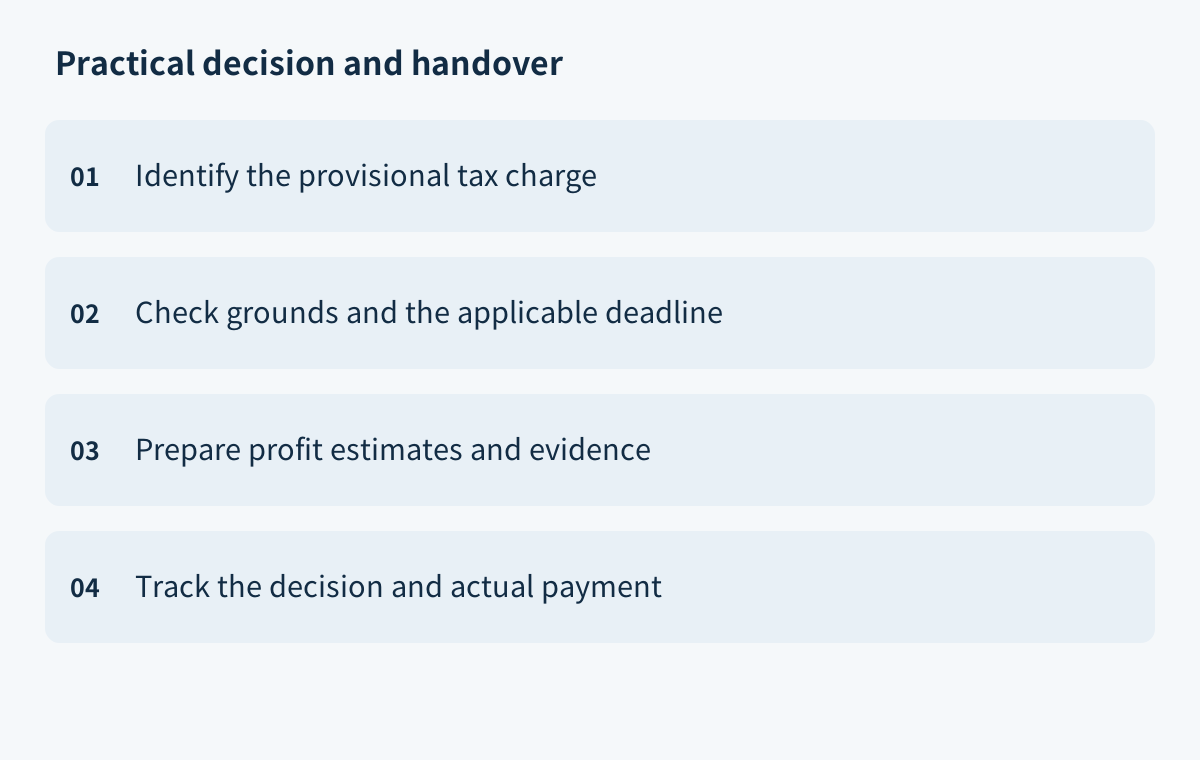
Separate assessed tax from provisional tax
Which tax amount can be held over?
Check the year, tax type, instalment, amount, due date and issue date; note payments. This application concerns provisional Profits Tax, not final Profits Tax already assessed, Salaries Tax or Property Tax. If a notice lists both a final assessment and provisional tax, record them as separate liabilities with separate balances and deadlines. Keep different tax types and years separate, too.
Provisional tax is charged before the relevant year ends. Once assessable profits for that year are known, provisional Profits Tax paid is applied against that year’s liability. It is an advance payment followed by an offset, not a waiver or an extension of another assessed amount. See the IRD’s Profits Tax overview.
How should you classify the notice and leave a handover record?
Track the company, notice number, year, tax type, instalment, amount, paid and unpaid balances, due date and owner. Keep the notice and payment evidence together, with the reviewer and date. If wording is unclear, retrieve the notice by reference or ask the IRD; do not infer the tax type from its amount or a bank debit.
If you object to an assessment, follow that process separately. While unresolved, the demand-note amount remains due unless the assessor instructs otherwise. Filing does not itself change the date. See the IRD’s guidance on objections and holdovers.
Check eligibility against the official grounds
Which circumstances may support an application?
Official guidance lists five grounds for holding over provisional Profits Tax:
- Current-year assessable profits are, or are likely to be, below 90% of the preceding year’s assessable profits or the estimate used to charge provisional tax.
- A loss brought forward for set-off was omitted or is uncertain.
- The business has ceased, or will cease before the provisional-tax year ends, and its assessable profits are, or are likely to be, below the preceding year’s profits or the provisional-tax estimate.
- The taxpayer has elected for Personal Assessment for the relevant year and the election is likely to reduce tax. This applies only to taxpayers eligible to make that election; it does not apply simply because an incorporated company expects lower profits.
- The taxpayer has objected to the preceding year’s Profits Tax assessment.
See GovHK’s holdover guidance and the IRD’s objections and holdovers guidance. The 90% test applies only to the profits-reduction ground. Compare assessable profits, not turnover or unadjusted accounting profit, and state the basis used.
How should you compare the figures and record your reasoning?
Hypothetically, if preceding-year assessable profits were HKD 1,000,000, 90% would be HKD 900,000. An HKD 880,000 estimate is HKD 20,000 below it. This calculation illustrates only the profits-reduction ground; it does not establish eligibility or predict approval.
Record the ground, comparison basis, figures, estimate date, remaining-month assumptions and supporting evidence in a table. Attach the loss schedule and assessments, cessation date and profit change, or objection receipt and IRD correspondence, as relevant. Name the preparer and reviewer.
Calculate the deadline from the due date and notice issue date
Which dates should you check for each instalment?
Lodge the application by the later of: 28 days before the provisional-tax due date, or 14 days after the notice issue date. Use the issue date printed on the notice, not the date it arrived. The IRD’s current FAQ includes 2026/27 examples and says an application may cover all or part of the second instalment even if the first was paid on time, provided the grounds and deadline requirements are met. See the IRD’s holdover FAQ.
Check each instalment separately; paying the first or filing earlier does not change the second’s deadline or payment date.
How can you calculate and document the deadline?
For example, if an instalment is due on 30 November, 28 days earlier is 2 November. If the notice was issued on 10 November, 14 days later is 24 November. The later date, 24 November, is the deadline in this example. Verify the actual deadline against the notice and current IRD instructions.
For each instalment, record due and issue dates, both calculations, deadline, planned filing date and owner; attach the notice. Allow time for signatures and delivery. Ask the IRD about unclear dates.
Prepare profit forecasts and supporting documents
Which accounts are needed for a profits-reduction claim?
For the profits-reduction ground, GovHK says to attach properly signed draft accounts covering at least eight months. Form IR1121 also asks for certified accounts and a tax computation. Do not assume every other ground requires the same accounts. See GovHK’s holdover guidance and the current IR1121 application form.
Distinguish accounting profit from estimated assessable profits. Show actual figures for closed months separately from estimates for the remaining period, with the calculation method and key assumptions. A cash-flow forecast or a statement that business has slowed does not show how the tax estimate was derived; an unadjusted accounting loss is not itself the tax computation.
A monthly or quarterly schedule can show revenue, costs, payroll and one-off items, explain major changes and link forecasts to records. It is an organising method, not a fixed document requirement for every ground.
How can you organise files for a review or handover?
List IR1121, accounts, computation, ground-specific evidence and tax notice. Label files by company, period, version, date and owner; separate forecasts from partial-year accounts. Have a second person check notice number, year, ground, amount, attachments and signatures. Retain source figures.
For related background, see the Hong Kong company audit guide and BIR51 tax-filing guide. Use IRD instructions and the form for holdover grounds and evidence.
What if the application is refused or only partly granted?
What should you confirm while waiting or after a decision?
Track submission, delivery proof, IRD acknowledgement and the formal decision as separate events. Proof that an application was sent or received is not approval. Until a decision arrives, keep the original due date in the payment plan. Do not assume a response date; timing depends on the IRD’s actual handling of the case.
For a partial approval, check the approved amount, balance not held over and each instalment covered. For a refusal, save the decision and compare its reason with the application. If the dispute concerns the assessment itself, check the objection process separately. IR1121 lists 187 8011 as the enquiry hotline for form-related questions.
What follow-up record should you keep?
Record the submission date and channel, delivery proof, reply dates, decision, covered instalments, approved and unapproved amounts, next due date and owner. Keep requests for information and responses as separate files; do not overwrite the original.
For each request, track the question, owner, document needed, completion date and return channel. If a reply is unclear, ask about the instalment, amount or date and keep the response. A partial approval covers only what it identifies. Recheck the year, instalment and notice number on every update.
Keep the decision and arrange payment
Which records should you retain after filing?
Keep the demand note, signed IR1121, accounts and computation, evidence for the selected ground, submission proof, IRD correspondence, decision and payment records. Index them by company, year and instalment, and mark each file with a date or version. IR1121 lists fax and post; GovHK describes electronic filing for eligible tax accounts. Check the current channel available to your account before filing and retain the fax result, posting receipt or electronic confirmation.
Track the original amount, approved holdover, payments, balance and credit status. Match payment confirmation to the notice; mark unconfirmed transfers as pending. After the decision, update each instalment’s holdover, balance, payment date and owner.
How should you arrange payment under the formal decision?
Use the formal decision and updated tax record, not submission proof or a verbal estimate, to set the payment plan. If refused or partly approved, confirm the balance and due date, then pay as stated on the demand note unless the IRD instructs otherwise. Payment by instalments is a separate process with its own conditions and documents; it is not included automatically in a holdover application. See the IRD’s information on paying tax by instalments.
For an individual assessment, submit a question through the website’s contact channel. This is general information, not tax or legal advice and does not guarantee an outcome.