Published · Updated

A designated representative for a Hong Kong Significant Controllers Register (SCR) is sometimes mistaken for a significant controller, the company secretary, or an outside person who takes over the company’s compliance obligations. One person may hold more than one of these roles, but each has a different basis and purpose. This article focuses on eligibility, contact arrangements, and how to handle a representative change separately from a change in the register’s location.
First check whether the SCR rules apply to the entity. In general, a Hong Kong local company formed and registered under the Companies Ordinance or a former Companies Ordinance, other than a listed company, must keep an SCR. A re-domiciled company is generally treated as a Hong Kong company from its re-domiciliation date, while a registered non-Hong Kong company is not required to keep an SCR under these rules. If the entity type or re-domiciliation status is unclear, verify it before proceeding. For an overview of the register’s purpose, see SCR: Purpose, Scope and Compliance in Hong Kong. The Companies Registry’s SCR FAQ sets out the scope and exceptions.
How a Designated Representative Differs from a Significant Controller
A significant controller is a natural person or legal entity identified by applying the company’s control tests. A designated representative is a person the company must appoint to assist law enforcement officers on matters relating to its SCR. The company remains responsible for taking reasonable steps to identify its significant controllers and maintain the register; appointing a representative does not transfer or remove that responsibility. The SCR records the representative’s name and contact details, but that does not make the representative a significant controller.
Assess each company’s control separately. Review its register of members, articles of association, voting arrangements, rights to appoint or remove directors, shareholders’ agreements and other relevant arrangements. A person may meet a control test by holding, directly or indirectly, more than 25% of the issued shares or voting rights; by having the right to appoint or remove a majority of the directors; or by having the right to exercise, or actually exercising, significant influence or control over the company. For a company without share capital, check rights to share in more than 25% of its capital or profits. Relevant control over a trust or a firm that is not a legal person may also need to be considered. Looking only at direct shareholders can miss indirect control.
The same person may be both a significant controller and the designated representative, provided they separately meet the representative eligibility rules. Record the control analysis and the representative’s eligibility as distinct decisions. A handover note can identify the company, the control basis, the representative’s qualification basis, appointment date, contact details, checker and any unresolved questions. Do not treat appointing a representative as a substitute for identifying controllers. The Companies Registry FAQ explains the control conditions and examples.
Check the Official Eligibility Criteria for a Designated Representative
A designated representative must qualify under one of two categories. The first is a member, director or employee of that particular company who is a natural person resident in Hong Kong. The second is an accounting professional, a legal professional or a person licensed to carry on a trust or company service provider business (a TCSP licensee). For the first category, residence in Hong Kong is the test, not nationality. For the second, check the person’s relevant professional status or licence. Familiarity with the company, availability, or a “company secretary” job title alone does not establish eligibility.
Check the candidate’s relationship with each company and, where the first category is relied on, confirm that the person is a natural person resident in Hong Kong. If relying on the second category, record the professional or licence basis checked. Keep a company-by-company record of the candidate, supporting document or verification method, date, checker and result.
Do not assume that a group role qualifies someone for every subsidiary. For example, if a person is an employee of a Hong Kong holding company, confirm whether they are also a member, director or employee of the subsidiary. If not, check whether they qualify under the professional or TCSP category. Recheck eligibility when employment, shareholding or professional status changes, and leave enough evidence for another person to repeat the check. The Companies Registry FAQ describes the eligible categories, including the group-company example.
Distinguish the Roles of the Company, Company Secretary and Licensed Providers
The company is responsible for maintaining its SCR and keeping its information up to date. The designated representative assists law enforcement officers on SCR-related matters. A company secretary may support governance and document processes. Accounting professionals, legal professionals and licensed TCSPs form a separate statutory category of people who may qualify as designated representatives. Some tasks can overlap, but holding one role does not automatically mean the person holds another, and assistance from an outside provider does not remove the company’s responsibility for its register.
A company secretary may be appointed as the representative only if they also meet one of the statutory eligibility categories. Check a shared group secretary’s relationship with each company: being employed by the parent does not automatically make the person an employee of a subsidiary. A TCSP licence is a separate qualification; do not infer that a company secretary firm holds one from its name alone. An internal responsibility schedule can identify, for each company, who maintains the SCR, checks controller information, serves as representative, updates contact details, keeps the records and coordinates responses to inspection requests.
If an outside professional or licensed TCSP is involved, record the qualification relied on, agreed work scope, contact route and handover arrangements, and name an internal company contact. Keep “someone is assisting” separate from “the company has completed its checks,” so a successor can locate the register, the supporting basis and outstanding work. The professional roles and qualification categories described here are market context; they do not establish that Chan & Chung Consultancy Services Limited provides legal, accounting or licensed trust or company services.
Set Up Contact and Inspection Arrangements
The SCR must include the designated representative’s name and contact details. Confirm that the details reach the person, and decide who will maintain them, who keeps the current version, whom to notify when an inspection request arrives, and how to record the response. An internal worksheet might list the contact method, primary contact, backup handler, last verification date and storage location. These are practical handover measures, not a prescribed official format; keep them separate from the particulars that must appear in the SCR itself.
The company should know where the current register is kept and how to make it available. The SCR is not a general public register. Law enforcement officers may inspect it, and a person whose name appears in it as a significant controller may request to inspect it or obtain a copy under the prescribed process. Plan how the internal record keeper, representative and other responsible people will be contacted, and make sure the register can be accessed at its applicable location. If the representative leaves, is away or cannot be reached, assign someone to trigger an eligibility recheck, handover and contact update; avoid leaving essential instructions only in a personal inbox or on one device. See the Companies Registry’s Guideline on the Keeping of Significant Controllers Registers for details.
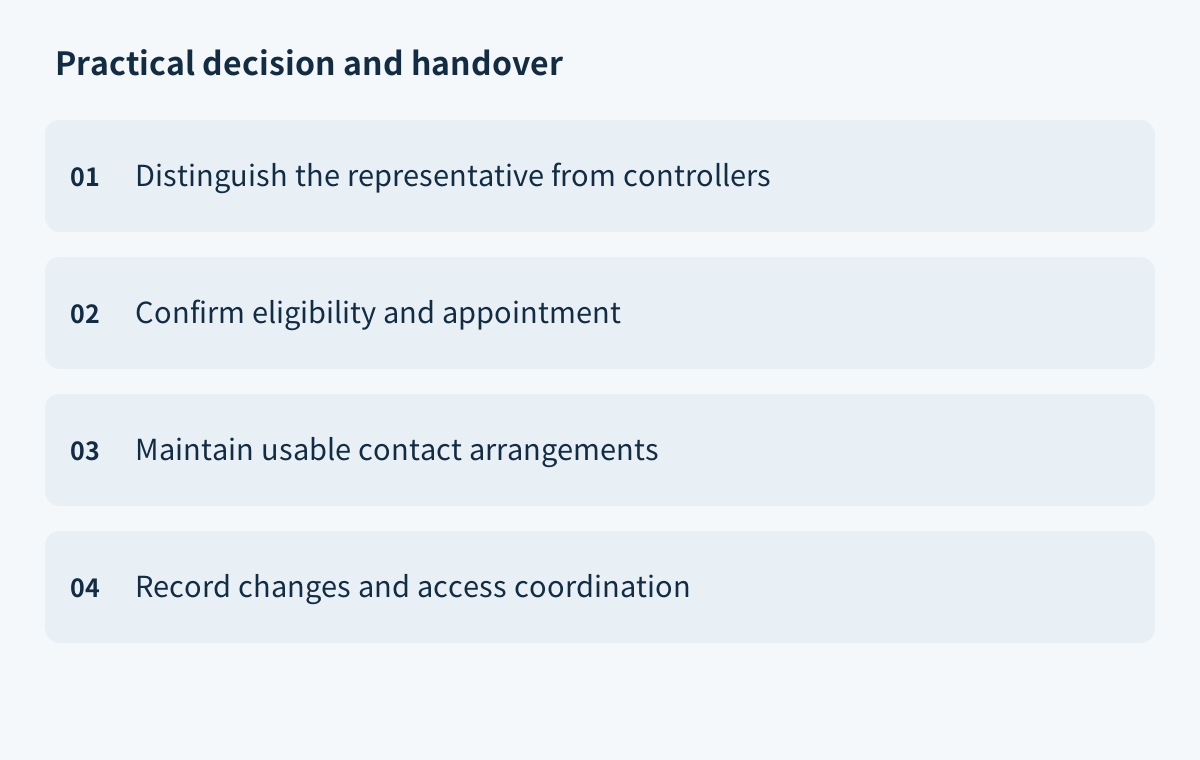
Handle Changes of Representative Separately from Changes to the Register’s Location
When a representative leaves, first check the successor’s eligibility and confirm that they understand the role and contact arrangements. Complete the handover and update the representative details in the SCR. Keep the appointment decision, eligibility evidence, handover date, before-and-after register versions and contact confirmation. A representative change does not by itself update significant-controller information, the register’s location or other company records; review those items separately.
Form NR2 is for notifying the Companies Registry of the location of registers and company records; it is not a form for changing the designated representative. If the SCR is kept somewhere other than the registered office, the company generally must notify the Registrar on NR2 within 15 days after it is first kept at that place, or within 15 days after a change of location. There are exceptions. For example, an existing company may not need a fresh notice if, since 1 March 2018, its SCR has been kept with its register of members and it had already notified the Registrar of the location of that members’ register on NR2. Do not assume an exception applies just because the company is older; check where the records were actually kept and what was filed. See the Companies Registry SCR FAQ and specified forms page listing NR2.
A registered office address change should be checked separately under Form NR1. A change to the business address recorded for business registration must be notified to the Inland Revenue Department (IRD), generally within one month. The IRD also offers an optional one-stop electronic notification for certain local-company changes; confirm that it covers the change in question. Record the registered office, actual SCR location and business registration address in separate fields, then check the relevant authority and evidence for each. Bank and tax records serve different purposes, so updating one does not confirm that the others have been updated. See the IRD’s business registration change guidance and one-stop service FAQ.
Review Contact Details and Company Records Regularly
Review the records when something changes. An annual review can be a useful internal control, but it is not a statutory deadline for updating the designated representative’s details. Triggers include the representative leaving or changing contact details; changes to shares, voting rights, director appointment rights or other control arrangements; moving the SCR; or changing the registered office or business address.
The Companies Registry’s update rules for a registrable change to a significant controller are separate from changes to the representative or a Form NR2 location notice. In general, a company must give notice to a significant controller within seven days after it knows, or has reasonable cause to believe, that a registrable change has occurred, unless an exception applies. For updating the SCR, particulars relating to a registrable person are entered within seven days after all required particulars have been confirmed; particulars relating to a registrable legal entity are entered within seven days after they come to the company’s notice. These periods concern the significant controller’s particulars, not a representative change or the NR2 deadline. See the Companies Registry guideline.
For each review, keep a concise record of the company name, review date, owner, company documents checked, whether the controller analysis needs to be revisited, representative eligibility and contact details, SCR location, completed actions and open items. Give each open item an owner and follow-up date. If one address serves as the registered office, business registration address and SCR location, still verify each record separately so that one notification is not mistaken for updates to all three.
For example, if the representative leaves but the SCR stays where it is, check the successor’s eligibility, update the representative details and complete the contact handover, then confirm whether any other filing is required. If the SCR also moves away from the registered office, separately check whether NR2 is required and its deadline. If the registered office or business registration address changes as well, check the NR1 and IRD requirements for those changes. Record the result of each check so the next person can see what is complete and what still needs attention.
If you need a case-specific assessment, submit your question through the website’s contact channels. This article is not legal or tax advice and does not guarantee any outcome.