Published · Updated

When a Hong Kong company allots shares, a shareholder transfers shares, or records are handed over, a share certificate may be reviewed alongside the register of members, transaction documents, Companies Registry filings and an external cap table. These records may describe the same shares but come from different sources and reflect different dates. The certificate is issued by the company; the register is maintained by the company; transaction documents explain the basis for a change. Public searches, scans and spreadsheets can help with reconciliation, but are not interchangeable records. This article focuses on Hong Kong local companies with a share capital. Re-domiciled companies, registered non-Hong Kong companies and other special arrangements need separate checks of the applicable rules and articles.
Share Certificates Are Different from Electronic Shareholding Records
What information should you confirm first to distinguish the records?
Start with each record’s source and purpose, rather than whether it is paper or electronic. A certificate helps verify what the company issued and the particulars it contains. The register reflects the company’s member records; allotment or transfer documents, resolutions and delivery records help trace why shareholding changed. Registry filings have their own update dates. An external cap table, spreadsheet or scan may be only a working summary or backup.
| Record | Questions to ask |
|---|---|
| Share certificate | Issuer, share class and number, certificate number and date? |
| Register of members | Who maintains it, what date does it cover, and how are changes recorded? |
| Allotment or transfer documents | Which transaction supports the change, and does it link to the register update? |
| Public filings and external tables | What date do they reflect, and are they a summary or working copy? |
How can you verify sources and timing and leave a handover record?
For each record, note its custodian, coverage period, last update and version location. Compare holders, share classes and numbers. The Companies Registry’s share capital and shares FAQ says a general transfer appears in the first annual return filed after the transfer, or in the next return if that year’s return was already filed. Public search results are therefore not a real-time copy of the internal register. Electronic records may be formal company records or an external cap table; cloud storage alone proves neither validity nor invalidity. Check who created and maintains them, their version history and links to original documents. Keep mismatching versions and log the check date, sources, fields that differ, originals reviewed, open questions and follow-up owner.
Reconcile Allotments and Transfers Against the Register of Members
What should you collect before comparing the records?
Confirm the company type, name and number, then set the review period. Separate an allotment of new shares from a transfer of existing shares. For an allotment, trace its terms, approval, recipient and number of shares. For a transfer, trace the documents, parties, share class and number, and when the company received and processed them. Keep transaction documents, approvals, relevant articles, register updates, certificate copies and delivery records together. A discrepancy table can capture the transaction date, holders before and after, share class and number, supporting document, register version, certificate number and open points. Investigate the transaction basis and record timing before changing a cap table.
How can you identify discrepancies and document the order of resolution?
Use transaction basis, company approval, register update, certificate and external filing as a practical review sequence, recording the documents and dates at each step. This is not a universal statutory order. The Registry FAQ says no specified form is required solely to report a general transfer when it takes place. A listed company’s sale or transfer of treasury shares has separate reporting requirements; see the Treasury Share Regime FAQ. The FAQ also says Form NSC1 is not required when founder members who signed the articles receive shares in the specified incorporation situation. Do not extend this exception to all allotments; check the actual requirements in the share capital and shares FAQ. If documents conflict, list each version and source without supplying missing signatures or dates. Hong Kong Share Capital Structure: Designing Shares and Shareholders’ Agreements Without Hidden Governance Risks provides general background, not a review of a particular file.
Check Certificate Details and Valid Signing Arrangements
Which certificate details should be checked against the register of members?
Compare the certificate, register and allotment or transfer documents field by field: shareholder name, share class, number of shares, certificate number, issue date and company identification details. If there is a restriction or notation, verify its source and meaning. Do not assume a field used in one format is a statutory minimum for every company. A spelling difference, a matching number of shares but a different class, or a certificate dated before the approval record warrants investigation. Editing a name or reprinting the certificate does not resolve the underlying discrepancy.
How can you confirm signing authority and document validity?
Obtain the articles in effect when the transaction occurred. Check that the relevant resolution, scope of authority, signatory’s role and authorization date align. If the articles were amended, identify the version and when the amendment took effect. If signing authority was delegated, retain a traceable delegation or decision record. File the final signed document with the register and transaction documents, and record where the original is kept.
Requirements can differ between companies, so check the company’s own arrangements before applying a general rule about signatories, seals or format. Mark scanned signatures, inconsistent dates, missing authorization documents or unusual company types for confirmation. The reconciliation record should show which documents support which particulars, rather than simply marking the review complete.
Confirm Issuance Deadlines and Replacement Procedures Against Official Rules and the Articles
Which conditions determine the deadline for an allotment or transfer?
Issuing a certificate after an allotment, updating records after a transfer and applying for a replacement after loss are different events and may have different starting points. Identify the transaction and company type, then locate the applicable statutory provisions, articles, transaction documents and resolutions. Confirm which event starts any deadline, who is responsible, what steps come first, and whether an exception or special arrangement applies.
Consult the current consolidated Companies Ordinance and relevant subsidiary legislation, and confirm amendment commencement before stating a number of days. The Companies Registry’s Companies Ordinance (Cap. 622) page links to the Hong Kong e-Legislation text. An index page or form title alone does not establish a deadline, condition or procedure. If you cannot match the provision and starting event to the case documents, do not write a fixed deadline into an operating guide.
What must be confirmed before anyone states a general deadline?
Confirm whether the company is a Hong Kong local company with a share capital, whether the change is an allotment or transfer, when the company received the documents, whether the articles add requirements, and whether the provision was in force at the relevant time. Do not apply assumptions for a local company to re-domiciled companies, non-Hong Kong companies or other special arrangements. If a deadline may affect a filing, rights claim or replacement procedure, record the provision, starting event, exceptions and reviewer. Until confirmed, mark the deadline unverified rather than substituting common practice for the current rule.
Do Not Reprint a Lost or Disputed Certificate Yourself
What should you check first if a certificate is lost, damaged or disputed?
Check the certificate number, registered holder, share class and number, last known custodian, and status of the company’s register and files. Distinguish a lost original from a damaged document, inconsistent particulars, someone claiming to hold the original, or notice of a share-rights dispute. These situations require different facts and may call for different procedures. Keep the applicant’s explanation, correspondence, images of the old certificate, transaction documents, resolutions, register versions and notices together, noting when each was received and where it is stored.
If someone disputes the holder or share rights, pause before reprinting or marking the original cancelled. Otherwise, two documents could appear valid or the status could become harder to determine. This is a risk-control step, not a decision about who has the rights.
Why should you avoid reprinting it yourself, and what evidence should you keep?
The Companies Registry’s specified forms page lists distinct procedures: NS1 is an application for a new share certificate under section 163(1); NS3 is a notice of intention to issue one under section 164(1); and NS4 is a notice to cancel the original and issue a new certificate under section 166(1). The form names help locate procedures but do not establish eligibility, which procedure applies or the deadline.
Compare the current register, original issue records, application details and notices already delivered, then check current provisions, form notes and articles. Keep dated copies of receipts, reviews, decisions, notices and delivery. If action is paused, record why, what evidence is outstanding and who will review it. Keep older versions and do not mark the original cancelled before the applicable process is complete.
Link the Old Certificate to Its Replacement
How can you link each old certificate to its cancellation status and replacement?
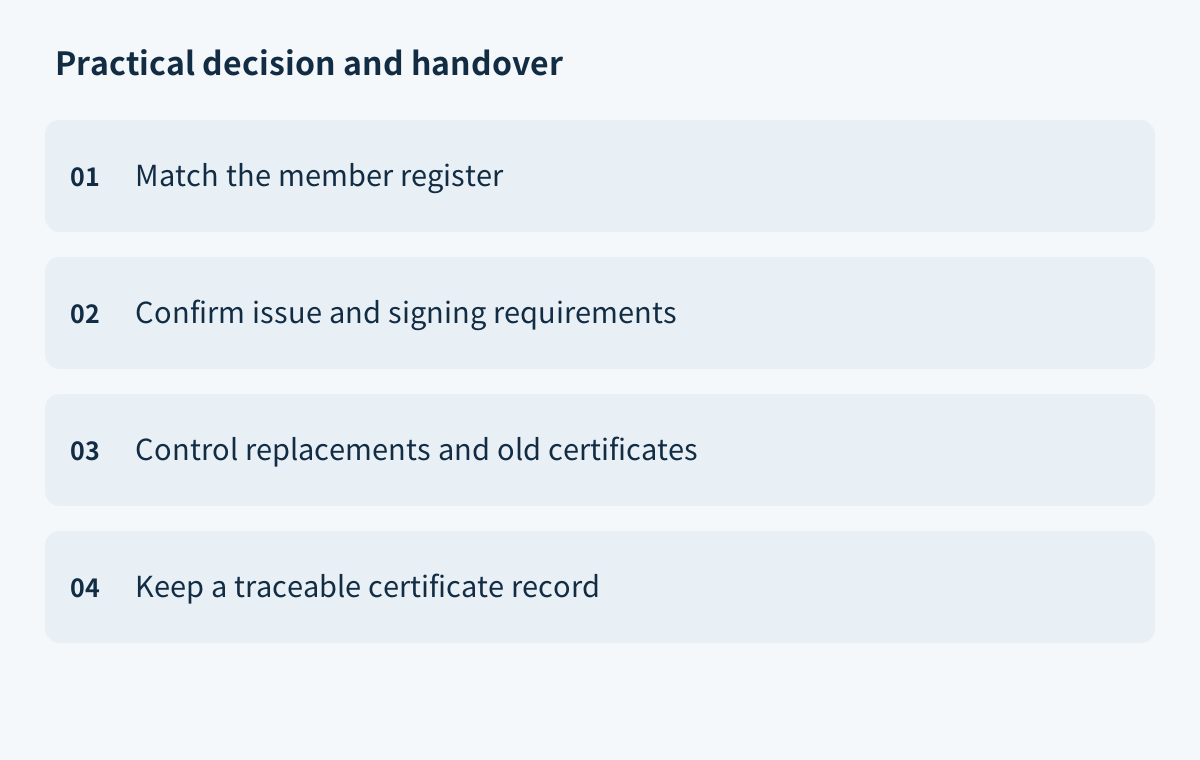
Create a record for each certificate number, linking it to the holder, share class and number, issue date, related transaction, register version and archive location. For a replacement, add the application basis, approval record, new certificate number, delivery date and proof of receipt or service. If the old certificate has not been recovered or its status is unconfirmed under the applicable process, label it “lost pending confirmation” or “dispute under review.” Do not mark it cancelled on your own.
What should a handover checklist record to make the process traceable?
Use fields that link to an original document or a named person responsible for the information:
| Handover field | What to record |
|---|---|
| Old certificate | Number, holder, share class and number, current status |
| Basis for status | Location and date of application, resolution or notice |
| New certificate | Number, particulars, issue and delivery records |
| Company records | Register version, update date and reviewer |
| Open items | Discrepancies, disputes, missing documents and follow-up owner |
This checklist supports traceability and handover; it is not a statement of statutory minimum fields. Have the next custodian confirm file locations, open items and follow-up responsibilities. Keep revision history so the company can reconstruct how the old certificate links to its replacement. Before acting, clarify the transaction type, company records and applicable rules. For a case-specific assessment, submit a question through the website’s contact details. This article is not legal or tax advice and does not promise an outcome.