
Hold incoming goods that differ from an approved sample or purchase specification, and preserve the decision basis. This helps keep incorrect materials out of production and identifies the lot needing supplier response. This guide covers internal receiving, quarantine, and release using mutually confirmed specifications. If scope or acceptance criteria were not agreed, mark pending and ask designated contacts to clarify.
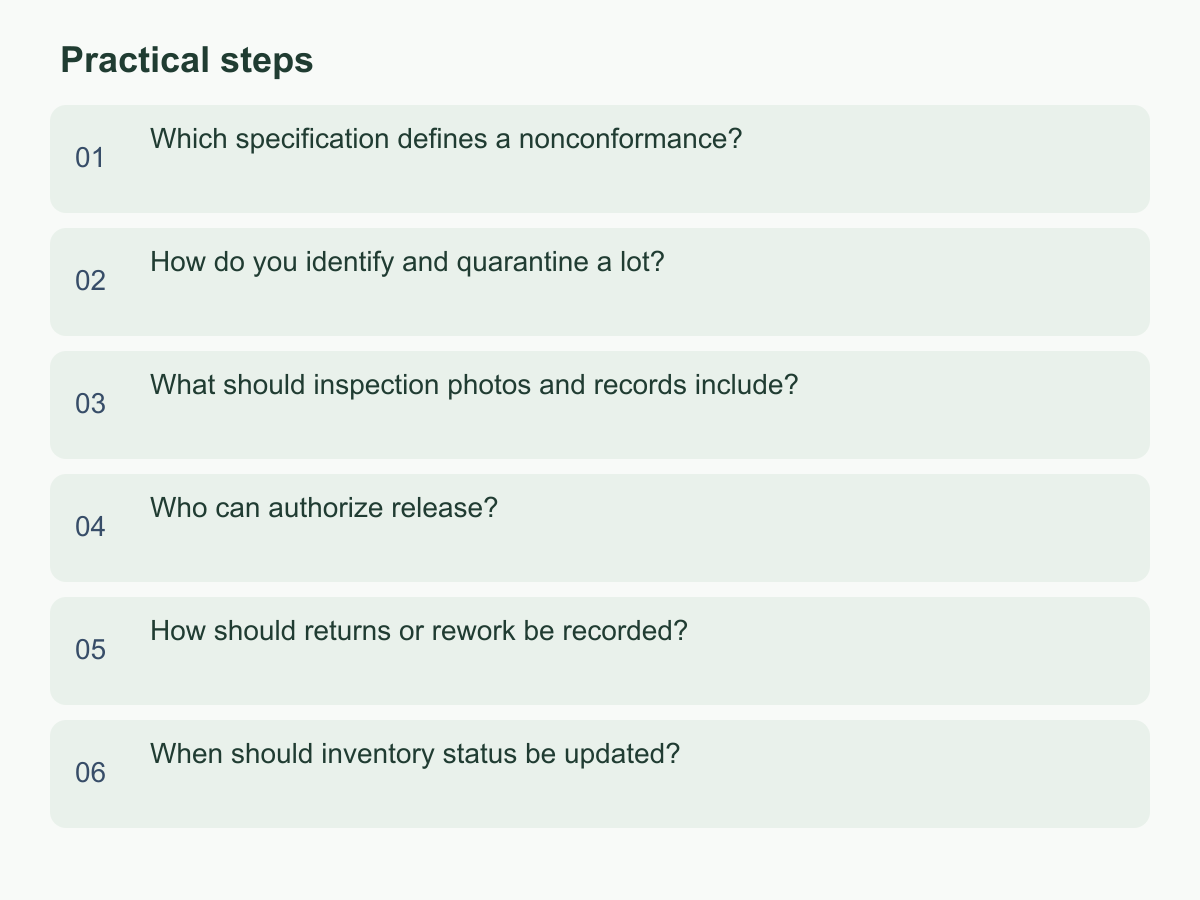
Which specification defines a nonconformance?
Use a document both parties confirmed; do not choose a reference after delivery. Record the purchase order, item number and name, specification title and version, confirmation date, relevant clause, quantity, and inspection basis. Retain later approved changes. Identify applicable samples, drawings, label proofs, or checklists, and the lots they cover.
For each criterion, record the requirement, measured or observed result, and difference. Hypothetical example: an agreed drawing specifies 20 millimetres; a sample measures 19 millimetres. Note the measurement point, tool reading, sample ID, and drawing version. If the acceptance range is unclear, mark pending and quarantine; never invent a tolerance or infer a regulatory standard.
If documents conflict, preserve originals and obtain written confirmation from the responsible contact about which version applies; record who, when, and why. For sampling, record the basis, carton coverage, and carton and sample IDs. Do not treat one sample result as a conclusion about the whole lot. Hold a suspect carton while the designated quality owner decides whether to expand inspection; record scope and findings. If the supplier disagrees, list both parties’ document references before discussing responsibility.
How do you identify and quarantine a lot?
Identify the lot, location, and quantity. Link supplier/internal lot IDs to the purchase order, item, arrival date, and carton/pallet numbers. For missing or unclear labels or mixed lots, assign temporary IDs to identifiable units and photograph existing labels.
Record received, inspected, suspected, quarantined, issued, and split quantities with units. Keep suspect stock in a marked area and restrict picking, issue, transfer, and mixing. If it cannot be locked, seal or divide it, or assign supervisor custody; log the custodian.
If 200 pieces arrive in 8 cartons of 25 and one may be damaged, identify that carton and quarantine 25. Do not release the other 175 based on appearance alone; the designated person decides from inspection scope and risk. Separate mixed supplier lots into sublots. Log each movement’s origin, destination, quantity, time, and handler. If counts mismatch, keep stock pending rather than increasing available inventory.
For goods already unpacked, shelved, or partly issued, freeze unused stock and trace destinations through issue records, transfers, and a physical count. Record quantities used, in work in progress, and on hand. Label lot, discrepancy, date, quantity, no-use instruction, and contact; index the location in the pending list. Release labeled sublots only after approval; count them at handover.
What should inspection photos and records include?
Take a wide view of the carton and lot label, the whole suspect item, and close-ups of each defect. For a dimension or surface check, include a ruler or tool with the reading and measurement point visible. Name files with the lot, carton, item, sample, and check—for example, “receipt-lot-carton03-itemA12-sample02-dimension.” Keep originals; save any annotated copy separately.
Link each photo to a record with the date, inspector, sampling method, number inspected, number with issues, inspection item, specification reference, and result. A photo cannot establish an electrical, leak, or performance result: record the actual test method and reading. Mark untested items “not inspected,” not blank or passed. If one sample has several defects, identify each and link its location photo to the relevant inspection entry.
Keep lighting and camera angle comparable; captions should identify location, scale, and orientation. Note the item’s condition and packaging if handling could change the defect. If the lot is not identifiable, photograph the label and item together. Retain correspondence references for return or rework disputes; record facts without assigning blame or guessing causes. Store files in a controlled folder, restrict editing, and record its path or attachment ID. Retake unclear images while goods are available and note why.
Who can authorize release?
The receiver records delivery and initial check; the inspector compares goods with the agreed specification; purchasing contacts the supplier and organizes disposition. A predesignated quality, engineering, or operations authority approves release. Teams may combine roles but must record each action; an inspector needs second confirmation to accept a deviation unless given that authority.
Before release, verify the discrepancy is closed or an exception approved, quantities and locations traceable, reinspection complete, and approval scope clear. For conditional use, record work order, quantity, expiry or review point, conditions, and monitoring owner; if these cannot be implemented, hold stock. A supplier’s “usable” response does not authorize buyer release; confirm verbal agreements in writing.
Record reporter, inspector, approver, time, decision, reason, and attachments; note missing information on returned approvals. Use an authorized proxy only; otherwise keep goods quarantined. If stock was issued, list slips and destinations for a stop-use or investigation decision.
Separate technical acceptance from inventory release. Quality or engineering assesses the deviation; inventory authority releases the verified quantity. If one person covers both, record both decisions and bases. Proxies stay within assigned authority. Changes to specification, use limits, or quantity need new approval. Approval applies only to recorded conditions and quantity, not future deliveries.
How should returns or rework be recorded?
Record disposition by quantity, action, and acceptance result; “returned” or “rework complete” alone is insufficient. Options include supplier return or on-site sorting, buyer rework to agreed instructions, approved deviation use, or disposal under internal procedure. For each, identify the lot and quantity, responsible contact, supplier instruction, planned date, and completion evidence.
For example, if 12 of 120 pieces are quarantined and both parties confirm that 10 will be returned and 2 reworked, reconcile the split: 10 + 2 = 12. Link the return to dispatch or handover evidence. For rework, record the method, operator, quantity completed, reinspection criteria, and results. If sorting creates accepted and rejected groups, give each its own quantity and label. Record replacement goods under their new lot number and link them to the case without overwriting the original disposition.
For unfinished work, name an owner, follow-up date, and escalation contact; these are internal dates, not statutory deadlines. An accepted deviation needs an approver, quantity, use limits, and review or expiry point. Before closing, reconcile returned, reworked, scrapped, released, and pending quantities to the affected total, with photos and handover evidence. Update sublot labels and locations. Reopen if the method changes, rework fails, or a new issue appears.
When should inventory status be updated?
Update each traceable quantity when its location or disposition changes; do not accept a whole purchase order at once. Use statuses supported by available tools, such as awaiting inspection, quarantined, awaiting supplier response, in rework, awaiting reinspection, released, or returned. At receipt, separate inspection stock from available stock and record frozen quantity and time when a concern arises.
Release only after authorized approval, required checks, and physical and recorded balances match. If the system cannot lock inventory, segregate goods, keep a controlled pending list, and name one owner. For split disposition, record quantities separately: if 10 of 12 are returned and 2 pass rework, record 10 returned and 2 released. Keep any other pending quantity on hold.
Record each change’s reference, old and new status, quantity, reason, approver, and time; preserve prior values in correction records. At handover, reconcile physical stock, labels, ledger, and open cases. If availability is only at purchase-order or item level, keep a lot ledger and ask the inventory owner to verify both views before issue. Release only approved quantities; hold uninspected, unanswered, or unretested stock. Cross-reference the case, transaction, and quantities transferred, returned, or disposed.
Start with one open receiving record: complete its lot details, photo index, quarantine location, pending disposition, and approver, then check each against this workflow. To learn more about Chan & Chung, visit the English website.