
When an external notice arrives, first preserve the original message and every attachment. Then identify what it asks, who should own the next step, and what still needs confirmation. The workflow below can help route accounting, banking, customer, supplier, and general administrative correspondence. Record dates and deadline wording exactly as received; do not infer legal effect from the wording alone.
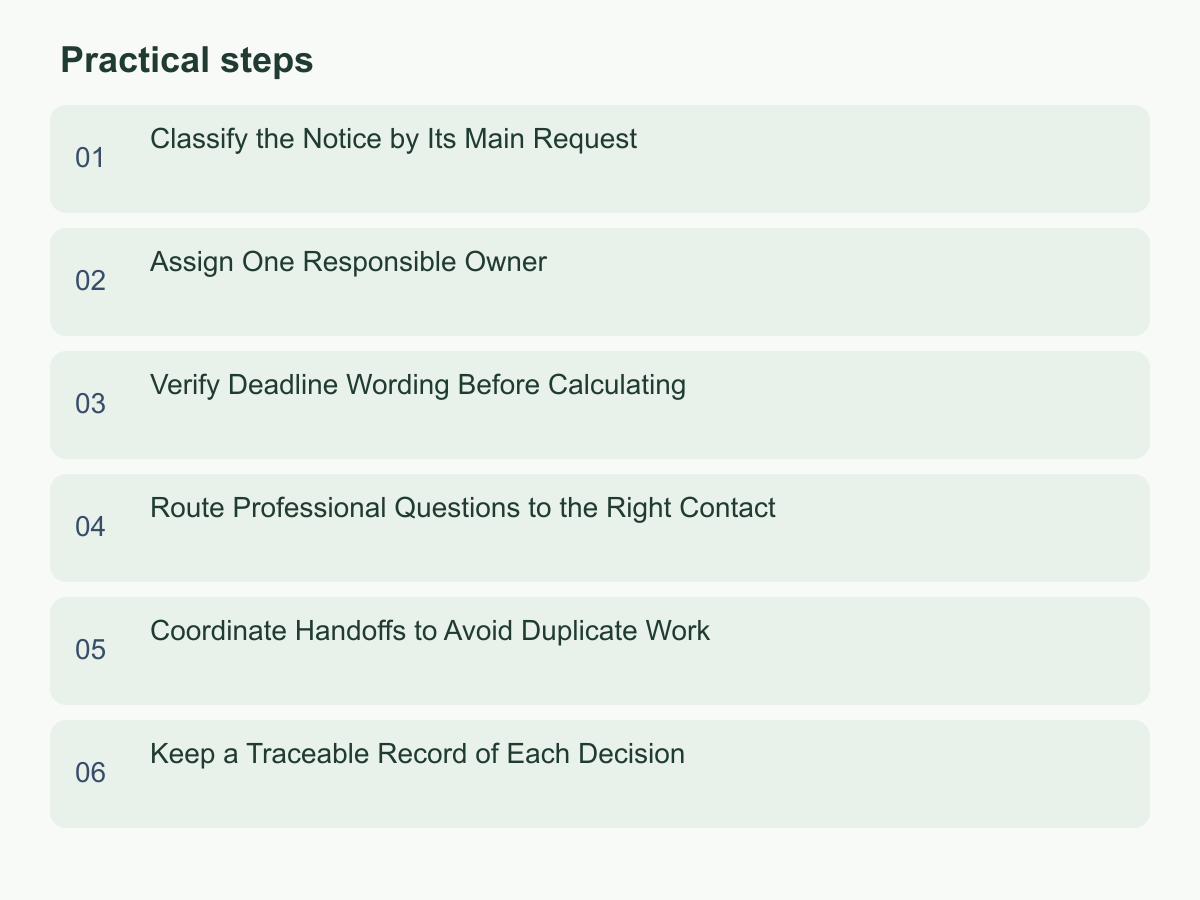
Classify the Notice by Its Main Request
Classify by the main requested action, not the sender or subject line alone. The same institution may send an accounting request, an account-data update, or an administrative reminder. Read the message, attachments, and relevant correspondence; note who must do what and which payment, account, customer, or matter is involved. Keep the evidence behind the category.
Use five starting categories: accounting, banking, customers, suppliers, and general administration. If a notice spans two, assign the category tied to its main action and list the other as a collaboration topic. Record the sender, recipient, subject, channel, attachment names, and a short request summary linked to the original files.
For example, a bank asks an administrative colleague to verify payment-account details. Classify the notice as banking, with accounting as a collaboration topic. This helps route the work; it does not establish the notice’s authenticity, applicability, or authority for a financial action.
For multiple requests, list each action, expected output, and missing information; avoid a vague “please handle.” If the main request is unclear, mark it pending until one owner confirms the category. A supplier notice about an invoice name and payee account might list the invoice as primary, the account as related, and cite the field on page 2 of the attachment. If correcting the invoice depends on verifying the account, make banking primary and accounting collaborative; if they are independent, track them as separate tasks.
Assign One Responsible Owner
Assign one person who can verify the details and move the work forward. Consider the relevant business records, who holds the data, and who has authority to act. Start with the person closest to the accounting entry, bank relationship, customer, or supplier purchase, then check whether they can fulfill the request or need someone else’s approval.
Put one name in the owner field; list collaborators, the deliverable, open questions, and the next review time. Send the original notice and attachments with a brief summary, and ask the recipient to acknowledge ownership. If responsibilities are unclear, the original recipient keeps tracking the notice until someone explicitly accepts it. Forwarding alone is not a completed handoff.
If a notice asks the team to check a supplier payment, route the check to the person with the payment records and ask the supplier contact to compare the name and transaction details. Keep one owner and specify what each collaborator must provide or approve; “Finance to handle” leaves responsibility unclear.
If there is no suitable department, the usual contact is away, or records are spread across the team, appoint a temporary coordinator to locate records and responses, then confirm the long-term owner. Tracking does not grant decision authority. For a customer request, Lin, who holds the customer file, might own “list the dates and IDs for 3 transactions,” while a colleague with receipt records collaborates. If Lin cannot access the data, reassign the task that day and record why.
Verify Deadline Wording Before Calculating
Copy any date, time, time zone, and deadline wording exactly as written. Also record when and how the notice arrived, its attachments, and any later corrections. An administrative contact can organize these facts and flag urgency, but words such as “deadline” or “reply by” do not by themselves establish a legal deadline, how it is calculated, or the consequences of missing it.
Track three separate fields: the wording in the notice, the internal target date, and the question still requiring confirmation. The owner should ask a professional authorized to interpret the issue or the relevant institution contact what the date means, how it is calculated, and who it applies to. Until then, prioritize the check and keep the source wording.
Suppose the notice says, “Please reply by October 28.” Copy that phrase and the receipt date. Ask what “by” means, which time zone applies, and whether delivery must occur that day. An internal target of October 25 for a draft is only a work plan; it does not confirm the external deadline or its calculation.
If notice versions conflict, the time zone is missing, an attachment gives another date, or the matter appears to involve a formal filing or rights, do not calculate it yourself. Give all versions and receipt times to a suitable professional or the issuing office. For an email saying “within five business days” when an attachment gives a fixed date, record both, including the attachment page and version. Ask whether the date replaces the period and which region defines business days. Log the answer and its source before updating the status; until then, mark the deadline for confirmation.
Route Professional Questions to the Right Contact
Separate administrative checks from questions that need professional judgment. An administrative contact can verify names, dates, missing attachments, and consistency with internal records. Questions about legal meaning, accounting treatment, bank requirements, or other matters subject to professional rules should be framed clearly and sent to the company’s appointed lawyer, accounting professional, bank contact, or another suitable professional.
Before asking, assemble the original notice, attachments, relevant context, facts already checked, the decision needed, and any missing information. Split “What information does the notice refer to?” from “How should we respond?” Save the answer, its date, and the scope it covers so a single opinion does not silently become a general rule.
For a notice listing a fee and a document request, the owner can compare internal transaction records and list the fee items and missing papers. They might ask an appropriate accounting professional about the accounting question and the issuing institution about the required submission format. These are possible routes; choose based on the notice, existing arrangements, and the question to be answered.
If an answer covers only part of the issue, record confirmed and unresolved items separately rather than filling gaps yourself. Ask what the answer covers, what source material is needed, and who owns the next step. Organize each query around the fact requiring judgment, the decision sought, and the materials supplied. To match a receipt to an invoice, for example, provide the transaction date, amount, and both document IDs; separately confirm response format with the sender. For questions across disciplines, ask each contact about their part and record the scope of each reply.
Coordinate Handoffs to Avoid Duplicate Work
Use one shared notice record as the starting point, with one owner, collaborators, current status, and next action. Avoid saving similar copies of attachments, contacting the sender twice, or sending competing replies. Each participant should check the record and update their assigned item.
Log who obtained which information and when, what they checked, what remains, and the next step. The owner coordinates external contact. If work is split, assign distinct questions and reconcile the facts, attachments, recipients, and wording before sending one coherent reply.
For example, when accounting and banking contacts both need to examine the same account notice, the owner can ask one person to check internal payment records and the other to clarify the requirement with the sender. Both enter their results in the same case. If one has already contacted the sender, record the time, question, and awaited reply so others can avoid duplicating the inquiry.
When an owner changes, is away, or is delayed, keep the source notice, current understanding, open work, and contacts in the record. The successor should confirm acceptance, and the owner and handoff time should be updated. Until then, the current owner tracks the work and raises any internal gap; a group message is not proof of handoff. If two colleagues receive the same forwarded notice, compare its receipt date, subject, and attachment names, keep the existing case ID, and assign the second recipient a specific task, such as checking the attachment version. If a reply is being drafted, pause it, merge any new facts, confirm the recipient and attachments, then log the single final version and its send time.
Keep a Traceable Record of Each Decision
Record why the notice went to a particular owner, what has been verified, and what remains open. Include the receipt time, sender, subject, classification basis, location of the original file, owner, collaborators, tasks, verification results, and last updater. Describe decisions with facts and sources rather than a status such as “handled.”
Store the original notice, attachments, handoff summary, and external replies where the team can find them under existing access rules. Link them using a consistent case ID. Keep earlier versions and their receipt times when a notice or reply changes; do not overwrite them. Limit access to sensitive information to people who need it for the check or decision.
For example, a customer notice may initially be classified as general administration, then reassigned to accounting after an attachment reveals an amount that needs checking. Keep the initial category, reason for the change, attachment reviewed, reassignment time, and new owner. If a professional confirms that more information is needed, record the scope of that confirmation and the delivery status; do not turn an unverified point into a conclusion.
Before closing, the owner checks that the original and attachments are available, each request has a result or a named follow-up owner, deadline verification status is recorded, and any external reply and its basis are saved. Keep unanswered questions open with a tracker and review time. A decision log might show “14:20 customer; 15:05 accounting; reason: attachment lists an unmatched payment; evidence: file name and page; decision owner: Ms. Wang; next step: payment-record holder to check.” If the category changes again, add the time, reason, and source instead of overwriting the earlier entry. Record who accepted the work and when it should be reviewed; forwarding is not closure.
Start by adapting these fields to your existing intake process and checking who owns each handoff. For related information, visit the Chan & Chung website.