
When organizing an internal month-end adjusting journal entry, the supporting record should let the next person follow one clear chain: why it was proposed, what evidence supports it, who reviewed it, what was posted, and how the result was checked. This guide treats one entry at a time. Its examples illustrate documentation only; they do not determine account selection, recognition timing, or appropriate accounting treatment. Flag questions that need professional judgment and route them with the available evidence.
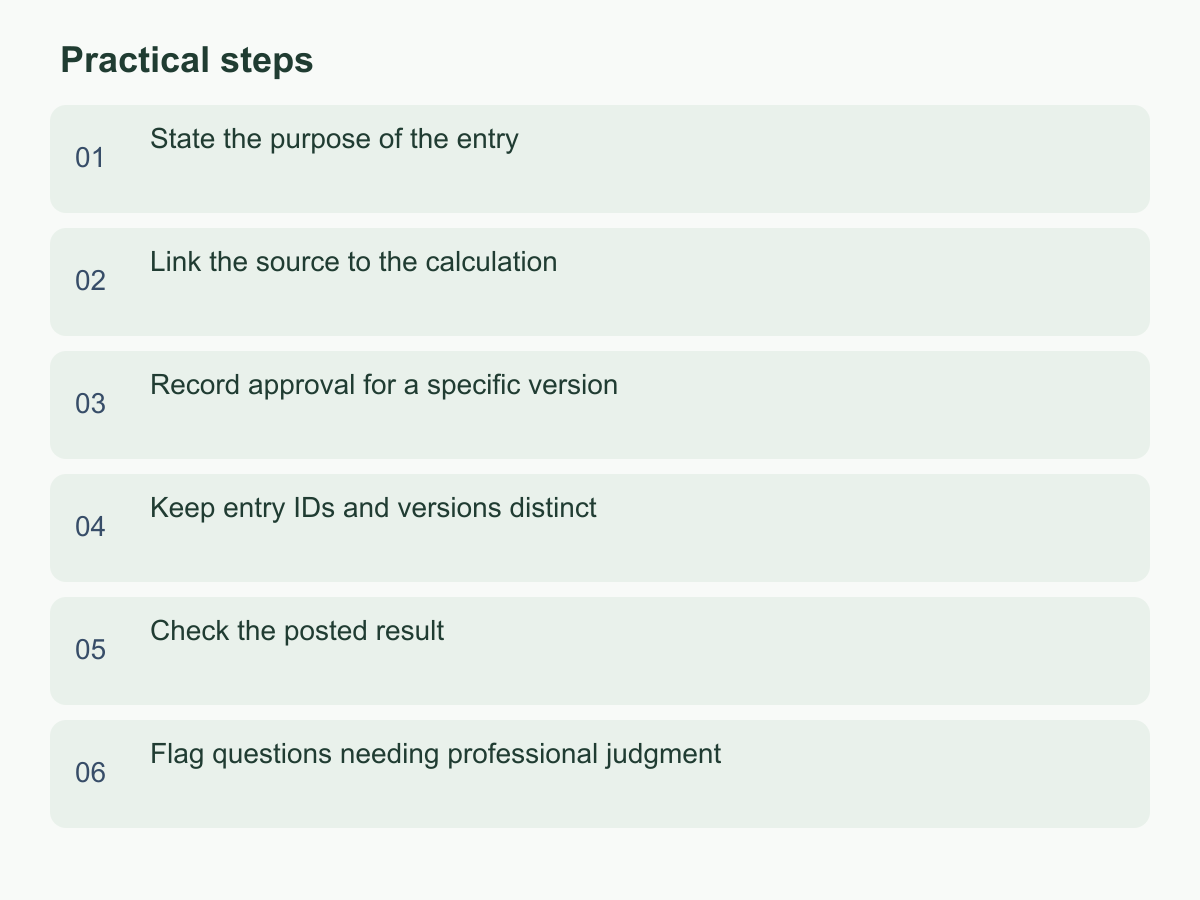
State the purpose of the entry
An adjusting entry’s purpose should explain the period, process, and observed difference, not merely assign an amount to an account. In one or two sentences, state the event, observation, and scope. For example: “Based on this month’s completed-service list, documenting amounts not yet reflected at month-end for review.” If the cause is uncertain, label it “pending review”; do not present a guess as fact or use a vague note such as “month-end adjustment.”
Include the period, activity or transaction, reason for proposing the entry, data range, and confirmed or unresolved points. Explain how sources were combined, or identify the subset and exclusions. Keep amount and account details in the entry lines.
Have someone outside the preparation read the purpose and summary. Can they explain the issue and evidence boundary? If not, clarify the event, period, or difference. Use one entry ID across the purpose, workpaper, approval, and checkback.
Example: “October handoff difference between completed items and the payment schedule. Covers three records with delivery IDs and pending-confirmation status; excludes matched items. Two records with missing dates are tracked separately.” Preserve the filters so another person can reproduce the list if its count changes.
Link the source to the calculation
Link each entry summary to the actual source, not just a file name. Record the document, supplying team or system, period, receipt date, and relevant sheet, fields, rows, or filters. For handoffs, note who supplied which version; for exports, keep the export and filters that identify the batch.
Show in the workpaper how inputs produce the proposed amount: formulas, sum range, rounding, and exclusions. Example: source amounts 4,800, 3,200, and 2,000 should reconcile as 4,800 + 3,200 + 2,000 = 10,000, with each item traceable to the source. This illustrates traceability, not appropriate account selection or treatment.
Keep the original separate from the working copy and identify the version used. Document manual duplicate removal, missing-data completion, or unit conversion, including reasons and counts or totals before and after. If a source is missing, filters unclear, or totals disagree, list the gap as pending and leave the workpaper incomplete.
When exports or merges rename fields, map original and workpaper headings, conversions, unmatched counts, batch or revision time, and blank-index row numbers. Never invent missing IDs.
Record approval for a specific version
Seek approval before posting and tie it to an identifiable version. Send the purpose, source, calculation workpaper, entry lines, and open questions; a bare amount is not enough. Record the confirmer’s traceable identity, role, time, version, and outcome—approved, returned, or more information requested—and retain the team’s authorization record.
State the review scope: source completeness, reproducibility of calculations, fit between summary and purpose, and questions requiring follow-up. Approval does not guarantee every accounting judgment; note issues outside the reviewer’s scope. If discussion is verbal, document any resulting change to amount, scope, or entry.
For returned work, record the time, issue, person supplying more information, and resubmitted version. A change to source, formula, amount, period, or entry line requires confirmation of the new version. Keep it pending meanwhile; an earlier approval applies only to the version it identifies.
Separate receipt from approval. “I reviewed the attachments” confirms receipt, not permission to post. If only the calculation was checked, record that limited scope and leave the entry unapproved until an explicit decision.
Keep entry IDs and versions distinct
Give each matter a stable ID and each revision its own version label. The ID connects purpose, source, workpaper, approval, and checkback; the version shows sequence. For example, use “JE-2026-10-031” for a matter and “v01,” “v02” for drafts. The team can choose its format if items remain identifiable and sortable.
For each version, record creation time, preparer, status, and key changes. Note updated amounts, added sources, changed lines, and reasons. Retain earlier versions but mark the current one; avoid multiple “Final” files or names identifiable only by month. Record added documents even if entry lines did not change.
Before posting, confirm the approved version is the write candidate, the workpaper total matches the entry, and the source version matches the calculation. Resolve inconsistencies and decide whether to recalculate or seek approval again. Mark replaced or void versions instead of deleting their history.
An index can list ID, version, parent, file location, time, changed lines, and status. If a teammate corrects a source-row ID in v02, record old and new values and source, create v03, and mark v02 superseded. Review differences between parallel copies; do not pick by last-save time. Confirm the merged fields against the workpaper.
Check the posted result
After posting, find the result in ledger detail, a posting list, or retained confirmation. Confirm period and entry ID, then compare every line’s account, description, date, currency, debit or credit direction, and amount. Do not rely on totals alone. Link the result to the same ID and record a locator another person can use.
Example: the approved draft has debits of 8,000 and credits of 8,000. If the result shows the same ID and period and equal totals, still compare each line. Record any 7,500 amount, wrong period, missing line, or amount posted to another matter as a difference; similar totals do not establish a correct posting.
For a match, record checker, time, result location, and conclusion. For a mismatch, retain the difference list and progress, then check the corrected result. If the posted version differs from approval, identify the changes and follow the team process for correction or added approval. Check period, amount, direction, account, description, and version against evidence.
Use statuses such as matched, partially posted, not found, or possible duplicate. If four lines were expected and three appear, record their locations, missing line, and search filters for follow-up. Preserve both locations for a suspected duplicate; do not offset either entry yourself.
Flag questions needing professional judgment
Separate facts, assumptions, and questions requiring professional judgment. Facts are what the source shows; assumptions are temporary premises; open questions concern treatment the records cannot answer. For each, record the question, known and missing information, person raising it, appropriate professional to ask, and response status.
If records do not show which period a payment relates to, note the dates and transaction data available plus any missing contract or confirmation. Leave treatment unresolved; do not invent an accounting conclusion, statutory deadline, or tax effect. When evidence arrives, record its source and receipt date, then update the workpaper and version. Distinguish source gaps, formula errors, differing import scopes, and treatment questions.
Track open items by question, owner of follow-up, next review date, and documents to update. Do not call an unanswered issue approved or complete. Preserve the reply and show its effect on the purpose, calculation, or entry version; repeat approval or posting checks when needed.
Before consulting a professional, frame one answerable question and provide an index of supporting records, contrary or missing evidence, assumptions, and response-date field. If a service completion date and contract attachment have different item IDs, ask what evidence would establish the match. Keep that evidence question separate from the accounting-treatment question.
Start with one month-end item and connect its purpose, source, calculation, approval, and checkback using the same ID. Then apply the same checklist to the remaining items. For Chan & Chung’s public information, visit the Chan & Chung homepage.