
A market pilot should end against the demand, cost, delivery and risk conditions agreed before launch, not on the team's most optimistic or most exhausted day. Use those conditions to decide whether to continue, adjust scope or stop investing.
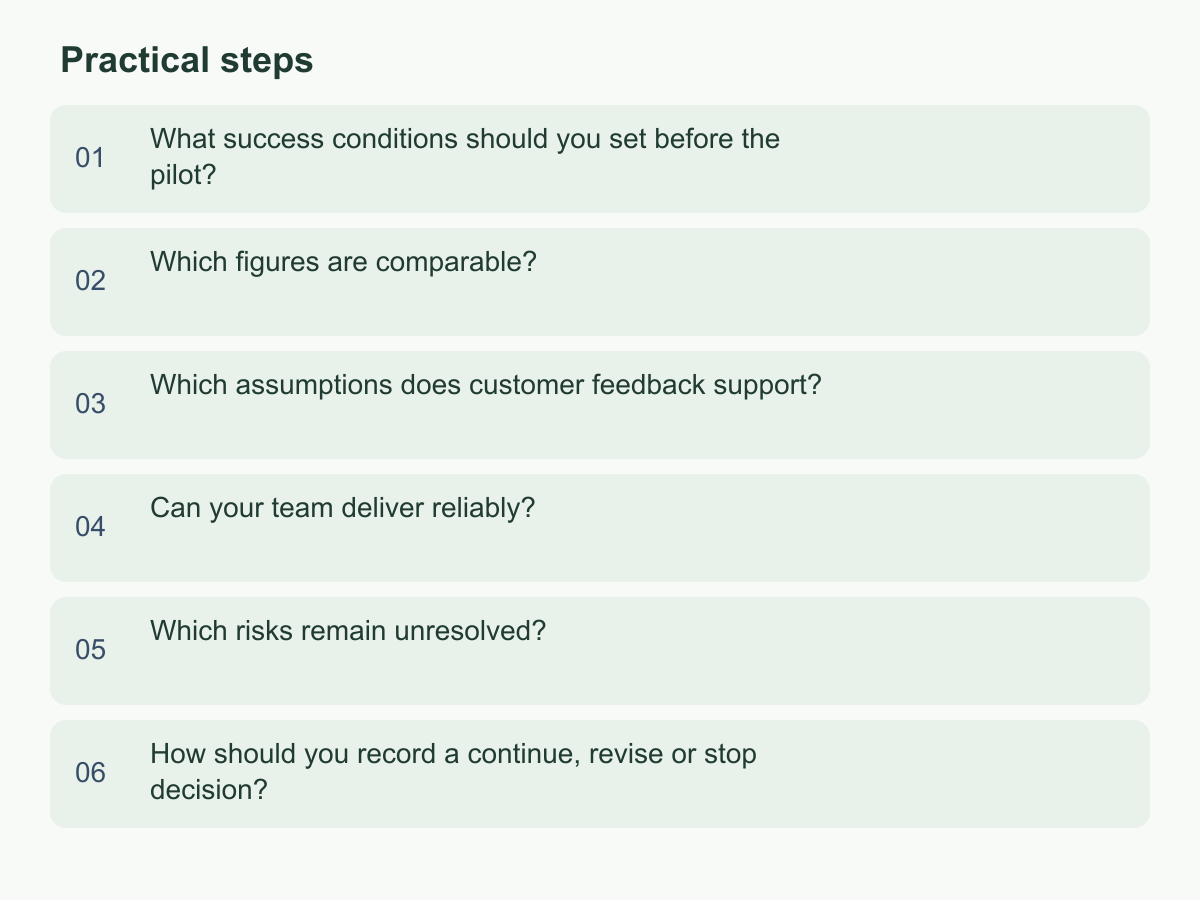
What success conditions should you set before the pilot?
Before testing begins, define success in observable terms rather than impressions such as “the market is interested.” Specify the target customer, situation, problem and action you want to validate. Track outreach, qualified demand, commitment and closed sales separately; clicks and enquiries are not orders.
Set a threshold, time window, data source and owner for every condition, and mark which are essential versus supporting signals. If the goal is to validate willingness to pay, weak evidence cannot be offset by impressions or reach. If the pilot may yield too few observations, agree in advance on any extension, its duration and maximum additional interviews or spending.
Use a consistent cost definition covering research, localization, logistics, support, returns and internal staff time, not just advertising. State delivery limits such as customers served per week, response times and minimum quality standards. Identify stop triggers. Save assumptions and the decision date in a one-page record. If new information justifies changing a threshold, record why and when it takes effect instead of quietly moving the goalposts.
For example, to test whether a distributor will actively sell, require a named contact, a product briefing and a proposed first-order process. A reply saying only that they are interested is an early signal, not a sales commitment. Assign an owner and update date to each metric. Record seasonal or promotional conditions, preserve channel differences, and define which changes to the market, language or delivery still count as the same pilot.
Which figures are comparable?
Comparable figures use the same unit, time period and denominator, with consistent definitions across data sources. Define a qualified opportunity—for example, one matching the target customer, having a relevant need and involving a decision-maker. Specify whether conversion uses qualified prospects or everyone contacted as its denominator; do not switch definitions midway.
Show the original target, actual result, gap, trend and data completeness together. Flag one-off events, duplicate contacts and missing records. With a small sample, show raw counts and effort per result instead of presenting a percentage as a stable market pattern. Compare results separately with the pre-pilot baseline and other customer groups or channels.
Count staff time, discounts, fulfillment, support and rework alongside cash spending. If the baseline and pilot periods differ in length, compare rates such as qualified contacts per week or staff hours per qualified opportunity, while retaining original totals. Check whether records use the event date or the entry date. For shared costs that cannot be allocated reliably, label them estimates and state the allocation method.
The illustrative figures below are internal planning units only, not market benchmarks:
| Metric | Pre-pilot threshold (assumed) | Pilot result (assumed) | Reading |
|---|---|---|---|
| Qualified demand interviews | At least 12 | 14 | Met |
| Verifiable purchase commitments | At least 3 | 2 | Not met |
| Direct staff time | No more than 80 hours | 92 hours | 12 hours, or 15%, over |
| Internal cost points | No more than 100 points | 96 points | Met |
Here, interviews and cost points met their thresholds, but commitments fell short and staff time exceeded its limit. Averaging the four measures into “mostly successful” would hide unmet conditions. Check for missing records and investigate the overrun before deciding whether a narrower retest is justified. Higher total volume alone does not show improved efficiency; compare added effort with added results.
Which assumptions does customer feedback support?
Compare each interview or transaction with the assumptions set before the pilot instead of sorting feedback only into praise and criticism. Record the person’s role, use case, problem frequency, current workaround, decision-maker, budget signals and evidence of a next step. Mark unavailable information as unknown rather than guessing.
Classify each finding as supported, contradicted or not yet tested. Check whether themes recur across customer groups and interaction types. A polite compliment, willingness to receive information, a scheduled evaluation and a paid trial indicate different levels of commitment; they are not interchangeable evidence of buying intent. If support and counterevidence coexist, look for differences in industry, company size, procurement process or urgency, then form a narrower testable hypothesis.
Choose the next question that best distinguishes between explanations: ask the person to rank the problem, describe the cost of the current workaround, identify who approves a purchase, or see whether they invest time in a next step. One rejection does not prove the whole market lacks demand, and one sale does not establish widespread demand. Note source bias when feedback comes from personal contacts or a single channel.
Link each conclusion to a de-identified record and date. Remove identifying details while preserving meaning, and keep raw transcripts separate from summaries. Look for counterexamples for each assumption: did the customer change their current approach, involve a buyer, or explain a delay? Confirm that people raising the same issue are in the target group before treating a common problem as sufficient commercial demand.
Can your team deliver reliably?
Demand does not prove that the current team can deliver consistently. Break each engagement into lead generation, presales, contracting, setup, delivery, support and payment follow-up. Record the responsible role, waiting time, rework and customer dependencies, then compare actual effort with the estimate.
Separate one-time founder effort from repeatable capacity. If every new customer needs a senior person to rescue delivery, apparent order growth may increase risk. To estimate next-stage capacity, subtract committed work, maintenance and a buffer from available staff time, then use observed hours per unit of work. Do not count hiring or outsourcing that has not happened as available capacity.
Check lead times, quality, response speed, payment milestones and third-party dependencies against the agreed minimums; include rare but time-consuming exceptions. If one step is the bottleneck, define a limited correction—narrow the scope, defer a type of request or prepare an operating guide—and assign an owner and measure. Do not expand before demand is stable or promise more than the team can fulfill to collect more observations.
Continuation requires deliverability and repeatability: different team members should follow the same process and meet the quality standard before expansion. A simple capacity table can show each step’s owner, standard and actual time, handoffs and blockers. Separate delays caused by time zones, language support or partners from issues the team controls, and estimate the effect if no one can take over. Check that normal operations can maintain their usual quality; pilot overtime is not sustainable capacity. Treat proposed hires, contractors and systems as pending resources until they are in place.
Which risks remain unresolved?
For each risk, record the trigger, likelihood and impact, observable warnings, mitigation, owner and acceptance deadline. Consider unresolved questions from the pilot: how customer data moves, whether a partner can deliver on time, whether payment processes work, how returns or after-sales support will be handled, and whether local rules need professional confirmation.
Mark legal, tax, privacy or transaction questions as needing verification, and have an appropriate professional confirm them. Do not treat unverified statements as rules. Sort risks into those testable in another round, those controllable by limiting scope, and unacceptable stop conditions. For a high-impact risk, define a clear trigger and fallback: for example, do not accept certain data until responsibilities are confirmed, limit customer numbers until support is ready, or avoid promising a timeline without a backup for a critical supplier.
A verbal assurance alone, or a risk without an owner, resources or evidence, leaves it unresolved. Record residual risk: what could still happen after mitigation, who bears the consequences and when it will be reviewed. A risk may not require stopping immediately, but it should shape the next step’s scale, customer group, commitments and budget. Meeting a demand threshold cannot offset an unacceptable safety or delivery risk.
When important conditions remain unknown, a short, limited retest with an exit condition may be better than declaring the market viable or expanding broadly. Name a decision-maker and action owner. Keep contingency plans for low-probability, high-impact events even if they did not occur during the pilot. If external conditions are unconfirmed, set boundaries—for example, refuse a particular payment arrangement or delivery commitment until reliable information is available—and tie each to a trigger, the evidence needed to remove it and a review date.
How should you record a continue, revise or stop decision?
Make the conclusion verifiable at the next review. Include the record version and date, scope, original thresholds, actual results, evidence sources, unmet conditions, risk status, decision, owner, resource limit and next checkpoint.
For a decision to continue, state which conditions were met, how you will address those still unmet and when you will review progress. For a revision, identify whether you are changing the customer group, message, channel, delivery scope or pricing assumption, and limit how many variables change at once so you can identify what drove improvement.
A stop decision should record its evidence, unproven assumptions, handoff arrangements for committed customers, and how data, partner relationships and spending will be closed out. Stopping a pilot does not prove the market has no demand. Assign one owner and date to every action. Set continuation boundaries: what must be achieved to enter the next stage, which risk pauses the work, and who may approve spending above the limit.
Have the decision-maker, delivery team and anyone receiving customer handoffs confirm the same version. Link source evidence and preserve dissenting views with their supporting data. If another test is needed, specify the smallest question that could change the decision, sample needed, deadline and cost cap. When evidence does not justify continuing or stopping, run a limited revised pilot and set its final decision date before it begins.
Keep the scorecard, source records and next review date together, with an owner responsible for updates before the deadline. Preserve options considered and why they were rejected. Record changed thresholds or data definitions in a new version with the reason and effective date; do not overwrite the baseline. If decision-makers disagree, document each view’s evidence and name who makes the final call. Afterward, check whether the evidence answered the original question and retain useful metric definitions for the next pilot.
For official information about Chan & Chung, visit the English homepage.