
A new-market pilot is a bounded way to answer a question that could change your next decision. Set a total cap, release funds in stages, and define evidence and stop conditions before spending. This keeps scattered costs from being mistaken for market validation and preserves options while information is incomplete.
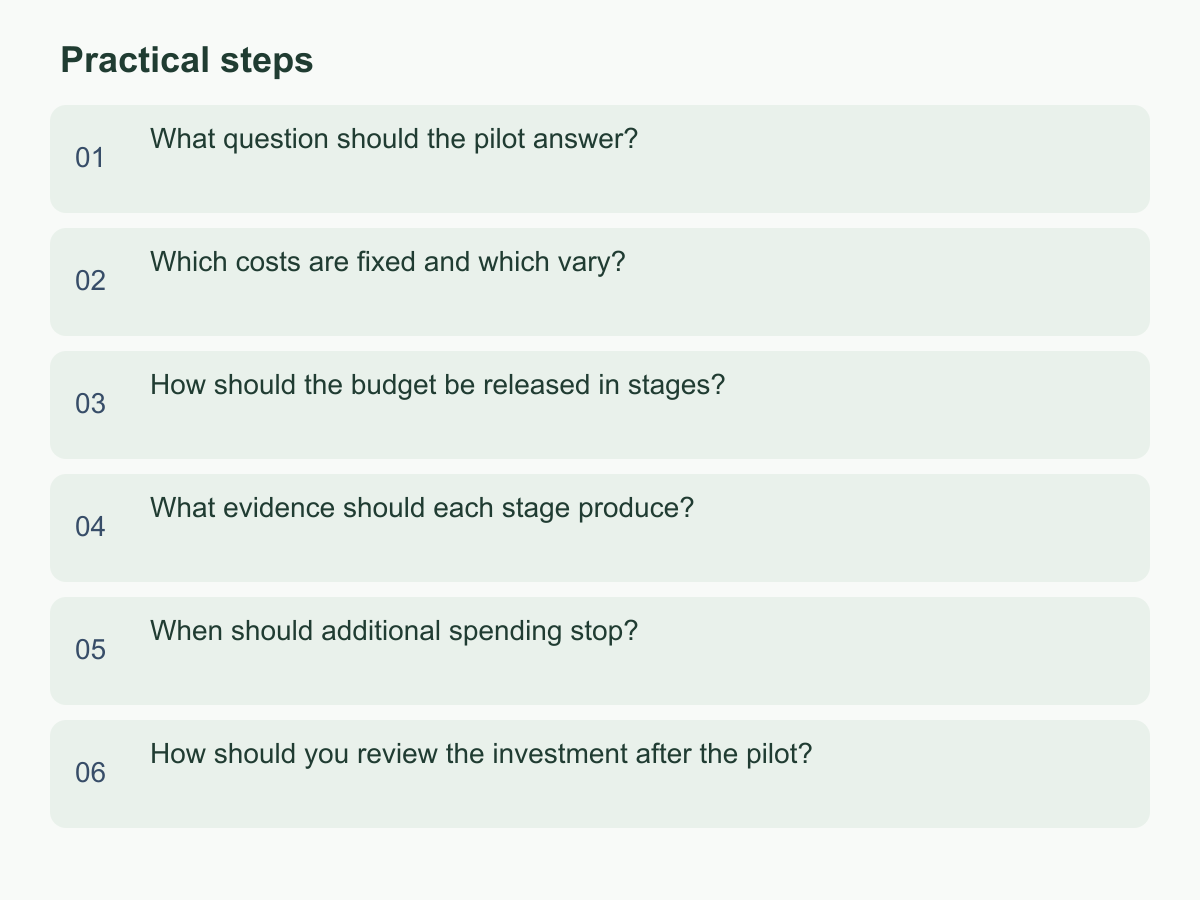
What question should the pilot answer?
Turn “we want to enter” into one falsifiable question and one action that fits the business model: share process information, discuss a quote, or complete a small paid test. Do not combine awareness, traffic, enquiries, sales, and long-term revenue; they occur at different distances from purchase.
Define the market segment, product version, customer-reach route, and observation period. Specify industry, company size, role, or use case; “all overseas-expansion businesses” is too broad. Keep the version stable during interviews so responses remain comparable.
Write the hypothesis and countercondition: “If we offer this solution to this buyer, they will take this action by this date; otherwise we will not expand investment.” Count qualified replies with a next step, not polite conversation or unrelated clicks. State what a positive result unlocks, what a negative result stops, and how many extra observations are allowed if evidence is insufficient.
For example, a hypothetical Taiwanese B2B software company tests whether mid-sized Malaysian retailers need inventory integration. Over six weeks, it asks target-role buyers to schedule a workflow discussion—a test of willingness to proceed, not annual revenue. Define eligible companies, outreach owner, valid replies, and end date in advance.
Which costs are fixed and which vary?
Separate new pilot costs from existing fixed costs. Setup may include market information, localized materials, a test page, or samples. Variable costs may include recruitment, advertising, shipping, travel, production, or commissions. These are cost categories or external options. Request quotes for the actual scope, not unit prices alone. Existing staff time may not add cash spending, but record hours, owner, and delayed work.
Separate paid, nonrefundable amounts from unpaid commitments and cancellable bookings. For each line, note estimate source, owner, timing, and cancellation status; use a range when quotes are uncertain. Keep the reserve uncommitted until approved. For different currencies, record the conversion assumption and who bears changes.
This hypothetical classification totals NT$180,000; it is not a market quote:
| Item | Amount | Basis |
|---|---|---|
| Interviews and prospect-list preparation | NT$25,000 | Recruitment and notes |
| Localized content and samples | NT$30,000 | Preparation and shipping |
| Channel test | NT$45,000 | Small media or partner test |
| Delivery process rehearsal | NT$35,000 | Staff and external costs |
| Tracking and tools | NT$15,000 | Additional pilot costs |
| Contingency reserve | NT$30,000 | Necessary changes, after approval |
| Total | NT$180,000 |
How should the budget be released in stages?
Treat the cap as a boundary, releasing only the minimum needed after each stage supplies agreed evidence. Name an owner, deadline, deliverable, and missed-target action for every release.
Under the illustrative NT$180,000 cap, release NT$45,000 for exploration, NT$63,000 for outreach after qualified demand, then NT$45,000 for a quote, sample, or delivery rehearsal after a buyer agrees to a next step. These stages total NT$153,000; hold NT$27,000 for a separately approved reserve, making exactly NT$180,000.
| Release point | Amount | Condition |
|---|---|---|
| Exploration | NT$45,000 | Problem, audience, route defined |
| Demand validation | NT$63,000 | Qualified positive replies recorded |
| Process rehearsal | NT$45,000 | Buyer agrees to next step |
| Reserve | NT$27,000 | Purpose documented; approved separately |
Each allocation is a ceiling. If exploration uses NT$32,000 and answers the question, do not roll the unused NT$13,000 forward automatically. Record the variance and require the original gate. Before committing, check cancellation terms, delay, alternatives, and worst-case loss. Reassess changed quotes, audiences, or timing; name the approver and evidence required, and never transfer funds quietly.
What evidence should each stage produce?
Choose evidence that tests the hypothesis: recurring problems and impact in interviews; qualified replies, meetings, trials, or quote progress in demand testing; and staff hours, dependencies, errors, and buyer feedback in a delivery rehearsal. Impressions and clicks can diagnose outreach but do not establish willingness to buy.
Before starting, define “qualified prospect,” “valid response,” “next step,” and the observation window; record the denominator, channel, and segment. For response rates, count eligible contacts whose messages were delivered and exclude invalid details. For interviews, retain the question, date, respondent’s role, and source notes to identify recurring signals.
Suppose the illustrative target is 12 qualified buyer interviews in six weeks and four workflow demonstrations. Three agreements miss the threshold; they do not show that one quarter of the market wants the product or establish a conversion rate. Review role fit, list source, consistent invitations, and reasons for no next step. Then revise the proposal, allow limited observations, or close under the stop rule. Twelve is a management target, not a representative sample.
At each milestone, record target, result, source, gap explanation, remaining budget, and recommended action. Note sample counts and missing data. If qualification or tracking failed, label the result insufficient, not positive or negative market evidence.
When should additional spending stop?
Set stops before spending. Stop expansion if, by the deadline, enough qualified prospects were contacted but the next-step threshold was missed. Pause if forecast exceeds cap, delivery depends on an unavailable resource, or data cannot be obtained reliably and lawfully. Seek professional input on regulatory questions.
If the sample, list, or tracking is inadequate, or the proposal changes mid-test, label the result inconclusive. Allow one correction window: name a single factor, budget, deadline, and exit action. Changing the audience, product commitment, or channel creates a new hypothesis and needs a new estimate; the old threshold cannot validate it.
Review actual costs, commitments, and headroom daily or weekly. Set triggers for a forecast near the cap, a material overrun, or a delayed milestone. When triggered, stop new commitments and report why. Approve changes only within scope and if the next decision remains useful; silence is not approval.
If only one buyer proceeds from 12 valid interviews against the four-demo threshold, stop the next channel round, summarize reasons, and close the test. If a faulty list yields five interviews, pause, correct the source, and use approved funds to fill the gap only if results remain interpretable. Do not continue because money is spent.
How should you review the investment after the pilot?
At close, separate actual costs into paid, committed, cancellable, recoverable, and unconfirmed amounts. Add internal hours and delayed work. Compare each budget line and approved change with actual spending; explain variances such as remade samples, poor list quality, or extra delivery hours. Reporting only paid costs hides commitments and reusable assets.
Mark each hypothesis supported, unsupported, or insufficiently evidenced; include sample, source, period, and deviations. If calculating cost per qualified meeting or trial, define numerator and denominator. A small pilot’s unit cost describes this test, not a larger-rollout forecast. For reusable materials and workflows, note applicable scope, maintainer, and update needs.
Choose one decision: stop and archive, revise one factor and test again, or submit a separate expansion plan for approval. Record evidence, open questions, owner, and next review date. When stopping, list settled expenses and outstanding commitments. Keep reusable process materials distinct from market and channel judgments; assign a maintainer and update date. Do not make expansion automatic because time or money was invested.
To begin, put the hypothesis, total cap, three release points, required evidence, and stop threshold on one page. Ask cost owners to check estimates and commitments, then record the next decision. Learn more about Chan & Chung at the official website.