
Product names, specifications, units, and images may be scattered across spreadsheets, warehouse systems, and marketplace back offices. Teams then find conflicts: one record says “box,” another “piece”; an old image remains on a sales page; or a discontinued item is copied into a new listing. The remedy is to define one authoritative source per field, assign maintenance responsibility, and set release checks. This is a general guide to master records, conflict resolution, and update sampling. All examples are hypothetical. Start with one product and one update cycle; record sources, roles, channel readbacks, and error handling so the approved value, owner, and completion point are clear.
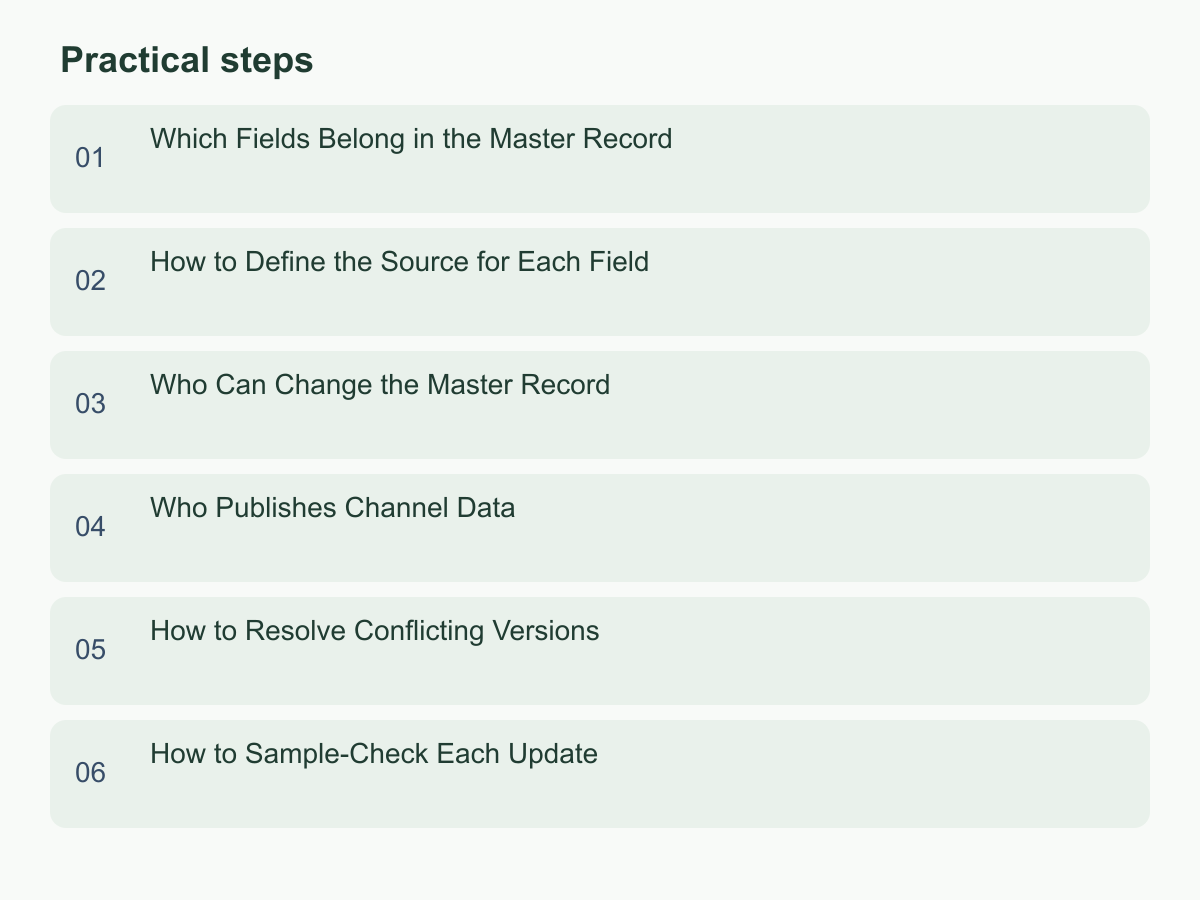
Which Fields Belong in the Master Record
Keep reusable, traceable product facts in the master record. Start with five groups: identifiers, sales details, assets, status, and channel data. Identifiers include a stable internal product ID, approved name, model, and variant. Sales details include unit of measure, units per pack, dimensions, weight, and price fields. When prices vary by channel, record the source or rule instead of treating one figure as universal. For images, note filename and version, source or license, replacement date, and main or contextual use. Status should be draft, available, paused, or discontinued, with an effective date. Discontinuing is not deleting; historical orders may still refer to the item. Channel fields can include marketplace IDs, listing status, channel-specific copy, and restrictions.
Before adding a field, ask which decision it supports. Include fields that affect purchasing, fulfillment, presentation, customer support, or auditability. For example, a travel mug sold singly and as a two-pack needs a separate sellable ID and pack quantity for each option. Do not describe the two-pack only in its title while sharing the single-unit barcode and shipping specification. Record dimensions as length, width, and height with units, not simply “medium.” Where colors use controlled codes, separate the standard color name from the marketplace display name. Link parent and child IDs so each child identifies an orderable variant. Retain the creator and last-updated time. Use controlled values such as “not applicable” or “pending confirmation” when information does not apply or is unknown, so a blank is not mistaken for an omission or zero.
How to Define the Source for Each Field
For each field, document its definition, format, authoritative source, maintainer, permitted overrides, update date, evidence location, and exception handling. Use approved product identity data for the name; an approved version or supplier data for specifications; packaging checked against the actual fulfillment unit for sales units; the approved asset library for images; and an operations decision with effective date for status. The team must identify where each record lives and who owns it; software is not automatically authoritative. Marketplace titles, promotional prices, and search terms may differ by channel, so keep them as channel fields instead of shared product facts.
If supplier data conflicts with the physical product, mark the item pending confirmation, hold publication of the disputed field, and ask the product owner to decide from evidence such as packaging, a purchase order, or a measurement. Suppose a two-pack contains two bottles. Marketplace A calls it “two bottles in a set,” while marketplace B says “double pack.” If the quantity remains two, that is localized wording, not a specification conflict. If the package changes to three bottles, first create a new version or effective-date record, then update affected fields and channels.
Set precedence by field; the newest file does not always win. Add format checks, such as units with weights, fixed status options, and image links to approved versions rather than temporary desktop files. Record exceptions with evidence. If an authoritative source changes, note the switch date and when the old data stops applying so two rules do not run at once.
Who Can Change the Master Record
Separate access by risk. A small team can assign four responsibilities: data maintainer, approver, publisher, and reviewer. One person may handle multiple low-risk tasks, but another person should review high-impact changes. The maintainer proposes evidence-backed changes; the approver classifies them as shared facts, channel exceptions, or new versions; the publisher maps approved data; and the reviewer checks samples against the master record, marketplace page, and relevant fulfillment data. Name who may create items, change units or barcodes, replace the main image, discontinue a listing, or make urgent corrections subject to later review.
A routine copy edit may be recorded and released by the maintainer. Changes to specifications, pack quantity, price, image licensing, or sale status need approval first. Pause and escalate changes affecting safety, compatibility, or fulfillment. When someone leaves, changes teams, or ends a contract, remove unneeded editing rights and document the handoff and data owner. For example, a marketer who spots a missing color in a name can propose a correction, but should not change quantity per box based on an assumption; the maintainer attaches evidence for approval.
Record each change’s owner, time, old and new values, reason, and evidence location. This makes responsibility traceable and provides a path back to the last approved version instead of a guess from chat history. Keep a permissions table with proposer, approver, executor, and alternate; alternates follow established evidence and thresholds. Before formal access, have new colleagues rehearse a sample change, approval, and rollback.
Who Publishes Channel Data
A completed master record does not mean every marketplace is synchronized. Treat publication as a handoff with an input and readback. The publisher uses a channel mapping table to connect common fields to marketplace fields. Only approved items may be overridden by channel, such as title order, local wording, or a channel-specific promotional price. Before publishing, check product ID, variant, unit, image version, and sale status; confirm fields are not truncated, options map correctly, and images appear under the right product.
After release, inspect the buyer-facing page or an operator-accessible product record. A successful export or clicked save button does not prove the listing is correct. If a platform cannot accept a field, document the conversion and owner. Treat manual entry as error prone and increase its sampling frequency.
Suppose a blue travel mug has an option called “Color” on marketplace A and “Style” on marketplace B. Use the mapping table to send the blue value to the corresponding field. If marketplace B cannot preserve image order, record its main-image rule as a channel exception; do not change the approved asset-library order for one channel. For a rejected listing, record the platform response, corrected field, and resubmission result. If the master record is ambiguous, return it to maintenance rather than create a lasting parallel version during publication.
The handoff is complete when visible values are checked on every affected channel and each remaining difference has a reason and reporting owner. The mapping table should include source, transformation, format limits, publisher, and reviewer. Attach a change-record number and list affected channels for each batch. If one channel is unfinished, mark it pending and notify its owner; do not report partial completion as full synchronization. Changes to the product definition still need master-record approval.
How to Resolve Conflicting Versions
Classify a conflict as a source fact, channel presentation, synchronization delay, accidental edit, or unrecorded change; the newest timestamp alone does not settle it. Pause pack-quantity disputes and have the product owner decide from verifiable evidence. Translated titles or promotional prices can remain controlled channel exceptions if they follow channel rules and do not change the product promise. For a delay, inspect the latest release and readback before retrying, since repeated overwrites can create more versions. Record the disputed field, candidate values, evidence, decision-maker, scope, effective time, and channels needing correction.
Suppose the master record says two items per box while marketplace B shows one. Check the latest approved packaging version and mapping. If the mapping confused “number of sets” with “number of individual units,” correct it and republish. If the physical package changed to one unit, create a new effective version and assess how unfulfilled orders should be handled. Keep the change history and note which channels were corrected; where needed, pause or discontinue the listing while the information is resolved.
If facts remain unconfirmed, pause the affected information and name an owner and expected confirmation time. Do not guess. Set an internal decision deadline or escalation route based on operational risk; this is not an external requirement. For a high-impact item, consider hiding the disputed information and alerting customer support and fulfillment so they can answer open questions consistently. After a decision, notify affected roles of the new value, applicable channels, republication order, and completion report. Keep the reasoning so the same criterion can be applied to similar cases.
How to Sample-Check Each Update
Check data accuracy and whether it reached every affected destination. After each update, the publisher compares changed product IDs and fields with the master record, then checks affected marketplace pages. A separate reviewer samples high-risk fields and channels with recent errors. Include new products, specification or quantity changes, image replacements, discontinued or restored items, and mapping changes. Choose samples by impact: check all items when only a few changed; for larger batches, stratify the sample and give high-risk changes more attention.
For each sample, verify product identity, specification, unit, image version, status, and channel exceptions. Record the result, discrepancy, person handling it, and completion time. If an error appears, check the same field across the batch, correct it, and recheck the affected scope.
For example, a batch has 12 updated products: 3 with changed pack quantities and 9 with description-only edits. The team could check all 3 quantity changes, then sample description changes by channel and product category. This is risk-based sampling, not a fixed ratio. Add recurring errors to the field dictionary, mapping table, or handoff checklist so the next cycle relies less on memory.
As a first step, select one product sold on several marketplaces. For six review fields—product identity, specification, unit, image, status, and channel exception—name the source and owner, then review one recent update. Record date, product ID, channel, fields checked, comparison source, result, and any corrective-action link. Extend the review across the batch for copy errors, and to all items until bounded for unit, specification, or status errors. Periodically review recurring errors and fix field definitions or mapping steps that require frequent manual handling, rather than compensating with larger samples every time.
For more information, visit the Chan & Chung website.