
To organize a cross-border company’s monthly close, put the period in scope, data owners, internal cutoffs, and review time on one shared calendar. Set dates according to when information is available and how the team is divided. The schedule should show who submits what and when, whom to contact if something is late, and what must carry into the next period. These are internal planning dates, not statutory deadlines.
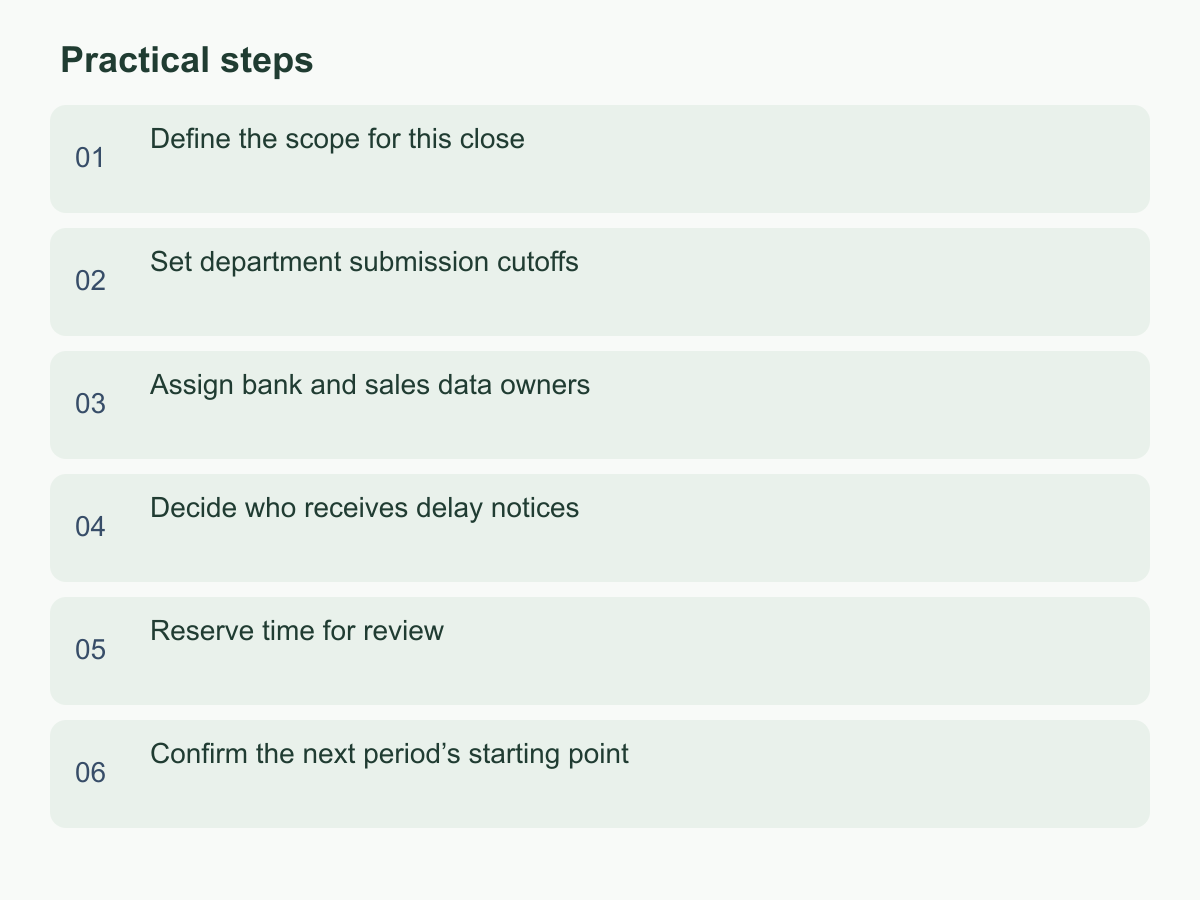
Define the scope for this close
Before scheduling, define this period’s boundary: the entity, month, transaction assignment basis, currencies, and included sources. Cross-border teams may have multiple entities and platforms, so list bank accounts, payment platforms, sales channels, expense sources, payroll, and intercompany balances. Bank posting dates can differ from platform transaction dates. Apply the company’s existing accounting basis; flag uncertain dates and name who will decide instead of asking submitters to guess.
Separate items to process from those awaiting confirmation. For a missing transaction description, a mismatch between an amount and its source, or a settlement file not yet received, record the known source, the person tracking it, and the person authorized to decide next steps. Keep open items visible. For multiple entities, use separate lists or tabs and state which side initiates and which checks intercompany items.
Define when the package is complete: every source has submitted, or a named contact has confirmed there was no activity. Test the list with one known transaction; check entity, period, currency, source, and status, then ask the reviewer to approve the format. For October, if Entity A has a Hong Kong dollar bank account, a US dollar payment platform, and two sales channels, list each separately. A row might read: Entity A | October | Platform A | USD settlement report | received. Record newly added or removed accounts, why, and the effective month.
Set department submission cutoffs
Set separate dates for initial delivery, follow-up items, and completed review. Base them on when sources become available and who prepares them. A report released only after settlement cannot reasonably be due earlier; a premature cutoff creates repeated missing-item updates. Fit the calendar to workload, holidays, and time zones. State its time zone and how cutoffs move when a date falls on a non-working day.
For example, an internal schedule could use:
| Assumed date | Milestone | Handoff | Owner |
|---|---|---|---|
| 2nd | First submission | Department records | Department contact |
| 4th | Follow-up cutoff | Missing items or corrections | Original submitter |
| 6th | Review complete | Differences and open decisions | Reviewer |
Show each step’s file location, naming rule, submission channel, and status. Keep first delivery separate from follow-up: the first shows whether information arrived; the second allows corrections and explanations. Anyone expecting a delay should notify the coordinator before the initial cutoff, stating why, the expected arrival date, and what can be shared meanwhile.
Work backward from availability. If a payment platform releases last month’s report on the fifth, the team might set initial delivery on the sixth, follow-up on the eighth, and review complete on the tenth. Those are internal examples, not external deadlines. If the sixth falls during a contact’s leave, name a backup recipient or move it to the prior working day. Log the old and new dates, the reason, and who was notified so a changed cutoff is not mistaken for completed work.
Assign bank and sales data owners
Assign submitters by source, rather than giving every file to the easiest person to reach. An internal finance or administrative contact with access to bank statements and payment records can assemble bank material. A sales or operations contact who knows orders, refunds, and platform settlements can provide sales data. Even where an external bookkeeper helps with posting, an internal contact should confirm the entity, period, and source: the external person may not know the business context.
For each bank handoff, identify the account, coverage period, currency, opening and closing balances, and payments or receipts that still need explanations. Use a source-identifying filename and short note instead of sending only a screenshot or an unclassified folder, and follow company access rules. The preparer checks the file against the list; the reviewer checks source coverage and whether the statement period has gaps.
Sales contacts should separate channels and flag refunds, cancellations, fees, and cross-period funds. Label the entity, channel, and period; mark each checklist item submitted, no activity, or pending. A no-activity confirmation distinguishes an intentional zero from a missing delivery. In the schedule, separate provider, preparer, and reviewer. If one person submits and organizes the files, name another reviewer. If no independent reviewer is available, mark the handoff pending and tell the coordinator instead of leaving the field blank.
Decide who receives delay notices
State in the calendar who receives delay notices, usually the close coordinator, the supplying department’s manager, and any reviewer whose work depends on the file. Avoid vague updates such as “still waiting.” Report the missing item, entity and period, source contacted, expected arrival, and any interim material. This lets the coordinator decide whether to move one check or revise review timing.
Track open items in a shared list, with one follow-up owner and a next update time for each. Use clear statuses such as awaiting submission, received and pending review, awaiting external response, and resolved. When a status changes, update the same record with the date and brief reason; private parallel trackers can show conflicting progress. If the amount or transaction treatment is uncertain, name the decision-maker. Tracking an item does not authorize the preparer to make that decision.
Assume a platform settlement file is expected two days late. Before the initial cutoff, its contact alerts the coordinator, shares the order summary already available, and gives the expected delivery date for the settlement file. The coordinator records which checks can start, which must wait, and when the reviewer will check again. If the estimate changes a second time, update the same item and notify its recipients. If no reply arrives by the team’s own escalation point, ask the department manager to decide whether to adjust the period’s schedule.
Reserve time for review
Reserve review time separately; the submission cutoff is not the close completion date. Estimate preparation time, then schedule an initial completeness check, a window to resolve differences and pending decisions, and a final confirmation. The first check compares submissions with the scope list: each source must be present or clearly marked no activity. Missing items remain open.
For differences, the preparer should attach the source, current understanding, and precise question. The reviewer can determine whether the company’s established basis is sufficient or a decision-maker must confirm. Currency, cutoff timing, refunds, and intercompany items should link back to original records and name who confirmed the treatment. If external accounting or bookkeeping support is involved, agree on the handoff files and response timing early, so both sides are not working from different versions.
At close, update the differences list, pending decisions, and file version. Reviewers should state what is missing; submitters answer each point and retain corrections. A named owner confirms the period’s status and open items. For example, if a bank statement differs from the internal payment list, log the date, amount, filename, and question for the original submitter. If the periods differ, check for missing pages or a cross-period item, then ask the authorized decision-maker to apply the existing basis. Keep the review open until the difference has a conclusion.
Confirm the next period’s starting point
At close, classify each unresolved item as carry forward, handed over, or confirmed no longer to track. Record the next step, owner, and next update date. Carry forward the source, known facts, and awaited response so the new month does not have to reconstruct the history; link resolved items to their outcome so recurrence is visible.
Before the next period begins, check for new accounts or platforms, changed contacts, planned leave, or a different way of obtaining data. Update the schedule version and applicable month. Confirm each submitter can still access the source and reviewers still have time. When people change, ask the outgoing contact to hand over file locations, naming, and common gaps. Review old cutoffs instead of copying last month’s dates: settlement cycles and team duties may have changed.
Pilot the calendar against the most recently completed month: list sources, submitters, initial and follow-up dates, reviewers, and delay recipients, then confirm each row with the team. Compare actual arrival times and reasons for waiting; adjust only cutoffs shown by experience to be unworkable. If a channel has released its report after the planned cutoff for two consecutive periods, record actual availability and move the next initial cutoff to a workable date while preserving time for follow-up and review. For changed accounts or contacts, record the effective month and handoff confirmation.
For more information about Chan & Chung, visit the English website.