
A good multilingual handover lets the next colleague continue from established facts instead of asking the customer to repeat information. Keep the original message, checked translation, steps already tried and questions still to answer in one case record. Separate the customer's words from internal summaries and unverified assumptions. The handover is complete when the recipient can take the next step.
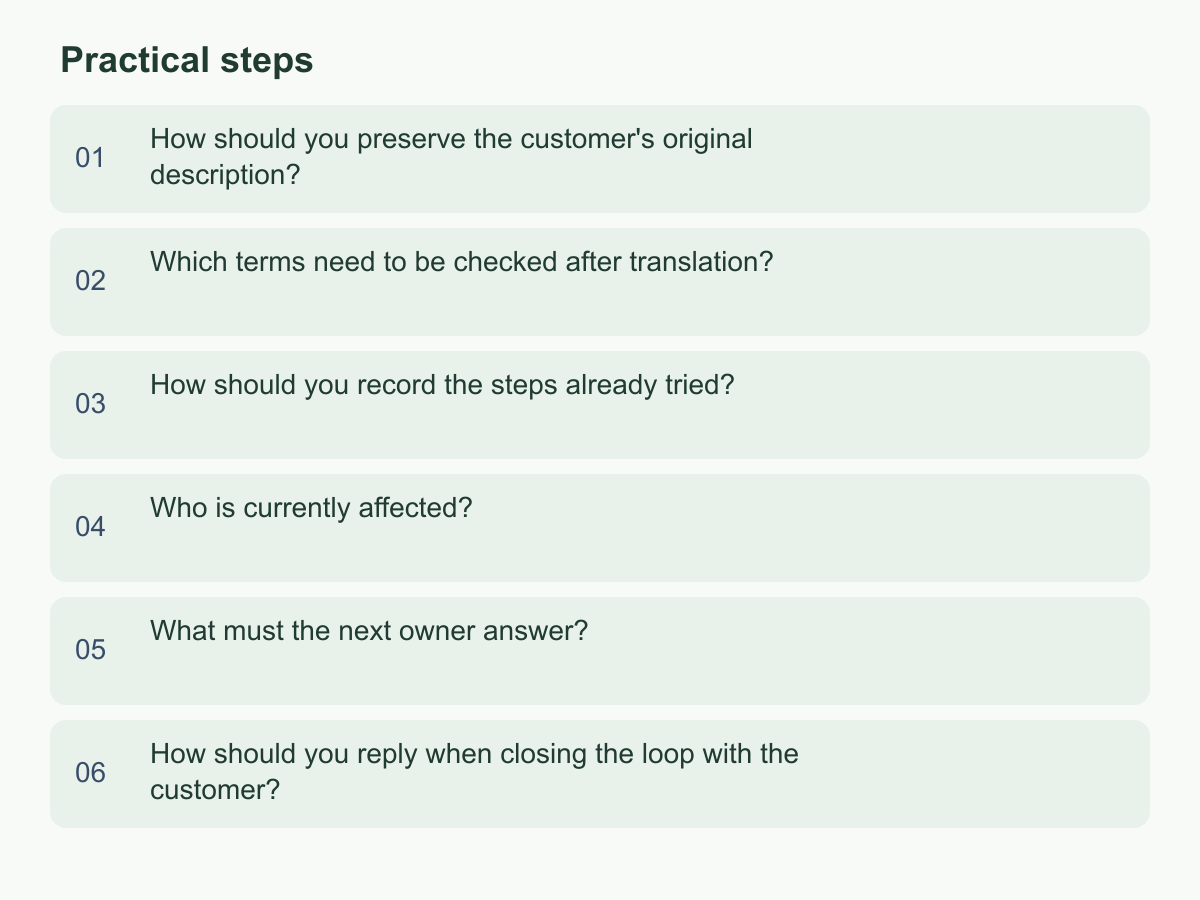
How should you preserve the customer's original description?
Keep the customer's actual words, not just the intake handler's rewrite. Save the original message or email link, received date and time with time zone, channel, attachment names and a controlled-access location. For chat, include the thread link and timestamps for key messages; a screenshot alone may lose context.
In a separate “Current understanding” field, restate the issue in one or two sentences and label it as an internal summary. For a voice message or image, link to the original file and note whether a transcription or text recognition was checked by a person. Preserve unclear names, model numbers and figures as received, marked “to confirm.” Include only information needed to handle the case; do not copy sensitive details into a broad group.
For example, if a customer says, “The amount has been deducted, but the recipient has not received it,” keep that as the original. Summarise separately: “The payment status and recipient's posting time appear inconsistent; whether they refer to the same transaction is unverified.” Do not call it a failed payment before checking.
The next handler should open the source and confirm the date, parties and surrounding messages. If the source is missing or inaccessible, record the blocker and ask the original handler for a link or summary instead of asking the customer to repeat the information. Keep customer words, internal summary and items to confirm distinct. For several messages, preserve their order and show which reply addresses which question. Identify the last customer-confirmed attachment version and date; for machine transcription, retain the source link and editor's name.
Which terms need to be checked after translation?
A translation does not replace the original, especially when wording could change responsibility, timing or the next action. Put decision-relevant sentences side by side in the source and working languages, and note who translated them and what remains unchecked. The translation should preserve negation, conditions, sequence and uncertainty, even when the wording is not literal.
Check amounts and currencies, dates and time zones, company or product names, invoice or transaction identifiers, error messages, units, and qualifiers such as “already,” “not yet,” “possibly,” “unless” and “still.” For example, compare “I have not received the revised file yet” with “I still have not received the revised file.” Confirm that “yet” describes receipt, not whether revision work has been done.
For ambiguous terms or internal expressions, record context and the question rather than choosing the smoothest wording. If the distinction could affect a customer decision, ask someone familiar with the language or subject to review both versions. Machine translation can help with comprehension, but does not verify the source. If review is not immediately available, mark the text “provisional,” quote the original and confirm it before promising a deadline, refund, responsibility or next step. Spend review time on decision-changing terms, not routine greetings. Preserve scope words such as “only,” “unless” and “before”; confirm names and figures from a source record rather than guessing. If translators disagree, keep both readings and ask the owner a specific question. Keep promises, requests and completed actions distinct.
How should you record the steps already tried?
Write each attempt so another colleague can reproduce it, rather than summarising it as “investigated.” Record the date and time with time zone, person, entry point or device, action, observed result and evidence location. Separate attempts made under different accounts, browsers or language settings because their conditions differ.
Use a status such as “succeeded,” “failed,” “not run” or “partially completed.” Preserve the exact error text or link to a screenshot, with unnecessary personal information removed. State the next step and its owner. If waiting on the customer, an external platform or internal access, say what is needed and from whom.
For example: “10:20 Taipei time; colleague A signed in again in a desktop browser; the prompt still reads [exact text]; screenshot link; another language version not tested.”
When information is incomplete, do only safe checks. Do not resend a payment, reset an account or change customer settings just to complete the list. If a result changes the conditions for the next step, record the new state and reason. Mark evidence for replacement if expired or inaccessible. Use explicit dates and time zones instead of “just now” or “tomorrow morning,” preserve error capitalisation and codes, and distinguish customer actions from staff actions. Put attempts in chronological order and make the latest entry state the current status.
Who is currently affected?
Separate “confirmed affected” from “possibly related,” with evidence for each. Identify which person, account, order or workflow is blocked, when it began and whether an alternative lets work continue. Check supplied identifiers against records available internally. Do not turn one contact's difficulty into a claim that all customers are affected; the absence of other reports does not prove only one person is affected.
To set priority, check whether work has stopped, whether there is a confirmed external deadline and whether a safe workaround exists without duplicate submissions or risky actions. Record answers with their source and time. Mark unknown scope “to confirm”; do not present an estimated number as fact.
For example, if a contact cannot export one data set, write: “This contact's current export is confirmed as blocked. The effect on other team accounts and later batches is not yet confirmed. Whether a manual copy is available remains to be checked.” This points to the next checks without implying a company-wide outage.
If several users are involved, record the known names or authorised scope without sharing personal details broadly. Note who supplied new information and when. State how current the evidence is, such as the customer's latest reply, an internal record checked at a particular point, or a source that remains inaccessible. Do not claim a cause, total affected count or restoration time without evidence, and do not infer severity from language, urgency or job title. Update the summary when the affected group changes, retaining the reason.
What must the next owner answer?
Name a next owner and a specific question; “please follow up” is not an actionable handover. Before assigning it, confirm the recipient can access the original record and attachments and has the needed language or process context. If they have not accepted, mark the case “awaiting acceptance.”
Useful fields include the fact to confirm, available options, actions that must not be taken yet, who can decide, the language for the customer and the next update time. Use an agreed time; if none exists, write “owner to confirm update time” rather than inventing a deadline. This hypothetical example turns open issues into checks:
| Field | Hypothetical entry | Question for the next owner |
|---|---|---|
| Known facts | Customer says the amount was deducted; recipient has not confirmed receipt | Is this the same transaction, and what evidence supports the answer? |
| Steps tried | Original message checked; payment not resent | Which safe source can confirm the current status? |
| Information needed | Transaction identifier not provided | Can existing records be checked, or is more information needed from the customer? |
| Customer update | No next update time agreed | Who will reply, and when can a definite update be given? |
Before transfer, the original handler should check that each question is answered or marked “to check,” each open item has an owner, and the customer knows the current status. If someone else has decision authority, list the precise options and their implications. After accepting the case, the recipient should confirm receipt and name the first item they will check, exposing missing access, language or responsibility early.
Check the original message and attachments before asking for the exact missing item; name the person who will review any outgoing translation. If an answer is still pending, record which sources have already been checked so the next colleague does not repeat the same search.
How should you reply when closing the loop with the customer?
A closing update should say which issue you understood, what was checked, what remains unknown and what happens next. Restate key facts in the customer's preferred language without presenting internal assumptions as causes. List completed checks and results. If unresolved, do not make the reply sound as though the case has been resolved: a handover confirms receipt by the next owner, not the outcome for the customer.
Ask only for information that could change the next action. Name the exact field needed, how the customer can provide it and what check it supports. Do not request details already in the record. If there is no definite answer yet, state what is confirmed, what will be checked next and when the customer will hear from you. Have the owner confirm that time; do not promise when an external organisation or platform will finish.
Before sending, ask someone familiar with the language to check figures, negation, dates and who is responsible for each action. Ensure “we are checking” has not become “the issue is fixed.” For example: “We checked the message you provided and confirmed that you said the amount was deducted, while the recipient has not yet confirmed receipt. We have not resent the payment and are still checking its status. Our next step is to check the records available to us and share the result once confirmed. If we need anything from you, we will list only the missing items.”
Save the reply and any commitment in the same case record so colleagues using different languages do not send conflicting versions. Every language version should reflect the same status and commitments, with one owner responsible for sending and logging it. For more information on Hong Kong businesses expanding overseas, visit Chan & Chung.