
When an overseas B2B transaction spans time zones, different payment terms, and partial payments, a single “total outstanding” figure rarely tells a team whom to contact or which invoice to address next. This guide uses one row per invoice or installment to standardize the aging start point, separate age from collection status, and turn example balances into a practical follow-up order. The dates, buckets, and review cadence are internal management choices, not statutory deadlines, universal standards, or promises of collection.
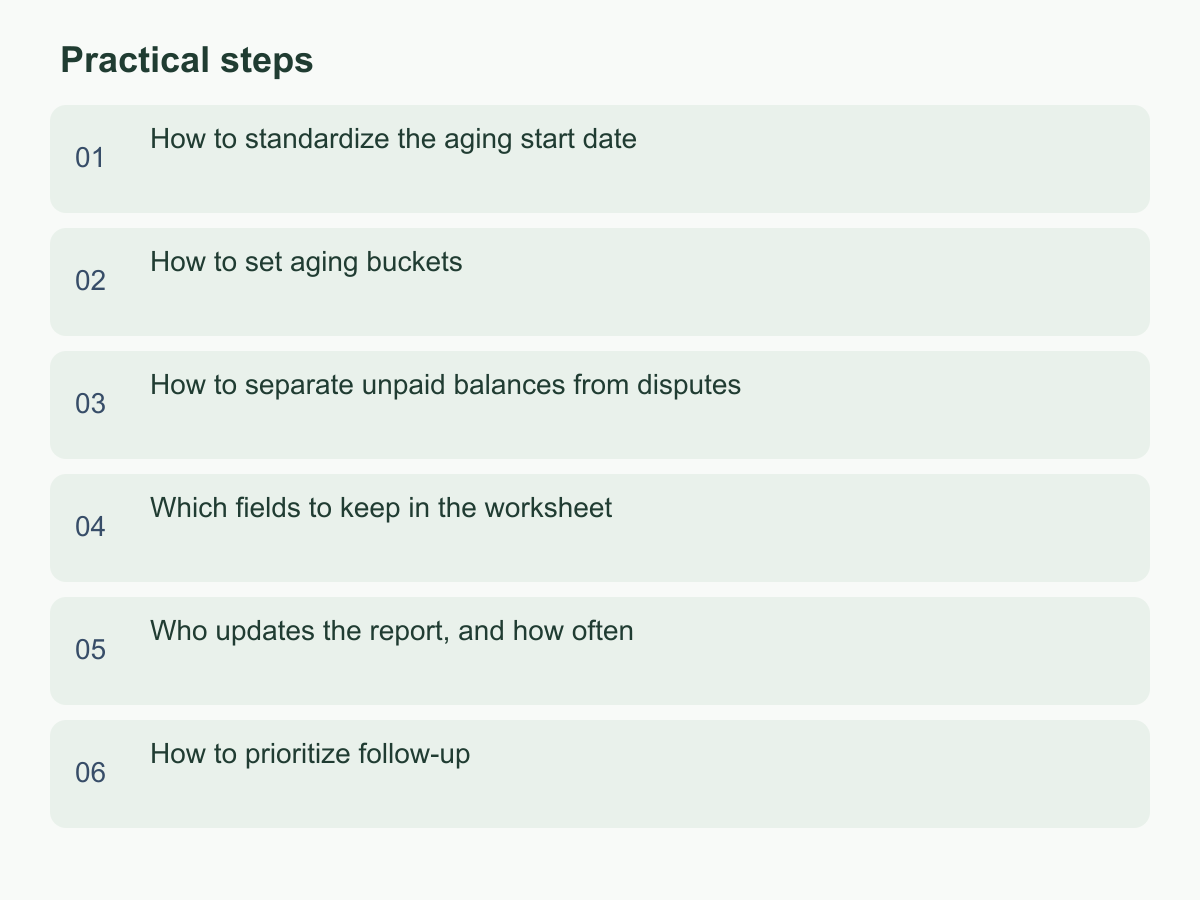
How to standardize the aging start date
Choose one reporting date and separately define the event from which each invoice is aged; the export date is not automatically the start date. An overseas B2B sale may involve shipment, acceptance, invoice issue, customer receipt, or activation of payment terms. If the contract says payment is due a set number of days after receipt, invoice issue may be earlier than the agreed start point. For month-end terms or payment after acceptance, retain the triggering event and a source record.
Use the contract, purchase order, or confirmed correspondence to enter payment terms, trigger, due date, and source document. Calculate days past due from the reporting date and due date as an internal convention, not a statutory deadline.
If records conflict, mark the invoice “Pending confirmation” instead of letting a spreadsheet guess. Record the date temporarily used, the reason, who will confirm it, and the next review date. For “a set number of days after month-end,” convert month-end into a verifiable date and apply one agreed rule; do not recalculate a different date whenever the report is refreshed. Choose a reporting time zone and use an unambiguous date format such as YYYY-MM-DD. If the due date depends on a closing cut-off, retain the invoice-received date and cut-off as source fields and document any manual correction.
For example, at an October 18 reporting date, an October 10 due date is 8 days overdue; an October 25 due date is 7 days not yet due. Use the same reporting date across the report so successive snapshots can be compared.
How to set aging buckets
Use the difference between the reporting date and due date to separate invoices that are not yet due, due today, and overdue. Then define buckets for the team, such as not yet due, 1–30 days, 31–60 days, 61–90 days, and 91 days or more. These are example management buckets, not legal deadlines, collection guarantees, or a standard for every industry. Adjust them for contract types such as longer acceptance processes, installment payments, or month-end terms.
Keep the raw number of days past due and map it to a bucket with a formula or fixed rule. State the boundary clearly: an invoice due today is “Due”; it becomes overdue the following day. This avoids inconsistent classification around month-end or holidays.
Buckets guide review cadence, not customer risk. Review payment patterns and give each bucket a distinct action: check documents before due date, confirm recent payments, and assign an owner to older balances. If one bucket stays crowded, investigate payment terms, delivery acceptance, or invoicing steps before adding more buckets. List each installment separately, and version bucket changes with an effective date. Start with fewer buckets; split them only when the change affects work or a management decision.
How to separate unpaid balances from disputes
Aging answers “how long since the due date?” Status answers “what is happening now?” Keep both. Common statuses include not yet due, due and unpaid, partially paid, payment promised, dispute pending, and closed. For an agreed credit, refund, or credit note, update the outstanding balance and link the supporting record.
A dispute does not necessarily apply to the whole invoice. If a customer questions one quantity or part of a delivery, record the disputed and undisputed amounts separately. Check evidence for the disputed portion while confirming payment arrangements for the rest.
A promise to pay is not a receipt. Record the promised amount and date, the person making the commitment, supporting message, and follow-up owner. Reduce the balance only after funds arrive and are reconciled internally. If the customer sends a remittance notice but the money has not arrived, mark it “Payment in transit / pending reconciliation,” not closed. For partial payments, record the receipt date, amount, and invoices credited; list unallocated cash separately to prevent duplicate credits.
Keep the time and person responsible for status changes, especially when a dispute is resolved, a promise is extended, or a balance is written off. An invoice can be both overdue and disputed, so status must not replace its aging bucket. Make the next action specific: who will do what, and by when. Define each status’s entry and exit criteria and evidence: a received amount and remaining balance for partial payment; scope, date raised, and owner for a dispute; amount and date for a promise. If payment is not visible, verify the payer, currency, receiving account, and transfer details before closing.
Which fields to keep in the worksheet
Use one row per invoice or installment. Create a unique key from customer code, invoice number, and currency. Record the customer name, sales owner, invoice date, receipt or acceptance evidence, payment terms, due date, reporting date, and days past due. Keep the original-currency invoice amount, amount received, credits or adjustments, and outstanding balance. For multi-currency review, retain the source amount for comparison with customer payments and bank receipts. A consolidated view can add a converted amount with its exchange-rate source and date, clearly marked as management analysis.
Add the aging bucket, status, disputed amount and reason, promised payment date, last contact date, next action, owner, source-document location, and last updater with timestamp. This checklist covers the minimum working set:
| Field group | Minimum contents | Purpose |
|---|---|---|
| Identity and terms | Customer, invoice number, currency, due date | Find the transaction and its agreed basis |
| Amounts | Original-currency balance, received amount, credits | Reconcile invoice and receipts |
| Age and status | Reporting date, days overdue, status | See timing and current stage |
| Ownership and action | Owner, last contact, next-action date | Keep work assigned |
| Evidence and updates | Document link, updater, update time | Trace changes and supporting records |
Make sure the summary leads back to searchable evidence. Do not put passwords, full bank details, or unnecessary personal data in a shared worksheet. Define who may change formulas, update receipts, and approve closure. Protect or centrally maintain formula fields, use fixed input choices, and periodically compare invoices, receipts, and balances. Keep field names stable and include the reporting date in exports for reliable handoffs.
Who updates the report, and how often
Assign one person to maintain the master worksheet, with updates from people closest to each event: sales records customer replies and promises; finance or the collections operator checks receipts, credits, and balances; the delivery owner supplies acceptance or dispute evidence. This is an example division of work, not a required organization chart. A small team may combine roles, but should identify who reports, verifies, and confirms closure. Avoid separate copies. Map input sources to worksheet fields; if an amount or date conflicts, mark it for reconciliation and preserve the original value.
Use “update when an event occurs, plus a regular review.” Record new invoices, disputes, changed promise dates, receipts, and approved credits as they happen. Also review open balances weekly or monthly according to transaction volume; this is an adjustable example, not a universal frequency. Each review should confirm that balances reconcile, the next action was completed, and overdue days use the same reporting date.
If a promised payment has not appeared by its expected date, first check whether it is in transit or receipt information is delayed, then contact the customer. Do not simply move the promise date to the next week. Record the reporting date, responsible people, decisions, and deadlines, and assign a backup during absences. Use one sorted list; for each item, ask whether the data is reliable, what is blocking progress, and who will act by when. For teams across time zones, agree on the reporting time zone and retain the source message’s original time or zone. If receipt or delivery evidence is unavailable, mark the item pending and assign an owner and deadline instead of leaving it blank.
How to prioritize follow-up
Consider amount, time overdue, and immediate actionability separately, then account for promises and disputes. The oldest invoice is not always the easiest to resolve: missing evidence may need to be supplied, while an undisputed portion may already be ready for payment confirmation. A simple team priority order could be: first, overdue, higher-value balances with enough information to reconcile; second, invoices due soon or with an approaching promise date; third, not-yet-due invoices with incomplete documents or acceptance steps. This is a work queue, not a credit score; overdue days alone should not trigger the same message to every customer.
The amounts and day counts below are hypothetical, and all three balances are in U.S. dollars. The outstanding total is $12,000 + $8,000 + $6,000 = $26,000. Invoice one is 45 days overdue with $12,000 outstanding, including $2,000 under review for a quantity dispute. Compile delivery records for the disputed portion and confirm payment arrangements for the undisputed $10,000. Invoice two is 12 days overdue with $8,000 outstanding; the customer has promised an initial $5,000. The balance remains $8,000 until receipt is reconciled. Record the promised date, verify payment when it arrives, and confirm arrangements for the remaining $3,000. Invoice three is 2 days overdue with $6,000 outstanding; first check whether payment is in transit, then send a standard payment reminder. Work on the other balances can continue while invoice one’s dispute is being resolved.
For each follow-up, record the owner, contact method, question to resolve, and next review date. Log the result and adjust status and priority when the customer replies, raises a new dispute, or supplies receipt evidence. Start with three to five open items for the week, check each against source documents, assign an owner, and enter the next-action date. At month-end, review causes of delay and adjust term records or handoffs where needed. For more information about cross-border business, visit the Chan & Chung website, and start by assigning an owner and next-action date to the three highest-priority items.