
Overseas B2B outreach can come through events, partner introductions, or direct prospecting. When a team records only closed deals, it cannot tell which channel produced worthwhile conversations or what those conversations cost. A bounded pilot makes the comparison more useful: choose a consistent target group, track company-level leads, agree on a qualified response, and set spending and time limits before contacting anyone. Treat the result as a small operational signal, not a forecast of future sales.
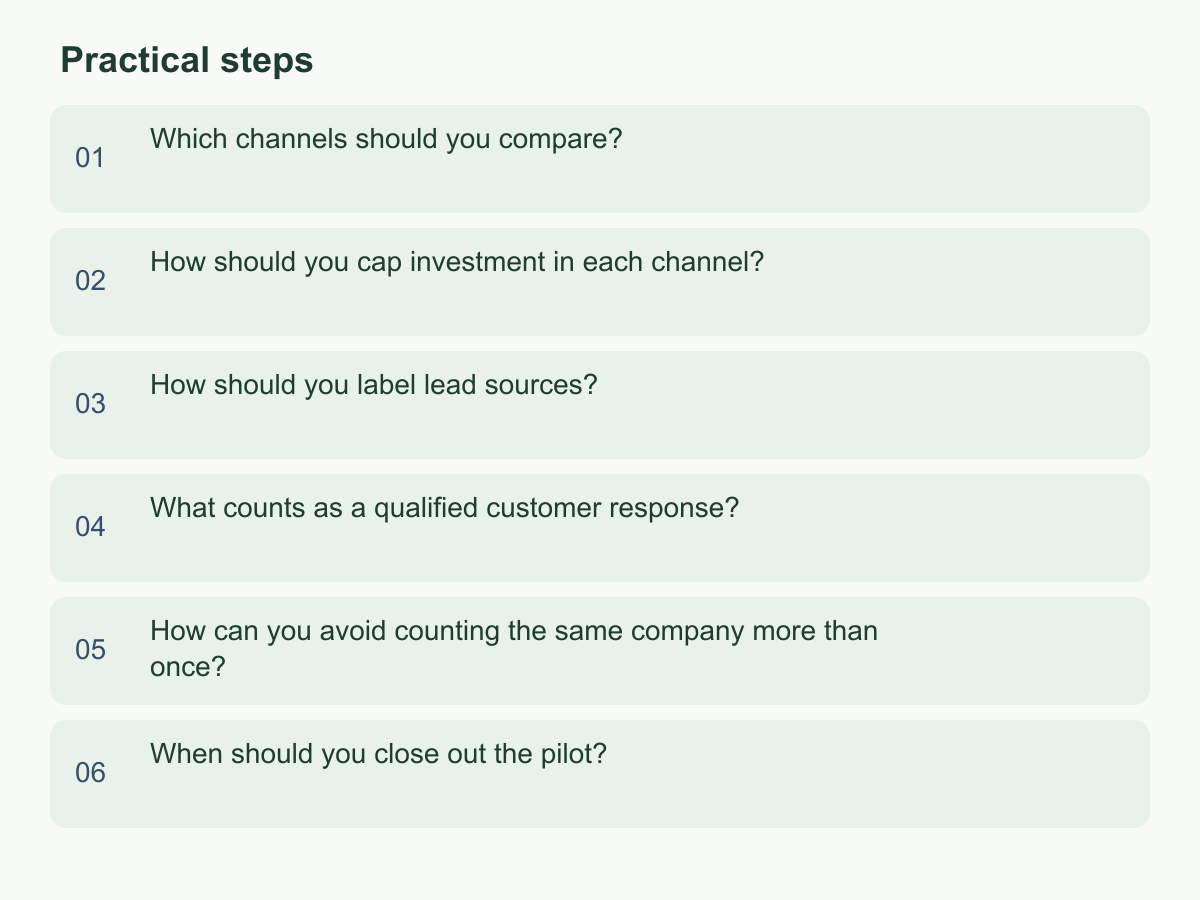
Which channels should you compare?
Choose two or three channels and define each by the first traceable way a target company learns about you. Event outreach includes invitations and follow-up; partner referrals record the introducer and agreed handoff; targeted outbound begins with a predefined company list. If testing search content or a lead-list platform, label each separately and specify the first contact that creates an identifiable inquiry. An event visit, business card, or sent message alone is activity, not a useful conversation.
Hold target geography, company size, buyer role, offer, and observation window steady where practical. Change one main condition at a time so audience or pitch changes do not confound channel results. Give each channel an owner, list, and follow-up process, then work in small batches. If the list is too small, label results exploratory. Write a one-sentence hypothesis for each channel and rate access to target roles, list control, expected reply time, and third-party dependence high, medium, or low. These are planning judgments, not measured results. Include preparation time and keep batch sizes and observation windows reasonably comparable.
How should you cap investment in each channel?
Set the maximum affordable loss if the pilot makes no sale. Count cash and hours: event tickets, travel, lodging, preparation; referral coordination and materials; outbound data, tools, writing, and follow-up. Apply one internal hourly rate to staff time, add direct costs, and state exclusions. Cap budget, hours, contacts, or leads per channel. Stop new spending at the cap but finish existing follow-up. Past spending is no reason to continue; no-fee referrals still use staff time.
Illustrative figures use one cost basis and exclude sales revenue.
| Assumed channel | Pilot investment | Qualified responses | Investment per qualified response |
|---|---|---|---|
| Event outreach | NT$12,000 | 3 | NT$4,000 |
| Partner referrals | NT$6,000 | 3 | NT$2,000 |
| Targeted outbound | NT$3,000 | 1 | NT$3,000 |
Calculations: NT$12,000 ÷ 3 = NT$4,000; NT$6,000 ÷ 3 = NT$2,000; NT$3,000 ÷ 1 = NT$3,000. With zero responses, record “no computable unit cost yet”; do not divide by zero. Referrals look cheapest, but this tiny sample proves no ranking. Report staff time and response quality separately; if staff time is excluded, label the metric “cash cost.” Audit caps (one event or weekly hours) and log expense dates and purposes. Separate initial pilot effort from ongoing maintenance.
How should you label lead sources?
Create a unique company identifier before outreach. Use the company as the primary record; keep contact names, roles, domain, and country separate. Record discovery source, first-contact channel, date, lead creator, event or referral code, consent status, and current stage. Use standard values—event, partner referral, targeted outbound, search/content, external lead-list platform—and a notes field. A tool’s name is not itself a channel; the introducer is not the customer source.
Separate data origin from the contact that prompted a reply. Record whether a company came from a directory, event list, partner, or paid database; for partner leads, retain the introduction and follow the agreement. When compiling a list, note when and where it was found without copying unnecessary personal details. One spreadsheet owner can check blanks, duplicate companies, and unknown sources daily; label missing data “unknown,” never guess.
Keep “lead source” and “contact channel” as distinct fields: origin versus first actual invitation. Add event-batch or partner codes, define company-name normalization, and verify domain, country, entity, and office before merging. Collect only necessary business data, limit access, and follow team policy and local contact and retention requirements.
What counts as a qualified customer response?
Define an observable qualified response before outreach. All three checks must pass: the respondent represents a company in the target group; the respondent or referring contact connects to a relevant buying, partnership, or decision process; and the reply names a specific need, suitable timing, next step, or relevant person. This separates a real business conversation from a click, card, courtesy note, or booking alone.
A reply agreeing to discuss a defined overseas-market need at an agreed time can qualify. “Thanks for your email” or “let’s stay in touch” without a topic or next step is general. A bounce, rejection, or unrelated request does not qualify. Someone saying the offer is unsuitable may still provide a qualified referral if they identify the responsible colleague and how to reach them; mark it as not yet an opportunity. A response is not a sale.
Count companies, not emails: log each contact, but count one company once. Report contact totals separately if useful. Review borderline cases weekly, mark disputes “pending” with a reason, and keep general, declined, bounced, and pending out of the qualified count. Post positive and negative examples beside the rule. Requests for materials remain general until a specific issue or discussion is identified; record the date the status changes.
How can you avoid counting the same company more than once?
One company may encounter content, meet you at an event, and later get a partner introduction. Crediting every channel with the full result inflates totals. Use the company as the primary unit, retain individual contacts, and define attribution before outreach: first verifiable channel is “first touch”; a later channel that helped prompt a reply or meeting is an “assist.” Show them separately and never add assists to first-touch totals.
Support first touch with dated evidence: an event list, introduction message, or sent email. If origin is unverifiable, mark “source unclear,” not the latest contact. Choose one pilot window, such as four weeks from first touch. Record later replies as delayed, without changing a locked comparison. Before merging, compare domain, country, offices, and contacts. Keep subsidiaries separate when buyers and purchasing processes differ; flag uncertain matches for review.
At closeout, report deduplicated companies, unclear sources, and replies outside the window. Ideally, keep one company master and a dated row for each contact, channel, and evidence reference. A single sheet should include company key, first-touch channel, assisting channel, and latest contact date; check possible matches after every list import. This shows overlap and later channel contribution without double-counting.
When should you close out the pilot?
Close when planned contact batches and observation window are complete; an early sale does not end the comparison. Set dates, per-channel company limits, budget and staff-hour caps, and a reply period after the final contact. Settings are pilot-specific. Example: three weeks of outreach, no new names after week three, follow-up in week four, then close after the reply period.
Extend a weak channel only for a stated reason—unsafe contact, poor leads, or an exceeded cap. If extending, record why and apply the same rule to comparable channels. At closeout, complete records, resolve duplicates, and verify classifications. Compare qualified responses, cost per response, meetings or concrete next steps, and sample size. With small or mismatched samples, choose “worth retesting,” “pause,” or “revise and retest”; low cost may still produce poor-fit responses. One pilot cannot prove a general result, so change one main variable next round.
Stop early if the list is invalid, contact data is wrong, or a cap is exceeded. Log the reason and spend so an incomplete test is not recorded as zero. Put the channels, shared audience, caps, four source fields, and response rule in one sheet; set the first review date. For more information about Chan & Chung, visit the English homepage.