
After an overseas B2B contract is signed, the common gap is not that nobody starts work; it is that sales and delivery may understand the promise differently, or delivery lacks needed information. Kickoff turns outcomes, owners, dates, dependencies, and open questions into a shared baseline. This checklist uses an international client and multi-department project as its setting and can be adapted by consulting, agency, or enterprise service teams. Each commitment should point to a source, owner, and next action, so the next person knows what to do and how completion will be recognized.
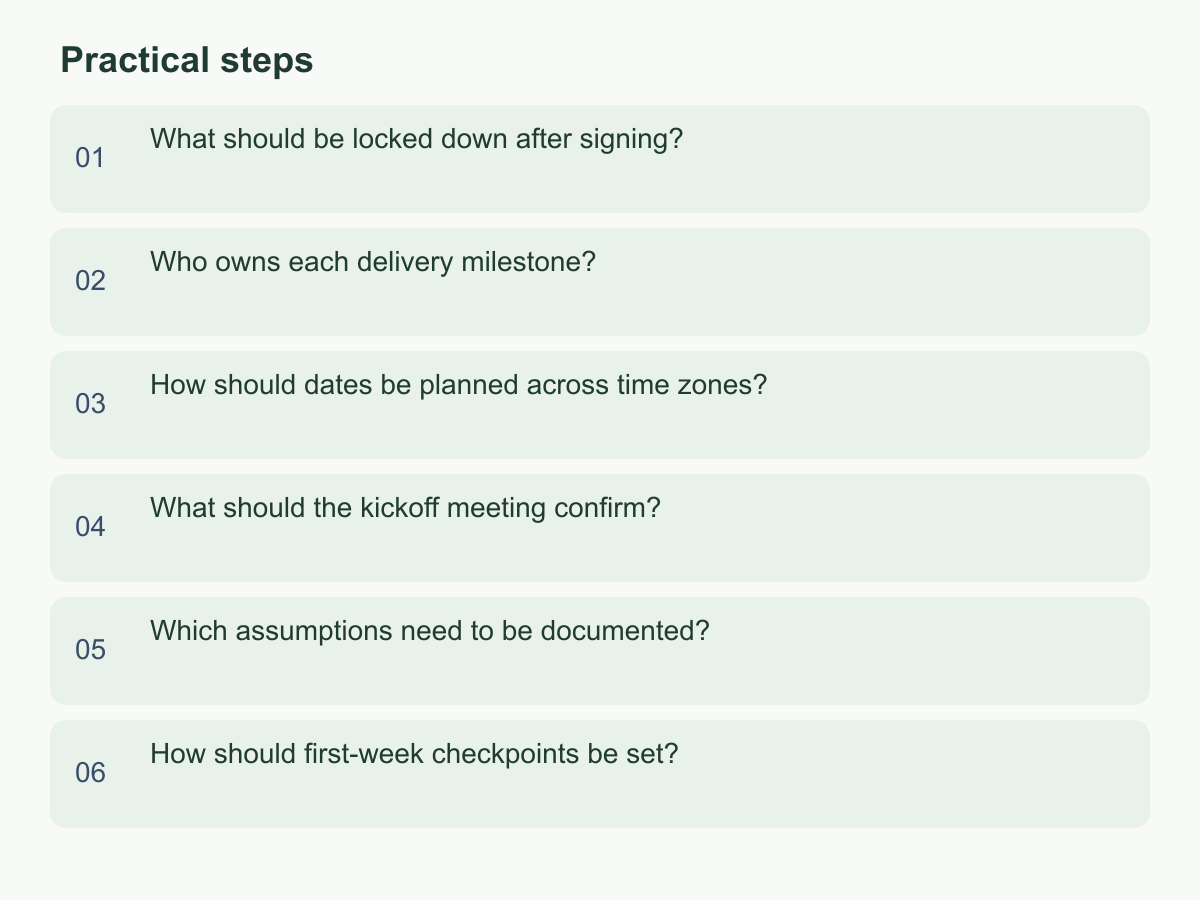
What should be locked down after signing?
Create an execution baseline; do not treat the sales presentation as a complete handover. Sales and the delivery lead should check signed documents, the latest statement of work, promised outcomes, delivery formats and acceptance method, client inputs, dependencies, key dates, and anything discussed but not recorded. Note each item’s source, version, and confirmer. If an attachment, presentation, and email conflict, preserve the difference and assign someone to resolve it by a stated date. The delivery team should not choose a version itself.
Classify inputs as confirmed, awaited, or needing clarification. For confirmed items, provide an accessible link and usable version. For awaited items, note the provider, needed-by date, and work blocked by delay. For questions, record the question, decision-maker, and response date. For example, if the client supplied brand assets but two product-specification versions exist, inventory the assets but do not produce from either version until the client identifies the baseline. Mark affected milestones. Keep any mismatch between a verbal promise and written scope open; it does not quietly become a commitment.
The handover is ready when the next owner can answer: What are we delivering? How will completion be judged? Which inputs are missing? Who decides? What cannot start? Keep the summary, source links, and decision log in a shared location with a maintainer. Mark gaps pending instead of guessing. Record each update’s date, change, and reason. Both sides should review the same version before kickoff; note when the delivery lead confirmed receipt.
Who owns each delivery milestone?
Assign one accountable owner to each milestone. The owner moves work forward, reports status, and raises blockers. Also name the executor, input provider, approver or confirmer, and people who only need updates. Roles may include sales, project management, product, design, engineering, a client contact, or procurement. Small teams can combine roles, but each milestone needs a clear final confirmer. Name a backup and alternate contact route if the owner is unavailable.
Break the plan into checkable work, rather than broad outcomes such as "launch the website." Each row can show the deliverable, executor, owner, confirmer, dependencies, target date, status, and completion evidence. Treat client assets, internal review, and third-party access as separate milestones, with a provider and recipient who confirms receipt. This reveals where a delay occurs. If departments disagree, the owner should take options and their effects to the decision-maker; a majority of replies is not approval.
For a content project, sales might own commercial handover, a project manager coordinate the schedule, the client contact confirm materials, an editor produce a draft, and a brand lead approve wording. This is an example, not a fixed organization chart. For each deliverable, verify who produces it, supplies inputs, approves it, and receives it. Ask incoming owners to confirm their names and authority. Identify missing approvers before scheduling. Handover is complete when the delivery lead acknowledges receipt, identifies gaps, and assigns follow-up—not merely when sales forwards files. Keep one clear client response contact, even when internal work is distributed.
How should dates be planned across time zones?
Work backward from the client’s requested outcome date. Put prerequisites, reviews, and buffers on one calendar, showing the working-day calendar, time zone, and time for every deadline. Confirm meeting invitations in both parties’ local calendar times; "by Friday" or a date without a time zone is ambiguous. For client-dependent work, identify the responder and time zone, and state how a late reply affects the next milestone. Name the time zone and verify the conversion in the invitation.
This example shows the counting logic, not a standard delivery speed. T0 is Monday, when both sides confirm the project is ready to start. Count business days only, assume no public holidays, and use the client’s location for all deadlines. Leave one business day between adjacent milestones for handover and checking.
| Milestone | Illustrative deadline | Calendar basis | Prerequisite |
|---|---|---|---|
| Kickoff inputs complete | T+1 business day | Client location | Client contact uploads materials |
| Requirements confirmed | T+3 business days | Client location | Project manager consolidates questions |
| First draft delivered | T+5 business days | Client location | Specifications are confirmed |
| Feedback consolidated | T+7 business days | Client location | Designated approver responds |
For the actual plan, mark immovable client meetings, internal reviews, and cross-border holidays first. Schedule live discussions where needed; give asynchronous reviews a clear deadline. If work arrives after a team’s day ends, start counting from the next agreed working window, not the message’s send time. Check that inputs precede dependent work, approvals precede production, and owners are not double-booked. Record the calendar time zone, owners, and rescheduling process. When dates change, update the schedule version and notify affected people, not just meeting attendees.
What should the kickoff meeting confirm?
Use the meeting to confirm decisions and ownership, not reread the agreement. Send the baseline, milestone list, open decisions, and draft schedule beforehand. Identify who must bring answers and who can approve. Align on the goal and success criteria, then confirm scope, inputs, acceptance evidence, dependencies, dates, communication channels, and the change process. For unresolved items, record options, decision-maker, and schedule impact. If the meeting cannot settle one, name who will answer and by when.
A practical agenda covers goals and outcomes; roles and contacts; delivery order; client-provided items; cross-time-zone arrangements; risks and escalation contact; and the next checkpoint. Ask both sides to explain what “done” means for each deliverable. For example, specify whether it is an editable file, who reviews it, and how feedback is returned. Rewrite ambiguity into observable terms. Replace “as soon as possible” or “when the client is satisfied” with a deadline or acceptance step. Do not record an unconfirmed point as a decision.
Before closing, read each action aloud: task, owner, deadline and time zone, required input and provider, and milestone affected by delay. The note-taker should send a decision summary so absent departments have the same record. Participants may flag errors within an agreed window; silence is not automatic approval. Keep items awaiting the client’s internal confirmation pending, with a follow-up owner and date. A useful meeting leaves actions owned, open items with a resolution path, and the first work ready to begin. Link decisions affecting scope or sequence to relevant milestones.
Which assumptions need to be documented?
Record any premise that could affect scope, quality, timing, or responsibility. Examples include input completeness, language or market version, asset rights, third-party system access, the client response contact, final approver, acceptance evidence, and prerequisites. For each, capture who raised it, its current basis, affected milestone, confirmation deadline, and verification method. Label team expectations as assumptions, not client commitments. This prevents unverified assumptions from becoming task-card facts.
Suppose an overseas client has not named a local-language proofreader. The team might use the client’s designated contact to consolidate feedback as a temporary scheduling assumption, but should ask the client to confirm that person and their response time. If confirmation misses the agreed date, the owner should explain affected outputs and offer ways to adjust the plan. Do not appoint an approver for the client or quietly transfer proofreading to the internal team. If the client’s need changes, record the new information, who confirmed it, and its effective date. Then assess whether order or timing must change and use the agreed change-confirmation process rather than revising an oral commitment in chat.
A four-column log can track assumption, validation, impact, and decision: state the premise; name who will verify it and by when; identify what may be blocked; then record the result and next action. If the result differs, link affected tasks and schedule and notify relevant people. Revisit open assumptions at kickoff and each checkpoint. Mark one confirmed only after verification. If its date passes without evidence, update the owner and deadline. Keep validation status visible so uncertainty can be managed without overpromising.
How should first-week checkpoints be set?
Use the first week to check whether handover, roles, and communication support real work, not to maximize output. Set three checkpoints: at the start, confirm access, materials, and owners; after the first batch, check quality, dependencies, and response cadence; before week’s end, have the delivery lead summarize completed, in-progress, blocked, and pending items. Follow both parties’ working days rather than assuming a Monday start. If the first week is shorter than a full workweek, state which days it covers. Inspect an artifact or record at each checkpoint, not just a claim that work is underway.
Walk through one small deliverable that represents the wider process. Confirm who supplies its input, how files are named, who reviews them, where feedback goes, and how revisions are versioned. If requirements conflict, access is missing, or an approver is unknown, record the blocker, effect, and owner. Decide whether unaffected work can continue; do not bypass a key confirmation to manufacture progress. If a problem recurs, make a process change, such as adding a missing field or using one feedback channel, and have relevant people confirm when it starts.
In the first-week review, use three statuses: completed, with evidence; in progress, with next action and date; and blocked, with the needed decision and escalation contact. Update milestones, assumptions, and dates afterward. Close resolved items and keep an owner on anything awaiting external input. If the baseline changes, mark the new version and notify affected departments. Before moving to the regular project rhythm, confirm the next-stage goal, owner, and nearest decision date. As a next step, name a delivery lead, add these six checks to the kickoff page, and complete the first source-document review. To learn more about Chan & Chung, visit the official website.