
Cross-time-zone B2B opportunities move through emails, meetings, and requests for information. A record that says only “contacted” or “waiting for the customer” leaves the next person unsure what happened, who should act, or when. Make each interaction an actionable commitment: what happened, what each side agreed to do, who owns each action, the deadline in the relevant time zone, and how to reassess if conditions change. Names, dates, and scenarios below are illustrative. The aim is a verifiable next step after every exchange.
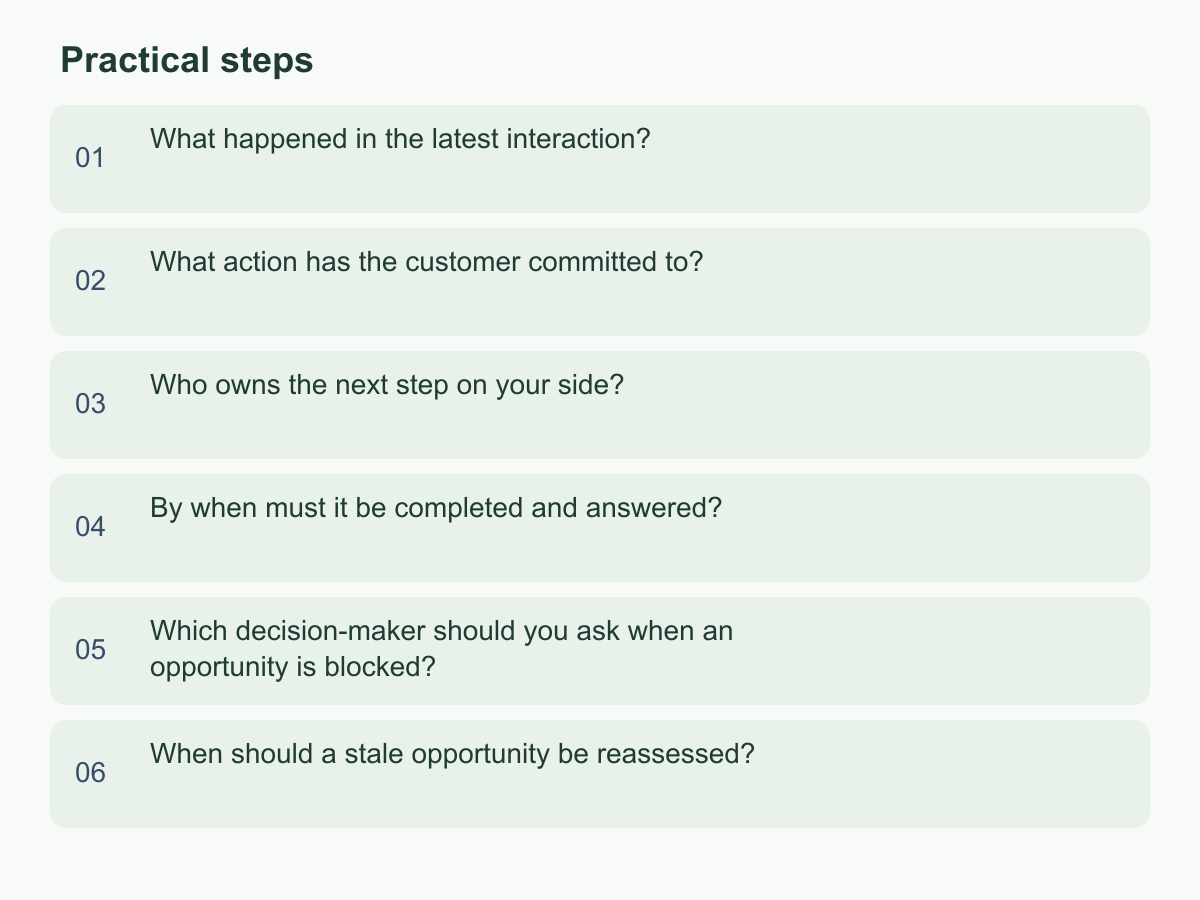
What happened in the latest interaction?
Do not record only “meeting held” or “email sent.” Include date and time zone, participants and roles, channel, customer questions, confirmed conclusions, and unresolved points. Separate the customer's words from your interpretation. If the customer says, “We will assess the budget internally before month end,” note that neither a purchase nor an approver has been confirmed.
Organize meeting notes under background, issue, decision, and open question. For email, keep the subject or document name and key response rather than pasting a long thread. With multiple time zones, choose a team-wide reference zone and include the customer's local time: “20 October 2026, 16:00 Taipei / 09:00 London,” not “Friday afternoon.”
Ask whether a colleague who was not present could identify the customer's problem, current decision, and next unanswered question. If not, add specifics. If a trial account cannot invite a finance colleague, record where the error occurred, who is affected, and whether a workaround exists—not simply “technical issue.”
For meetings with several agenda items, record each decision, who raised it, and who must confirm it. A recording or transcript does not replace a searchable summary. For amounts, specifications, or dates, note whether the customer supplied them, both sides confirmed them, or your team estimated them, and identify the document version. Keep corrections with their time and confirmation source. Separate distinct items: the customer approved a Taiwan warehouse for planning but has not supplied an address; the technical contact will confirm the test date and is expected to reply Thursday.
What action has the customer committed to?
Describe a commitment as a deliverable, recipient, and deadline: who will provide what, by when, to whom, and for which decision. If the customer says they will send estimated monthly order volume by Wednesday so both sides can plan the first shipment, record the data, sender or team, date, and purpose. If they only say “we'll take a look,” mark that no commitment was made and set a time to ask whether they need more information.
Label dates as expected, committed, or pending confirmation. After the meeting, send a recap so the customer can correct any misunderstanding. When material arrives, record the receipt date and version, then check whether it answers the original question. If incomplete, name the missing field and agree on a new reply date. Never add words the customer did not say or treat silence as agreement.
If a commitment depends on a third party, such as Finance supplying a cost range, record the dependency and risk. Keep the customer contact accountable unless direct contact with that third party is arranged. When several customer colleagues must contribute, keep one external contact in the main record, list contributors separately, and note when the customer expects to assemble their input. If the customer says they can decide once material arrives, confirm who decides and what the decision covers. Sending a document is not approval; holding a meeting is not authorization. Ask an easy follow-up question such as “Is the estimated volume monthly or quarterly?” rather than “Any news?”
Who owns the next step on your side?
Assign one final owner to each action and list others as collaborators. The owner must be able to complete the action, update the record, and notify the customer when needed. A department name is not enough. Use three fields: action, sole owner, and evidence of delivery. For example, Mr. Lin, the sales contact, consolidates specifications with help from a product colleague. Mr. Lin remains responsible for the customer response; evidence could be the confirmation email or updated requirements list.
| Action | Sole owner | Evidence of delivery |
|---|---|---|
| Consolidate specifications | Mr. Lin | Confirmation email sent |
| Check feasibility | Product colleague | Annotated requirements list |
For leave, role changes, or regional workday differences, assign a backup and define the trigger, such as when the owner is away near a deadline. Avoid “team to handle.” List dependencies with their own owners and dates, while keeping the opportunity owner responsible for the customer commitment. Check that each owner can access information, contact relevant people, and represent the team; if not, reassign and hand over background, completed work, and open decisions.
Record the customer's contact name or role, location, time zone, and preferred channel. If their authority is unclear, make confirming the right contact the next action. Confirm the assignee's capacity and availability, deliverable format, acceptance, and progress-reporting method. Set an internal deadline before the customer deadline. If analysis and external communication have different owners, split them into two actions and name who takes over the second.
By when must it be completed and answered?
Record both the completion deadline and the reply deadline; internal preparation may need to finish first. Include the date, time, time zone, and working-day assumptions. If the customer says “next week,” ask for a specific date. Set reminders around the customer's working hours and allow time for review or corrections.
Suppose the Taipei team receives a specification question from a London customer on Thursday, 22 October 2026, and the agreed reply time is noon Thursday in London. The record might say: “Product owner: finish the check by Thursday 17:00 Taipei time; sales owner: send the answer by Thursday 12:00 London time.” Each line names an owner and time zone. If a date depends on information or a meeting, record the dependency and fallback—for example, “If the cost range has not arrived by Tuesday, ask Wednesday morning whether timing needs to change.”
Avoid “as soon as possible” or “follow up next week”; neither triggers a clear action. When a promised date changes, keep the original deadline and reason, then add the new date and who was notified. Do not overwrite the history, which shows whether work was late or the parties renegotiated. Update the opportunity record as well as calendar reminders so colleagues see the same deadline.
Check working days and local dates, including weekends and holidays. If work is due Thursday after a Wednesday review, confirm Wednesday is a working day for everyone. If time is tight, renegotiate scope or deliver in stages, stating what is ready and what remains unconfirmed. Do not turn an estimate into a definite answer to meet a date. If information is incomplete, commit to a status-update time rather than a complete answer you cannot control.
Which decision-maker should you ask when an opportunity is blocked?
First identify who can provide missing information and who can approve budget or risk. A senior title alone does not show who can remove the obstacle. Map the roles: user, technical evaluator, procurement or finance contact, and final approver. Mark each confirmed or unverified; do not assume the only known contact is the sole decision-maker.
Suppose a trial is complete but the customer cannot schedule purchasing. Ask what evaluation remains, who will confirm it, when the next internal discussion is expected, and whether additional material would help. If the customer cannot share a name, ask them to forward a neutral summary or invite the right colleague. Focus on removing the obstacle: “To prepare material that fits your evaluation, could you confirm the role responsible for acceptance and the expected decision date?” Do not simply ask the contact to “talk to the boss.”
If stakeholders disagree, record each concern, the difference, and the open question, then arrange a joint discussion instead of choosing for the customer. List someone as an approver only after confirming their authority and contact route. Until then, mark them as a possible decision role and add a verification question.
When a conversation slows, summarize what is known and missing, then ask one or two easy questions at a time. For an introduction, explain its purpose, expected time, and what information the new person will receive. Record each fact's source: technical agreement is not commercial approval. If the decision-maker has not attended, confirm who should join next and share a short agenda.
When should a stale opportunity be reassessed?
No reply does not mean an opportunity has failed forever, but it does not justify endless follow-up. Start with the customer's agreed date and your team's promised cadence. If it passes, record the last meaningful interaction, completed and open items, and missed-reply date. A draft that was never sent does not count as contact. Send one concise message to check whether priorities changed.
Set a clear reassessment trigger. For example, a team might review after two agreed reply dates pass without the information, the original need becomes outdated, or the customer's project is paused. This is an illustrative team rule to adjust to the sales cycle, not a universal standard. At review, choose whether to continue following up, move to low-frequency nurturing, pause, or close. Record the evidence, restart condition, and next review date.
If the customer says budget may be available next quarter, note the expected month and whether it is confirmed, then schedule a justified check near that time. Without a restart condition, avoid a weekly “just checking in.” Before reopening, verify that contacts, needs, and dates remain valid. Compare the original need and timeline with the current situation, marking what holds, changed, or is unknown. A low-frequency follow-up should have a reason; otherwise, wait for the review date. If you close the opportunity, record why and what would reopen it without presenting a guess as a customer rejection. Base each status change on information available at the time. If the customer reorganizes or the contact leaves, confirm a new contact before resuming the cadence.
Choose one active opportunity and fill in the latest interaction, customer commitment, internal owner, completion and reply deadlines, decision roles, and reassessment trigger. Then visit Chan & Chung's website for more information.