
An overseas B2B opportunity that does not close rarely leaves one definitive answer. A useful review separates verifiable buyer statements, unconfirmed causes, and changes that can be tested next time. Do not turn silence, a discount request, or a delayed decision into the presumed cause of a loss. The hypothetical examples below illustrate recordkeeping only; they do not describe an actual customer or outcome.
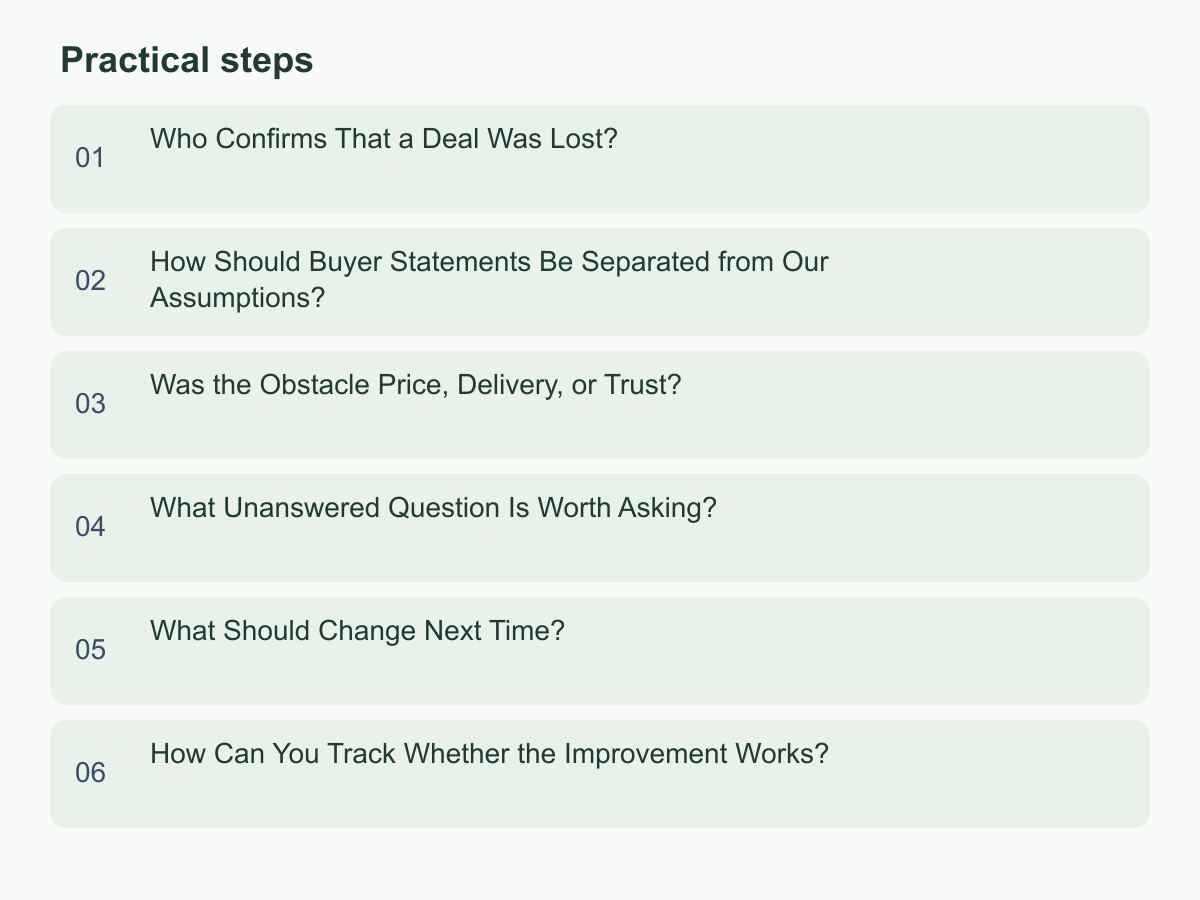
Who Confirms That a Deal Was Lost?
Begin by defining what “not won” means and who can confirm it. The opportunity owner should assemble the transaction record and check the status with the person who dealt directly with the buyer. If the contact is a user or coordinator, mark the statement as relayed rather than final. Record the decision date, roles involved, what stopped, and whether a next step remains possible. No reply, postponed evaluation, selection of another supplier, withdrawn budget, and an internal pause are distinct statuses. Without evidence, use “reason unconfirmed” or “paused,” never “lost on price” just to close the record.
In a hypothetical example, a buyer emails, “We will not move forward this quarter.” The confirmed fact is only that procurement will not proceed this quarter; do not infer supplier rejection or permanent loss. Save the email or meeting note, mark when the status was updated, and have a manager check that it matches the evidence. If the contact’s account conflicts with procurement or finance, list the gap and role to clarify rather than completing the buyer’s decision.
Keep the last substantive interaction distinct from the current next step. Record a follow-up time or trigger only when the buyer agrees; otherwise leave the deal paused rather than arranging outreach yourself. Distinguish the decision-maker, day-to-day contact, and person who raised the need. Ask the contact whether they can clarify the process before approaching other employees. Save handoff notes that let the next owner reconstruct the sequence from original sources. For an unresponsive deal, an internal date to organize records is not evidence of rejection.
How Should Buyer Statements Be Separated from Our Assumptions?
Record what the buyer said separately from the team’s interpretation. For each statement, note its source, date, speaker’s role, and original meaning; distinguish direct email, meeting notes, secondhand reports, and internal inference. Summarize faithfully; silence is not agreement. Log hypotheses separately with their basis and confidence: “The proposal arrived late and may have affected evaluation,” not “delivery was too slow.”
In a hypothetical case, the buyer says only, “We need to reprioritize the budget.” That supports recording changed priorities, not an overpriced quote or an assumption that the buyer has no money. List missing evidence, such as whether funds were approved, alternatives compared, or the timeline changed. When colleagues interpret a statement differently, keep both readings and mark them for validation; a majority vote cannot establish what the buyer meant.
Use four columns: confirmed facts, reasonable hypotheses, missing information, and ruled-out explanations. Link each conclusion to an email, meeting note, or explicit reply. Keep context such as whether “budget” means a quarter, year, or workstream. Record who changed an entry and why, so later information is not mistaken for what was known at the time. Ask, “If the buyer denied this cause, what evidence supports it?” Without an identifiable record, mark it a hypothesis. If recollection conflicts with the record, locate the original source instead of letting seniority decide.
Was the Obstacle Price, Delivery, or Trust?
Do not reduce every loss to price. Classify possible obstacles as price and scope, delivery terms, trust evidence, the buyer’s decision process, or external timing; mark each primary, secondary, or unknown. Compare price with scope, currency, payment milestones, and maintenance or change terms; delivery with milestones, buyer inputs, resources, and dependencies. For trust, note requests for security materials, clear responsibilities, verifiable experience, or internal sponsorship.
A discount request does not prove price caused the loss; it may be routine procurement negotiation. A schedule concern may come from the buyer’s approval process. In a hypothetical deal, the buyer asks about phased delivery but books no next meeting. Evidence supports testing a phased scope; it does not establish that trust is resolved. If the buyer states a total budget cap, record price as a confirmed factor and see whether scope can be narrowed before lowering the price.
A review table can list the buyer’s words or document, proposal version, supported factors, missing evidence, and next check. The primary factor should explain where the buyer stopped; secondary factors may have contributed. If two factors have similar evidence, list both. Write a testable conclusion, not just a label. Keep causes separate from adjustments: shortening a proposal is not a confirmed cause unless the buyer said its length delayed evaluation. When factors interact, record their sequence—for example, responsibility boundaries were needed before price comparison. In multi-region or multi-department deals, identify the market or role where the obstacle appeared; do not turn one contact’s view into organizational consensus.
What Unanswered Question Is Worth Asking?
Before following up, check that the relationship contact is willing to reply and that the timing is appropriate. Explain that questions will improve future proposals, not ask the buyer to defend the decision again. Ask one to three questions that could change the next step, beginning open-ended. For example: “If you are comfortable sharing, what condition mattered most in pausing this evaluation?” “If you revisit it, what would need to be in place first?” “Has the decision paused at budget, delivery, internal approval, or elsewhere?” Options can help recall, but include “other” and free response; the options are not answers.
In a hypothetical case where the buyer has paused without giving a reason, first ask whether a later follow-up would be welcome. This avoids repeated questions about price, competitors, and decision-makers. Check prior messages to avoid asking for information already provided. Put questions in one short note, say answering is optional, and offer text or a short conversation based on the buyer’s preference.
To learn about budget or timing, ask what change might prompt a fresh evaluation instead of suggesting the price was too high. Ask which competitor evaluation criteria mattered, without requesting confidential quotes, customer information, or business secrets. After receiving a reply, record the buyer’s words and check your understanding: “I understand the main issue is an unsettled internal timeline; is that right?” If the answer is vague, preserve the uncertainty rather than rephrasing until you get a particular answer. If the buyer declines or stops replying, mark the reason unknown, stop asking, and use only the agreed contact method. Success means obtaining a verifiable condition or learning no further information is available; it does not mean changing the decision.
What Should Change Next Time?
Do not change price, presentation, delivery promise, and follow-up cadence at once; if a later deal progresses, you will not know which adjustment mattered. Pick one low-risk change tied to the strongest evidence-supported obstacle. State a testable hypothesis, such as: “Showing a phased scope first will make it easier for a buyer to judge whether they can begin.”
Keep other conditions stable and define eligible opportunities, the owner, the observation, and the stopping rule; one success is not proof of a general effect. If a buyer is reluctant to commit to full delivery, add one clearly bounded first phase to the next comparable proposal. Name its deliverables and buyer inputs, and state that later phases will be decided separately. Keep pricing logic and response cadence unchanged. Observe whether the buyer identifies a workable scope, schedules another discussion, and raises remaining questions. If the first phase lacks information, record what is missing instead of rewriting the whole proposal into several versions.
Define improvement criteria in advance: moving from “no next step” to a named internal owner and evaluation date could count; a polite reply alone would not. For a price test, recheck scope and cost assumptions and document approval authority. Do not use a last-minute discount to hide unresolved delivery terms.
A test card can include the hypothesis, single change, eligible deals, observation signal, review date, and stopping condition. If responsibilities are unclear, revise the responsibility table without also changing the presentation and pricing. Have a colleague check that the change is clear, record whether it was applied consistently, and explain any exception. If a test affects contractual commitments, price approval, or professional boundaries, use existing organizational approvals; the test grants no new authority.
How Can You Track Whether the Improvement Works?
Judge an improvement by observable next steps in target opportunities, not by whether the team thinks proposals look better. Use consistent definitions. Record each opportunity’s source, size or scope, decision stage, best-known obstacle, adjustment used, buyer response, and final status; mark unavailable fields missing rather than estimating.
Possible measures include replies, meetings, progression to the next stage, and time from quote to decision. Define numerator and denominator in advance. For example, in a hypothetical set of ten comparable proposals, four advance: 4 ÷ 10 = 40%. In another set of ten, three advance: 3 ÷ 10 = 30%. This describes a difference, but a small sample alone cannot show the adjustment caused it. Check whether customer type, deal type, source, and decision stage are comparable.
Have opportunity owners update records weekly or monthly, and have a manager check classifications against underlying correspondence. Review meetings should focus on differences that could change a decision, not invent explanations to complete a report. If records are too incomplete, improve recordkeeping before comparing. If replies rise but next-stage movement does not, check whether the new conversations were only polite acknowledgements. If market or team conditions change, open a new observation period instead of treating before-and-after numbers as one test.
Start with one lost deal: complete confirmed facts, unknowns, and one proposed change, then track later opportunities with the same definitions. Make summary figures traceable to individual cases. Show counts alongside percentages: eligible deals, incomplete records, deals that received the change, and deals that advanced. Keep the denominator fixed and leave unreached or unevaluated deals under observation. At the review date, the owner records whether to continue, adjust, or stop and why, then checks that decision in the next cycle. For information about Chan & Chung, visit the Chan & Chung homepage.