
An overseas entry plan bundles three claims: someone has a problem, you can reach them, and they will change what they do. List assumptions about customers, demand, alternatives, channels, and decision thresholds. Test them in small steps, keeping statements, observed behavior, and decision rules separate. Investigation is not proof of demand.
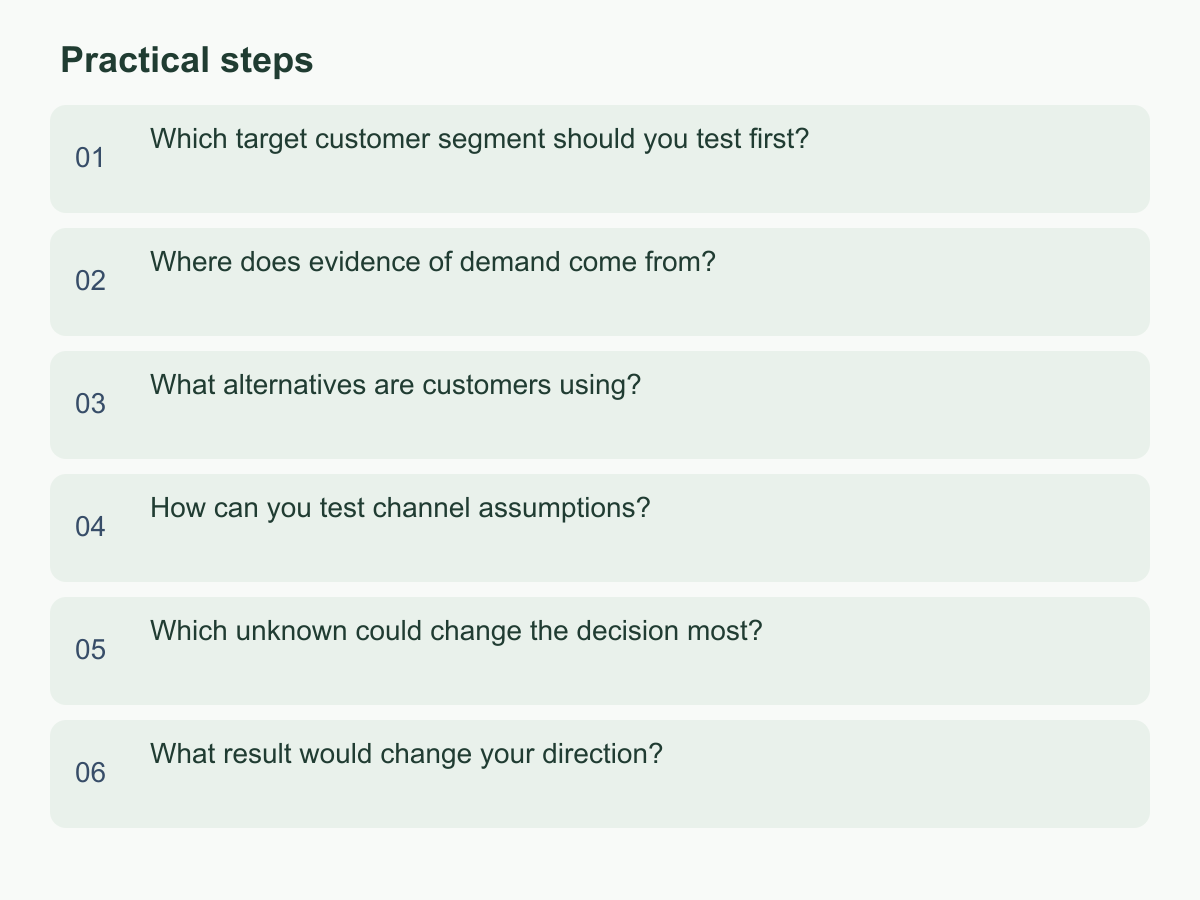
Which target customer segment should you test first?
Treat an overseas market as several segments, not one audience. Start with a narrow group you can reach and interview. Describe its business model, company stage, current market, destination, and decision-making role. For example, “software companies with established customers in Taiwan, founder-led decisions, and plans to win their first business customers in Malaysia” is easier to test than “small businesses looking to expand overseas.”
Add the situation they face, desired change, unacceptable costs, and who is out of scope—for example, a company without a settled product or assigned staff. Use observable conditions, not labels like “ambitious.” Convert them into screening questions: Does this person help choose the market? Is there a target-customer list? Has the company taken a relevant step recently? Mark unverified conditions unknown.
Rank segments by urgency, decision authority, reachability, and capability fit; scores only order work. List interview sources, your relationship to them, and people with no stake in encouraging your idea. Include users, buyers, and delivery roles when possible; record missing roles rather than treating one view as the company’s decision. If conditions keep shifting to fit interviewees, narrow the segment.
Where does evidence of demand come from?
Separate words from actions. Social comments, survey selections, and expressed interest can suggest a question, but do not show willingness to commit time, budget, or organizational resources. Ask about the most recent time the problem arose: What were they trying to do, who was involved, what did they try, how long did it take, and how did they resolve it? Past events reveal more than asking about a hypothetical purchase. Avoid leading questions or treating polite praise as commitment.
Compare interviews with inspectable evidence such as hiring or procurement notices, product documentation, search queries, quote requests, trial arrangements, or workflow examples an interviewee agrees to share. Search activity is information seeking, not buyer readiness; a quote request is intent, not ongoing demand. Record the assumption, source, date, exact words or action, counterevidence, confidence, and next step. Keep observations separate from interpretation.
If a problem exists but willingness to exchange resources for a solution is unknown, label it “problem exists; terms of exchange unknown” and choose a low-cost commitment test. Note who produced a document and what period or group it covers; one company’s process is not an industry norm. If a document is private, ask about the decision without requesting sensitive material.
What alternatives are customers using?
Count substitutes as well as similar companies. Customers may use a local supplier, cross-border platform, consultant or agent, existing software, in-house staff, a spreadsheet, personal referral, or delay entry. These compete for budget, time, or attention. Ask, “How did you handle this last time?” and “Why choose that option?” Find out who used and bought it, switching effort, what built trust, how long it took, and what remained unresolved.
Compare adoption timing, customer effort, remaining risks, and access to the right people—not only features and prices. Keep known details separate from questions:
| Alternative | What customers may value | What to verify |
|---|---|---|
| Local supplier | Familiarity with local processes | What remains unresolved |
| In-house approach | Keeping existing tools and staff | Time and handoff costs |
| Delay or no entry | Avoiding new commitments | What might prompt reassessment |
Treat public competitor claims as leads. Note the publisher and source scope; one case study does not establish typical results. Leave unclear features, delivery quality, or prices unknown until checked. Identify the minimum alternative customers accept and what a new option must improve. Classify organizations as channels, competitors, or possible partners by why interviewees use them, and record replacement steps.
How can you test channel assumptions?
Choose three: customer referrals, industry events, professional communities, potential partners, or active search. For each, note who sees the message, likely respondents, qualification criteria, and the next step to observe. Keep the invitation focused on the person’s situation and desired conversation; a long product description can crowd out discovery.
Test one request at a time: an interview, workflow example, product demonstration, or budget conversation. They involve different commitments, so do not count them as the same conversion. In a small, comparable batch, track contacts, qualified people, replies, useful conversations, accepted next steps, and time spent. If twelve people are contacted and three qualify and agree to follow up, that is three people in the sample, not a market-wide conversion rate. Record known refusal and nonresponse reasons.
If a route draws replies but few intended roles, it offers reach without qualified contacts. If qualified people do not continue, examine message, timing, and demand separately. Keep segment criteria and invitation stable where possible; change one factor at a time and note exceptions. Record referral relationships to distinguish personal-network effects from repeatable channels. Respect consent and local requirements when contacting people or storing information; avoid large list uploads or repeated follow-ups until requirements are clear.
Which unknown could change the decision most?
With limited time, prioritize the unknown most likely to change whether you enter, whom you serve first, or how you test. List assumptions about segment clarity, problem frequency, current alternatives, payer agreement, delivery feasibility, and reachability. For each, note evidence, what is unknown, the cost of being wrong, the cheapest check, and dependencies. Rank by decision impact and uncertainty; the score sets research order, not a forecast.
Match the test to the constraint. If you cannot deliver even when demand exists, advertising will not resolve it; speak with delivery roles or rehearse a small part of the process. If you can deliver at small scale and the uncertainty is whether customers will act, ask decision-makers about past behavior and what they will commit next. Separate reversible tests, like interviews or page copy, from costly choices such as a lease, hiring, local inventory, or a long-term agreement where relevant.
Prioritize high-impact assumptions with little evidence when cheap to check. If direct verification is costly, use a proxy only to narrow the question. Give each round one main question, a stopping condition, and acceptable evidence. Check cross-border delivery, data use, and regulation with appropriate local professional sources; interviews are not formal guidance.
What result would change your direction?
Before results, define what would support, revise, or pause the direction and the evidence each requires. One enthusiastic reply cannot establish a whole market; do not rewrite the segment to fit weak results. Set thresholds from your time, budget, delivery capacity, and risk tolerance, not invented benchmarks. If a team can conduct at most four interviews a week, that sets a round’s length and conversation capacity—not a demand threshold.
Recent problem examples, resources already spent, and willingness to schedule a next step may support a demand hypothesis. If people report a problem but lack decision authority, a budget source, or workable timing, revise the customer or buying-process assumption. If different routes repeatedly fail to reach a fit, revisit segment and access strategy. After each round, mark assumptions retain, revise, or stop; attach evidence for and against, then choose one change for the next round.
Define pilot scope, owner, cost limit, success conditions, and stop conditions. A pilot answers only what it tests. Limit conclusions to the roles, city, or channel represented. Choose a next action—interview buyers again, revise criteria, test another route, or pause investment—and set a review date. Distinguish a small sample from evidence against the direction; record what triggered the decision.
Start with a hypothesis sheet: choose the unknown most likely to change your market-entry decision, then arrange one conversation that can test it. For more information, visit Chan & Chung.