
Overseas market interviews reconstruct how customers recently evaluated, adopted, or set aside an approach, revealing alternatives and purchasing barriers. Asking only what someone might do can invite polite speculation. A recent event makes actual behavior, participants, and unresolved obstacles easier to see. This guide covers interviewee screening, neutral follow-up, and separating direct statements from interpretation. Interviews are evidence to validate, not a market conclusion; begin with a defined situation and revise assumptions as you learn.
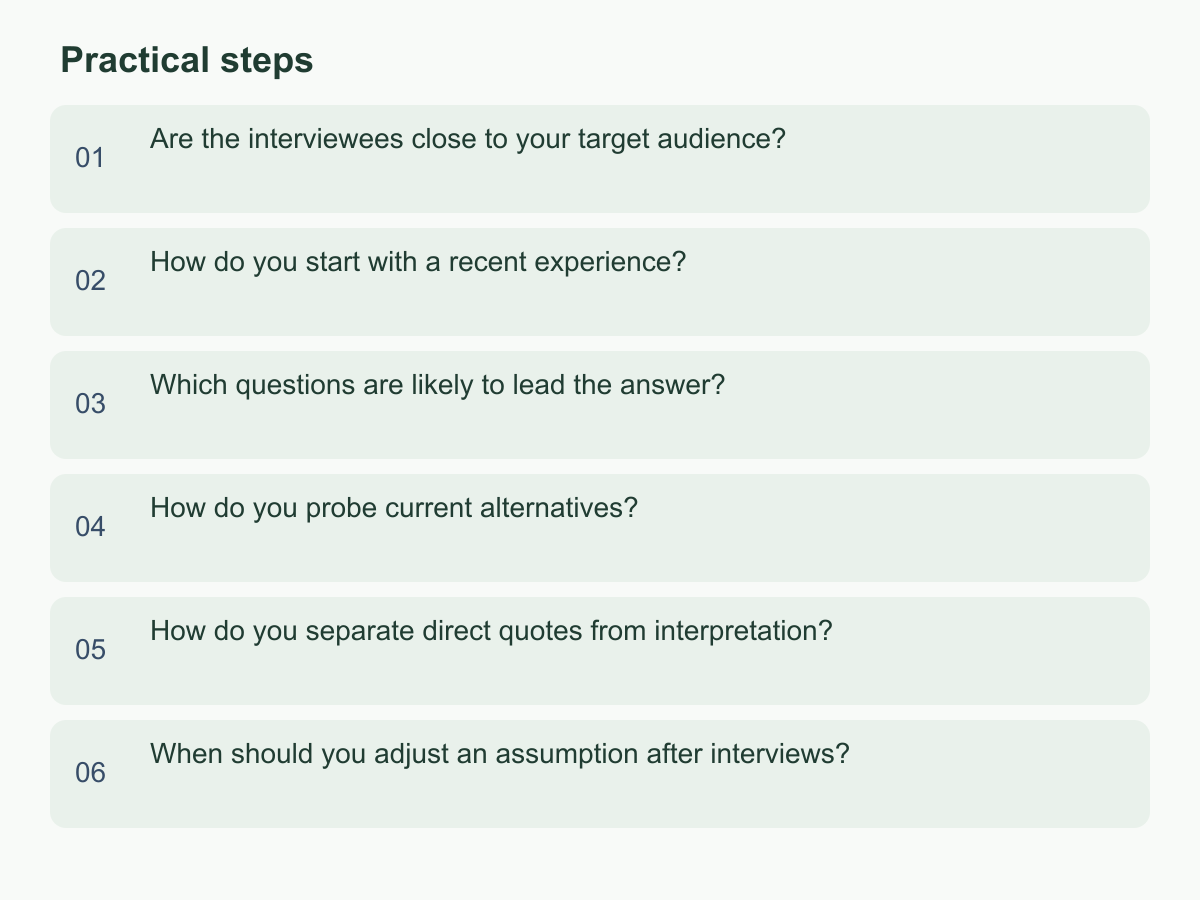
Are the interviewees close to your target audience?
Fit depends on personal participation, not title, industry, or interest in “going overseas.” Define observable criteria: recent market evaluation, finding customers or approving a budget, or handling payment or delivery. Before inviting someone, ask three questions: When did it happen? What did they personally decide? Who else took part? Someone who only heard about it can offer context, not firsthand evidence.
Record each candidate’s role, company stage, target market, recent experience, and source of knowledge. Label it firsthand, collaborative, or secondhand; this shows missing perspectives, not statistical representativeness. To study first attempts, include newcomers, not only firms operating in several countries. For team handoffs, include operators as well as founders.
For example, to understand how small Taiwanese brands evaluate payment options for selling in Southeast Asia, invite someone who compared them, an order operator, and a finance or operations colleague who rejected a proposal. The decision-maker describes the threshold, the operator the steps, and the objector the perceived risks. Explain that this is about what happened, not a pitch or test. Do not request customer names, account details, or confidential amounts.
An inclusion rule could be: “Personally evaluated the target market within the past year and can recall what was done.” This window defines the study, not a universal cutoff. Keep future plans separate from experience. If you interview only decision-makers, label findings as their perspective, not evidence of operator needs. If recruitment is difficult, change the channel or narrow the question; do not count out-of-scope people as target customers.
How do you start with a recent experience?
Ask for a recent, clearly remembered event, not a hypothetical like “What would you do if you entered this market?” Trace it in order: “What happened?” “What did you do first?” “Who did you speak with or what did you review next?” “How did you decide?” Ask one thing at a time, use the interviewee’s words, and turn “we usually do this” back to the latest specific instance.
Turn vague phrases into observable detail. For “a hassle,” ask which step took effort and how they handled it; for “a long time,” ask when it began and ended and what happened in between. Give the person time to recall rather than supplying an answer. A calendar, process, or document title may help if welcomed, but do not request confidential or personal material.
Use an event-based note template: trigger, goal, actions, resources, obstacles, result, and later effects. Record the interviewee’s account before evaluating it. “Paused the listing after asking two logistics providers” is closer to the event than “They stopped because shipping was too expensive,” which adds an unconfirmed cause.
Check the timeline before ending: “I understand that you did A, then asked B, and finally paused. What have I got wrong?” Invite corrections or an important missing event. This checks your notes, not your product assumption. Mark unresolved points for follow-up. When several people were involved, record who did each action, and label the source of time estimates.
Which questions are likely to lead the answer?
A leading question hides a conclusion: “Did you also find payments difficult?” suggests a pain point; “Would you buy a faster option?” imagines a purchase that has not happened. Ask, “Which payment step needed most attention last time?” and “What did you compare, and what did you choose?” Hear the full answer before probing evidence, timing, or participants.
Avoid “Why didn’t you just…?” because it frames one approach as obvious. If you show an untested feature, ask whether it matches the work described and where it falls short. That feedback shows reaction, not actual adoption or payment.
Start with open prompts, then confirm details that have not come up. Reading a list of choices too early can constrain the answer. To compare time, cost, and risk, first ask, “How did you weigh the options?” Then check whether those factors mattered. Use the interviewee’s own terms if they do not recognize yours.
Watch your tone, nods, and praise. Saying “Exactly, that’s what we wanted to hear” signals desired answers. A neutral response—“I’ve noted that; next I’d like to understand what you chose”—keeps the discussion moving. Probe contrary experiences equally. If you steered someone, correct yourself: “I may have put an answer into that question. What did you actually think?” Mark the correction so the prompted answer is not treated as independent evidence.
Before the interview, list open questions and conditional follow-ups; replace any yes-or-no prompt that assumes a problem, solution, or result with a request for an example.
How do you probe current alternatives?
Ask how the work is done now, who handles each step, when, and which tools or outside help are involved. Alternatives include a spreadsheet, manual outreach, an existing process, a partner, or postponing a decision—not only competitor products. Ask, “What worked best and what was hardest the last time you used this approach?” and “Without it, how would you get the job done?” Look for a task, not just a preference.
Ask what else they compared, what kept them with the current approach, whether anyone objected, and who would spend time on a purchase or changeover. Treat not buying as an outcome: Was the task not urgent, the budget committed elsewhere, a risk unresolved, no owner available, or the existing process good enough? These are not equivalent to “no demand”; each calls for different evidence and next steps.
If someone mentions cost, ask whether they mean the payment amount, staff time, switching effort, error risk, or an expense they cannot estimate. Invite an example of a comparison or approval process. For sensitive figures, a range or relative ranking may be enough; label it as the interviewee’s estimate, not an accounting record.
Suppose a brand operator says, “We reconcile it manually for now.” Ask when it happens each week, who checks it, how errors are fixed, whether busy periods change the process, and what else was considered. If they say, “There’s no time to switch,” ask about the latest attempt or why one has not started. This helps distinguish a temporary workaround, an acceptable process, and an unresolved task. One complaint cannot settle which explanation is right. The aim is to understand the work and why the current approach remains, not to pitch a predetermined alternative.
How do you separate direct quotes from interpretation?
Keep the interviewee’s words and your analysis in separate fields. Preserve their wording and use quotation marks only for an actual quote. State your current interpretation and missing evidence in the analysis field. Do not quote a polished summary or blend your prompt with the answer; readers need to distinguish interviewee observations from the researcher’s judgments.
| Note field | Example |
|---|---|
| Direct quote | “We’ll keep using the spreadsheet for now and revisit it in the busy season.” |
| Interpretation | They currently use a spreadsheet; the busy-season constraint and meaning of “revisit” remain unconfirmed. |
| Next question | When was the most recent busy season? What extra work came up, and what did you do? |
This hypothetical example is not a customer case. It turns a remark into a follow-up lead without rewriting it as “the customer needs automation.” Label condensed wording as a summary. If a verbatim note is shortened, mark the omission; do not add a motive or figure the person never stated.
A template can record an interview ID, date, role, event timing, interviewer, recording method, and open questions. Ask consent before recording; if the person declines, take written or typed notes. Keep only research-relevant information, avoid unnecessary personal, customer, or account details, remove identifying details before sharing, and keep original notes separate from edited versions.
Add context soon after the interview. Mark memory-based additions as interviewer notes, not quotes. Link each interpretation to a quote or event; otherwise label it a hypothesis. Group similar statements but retain differences and counterexamples so the team can check the source.
When should you adjust an assumption after interviews?
Do not rewrite a market assumption after one vivid story or erase a contradiction because answers differ. Break it into testable parts: who has a task, in what situation they use which alternative, and where an obstacle appears in the decision process. Sort evidence into support, counterexamples, and unknowns, noting the role and experience behind each. Repeated descriptions merit follow-up, but several comments from one person are not independent cases.
Adjust an assumption when evidence could change the next decision. If you expected people to lack a tool but they already have a process and mainly get stuck at internal approval, revise the hypothesis toward purchasing and approval, then speak with someone involved. Do not jump to “the market has no need.” For a counterexample, ask whether role, company size, location, or event stage explains the difference. If not, keep multiple possibilities open.
After each round, update a short table of the assumption, supporting events, counterexamples, unknowns, next role, and next question. Confirm key details if conversations repeat an existing situation. If a new alternative, decision-maker, or obstacle emerges, adjust recruitment and questions. Stop when remaining uncertainty would not change your next step, not after a fixed count or percentage.
For the next step, write down the most important assumption and invite one person who has personally done the task. Document one complete event using this sequence, with direct quotes, interpretation, and open questions in separate fields. Then choose which role or process to explore next and record the evidence behind the revision. For official information about Chan & Chung, visit the Chan & Chung website.