
Overseas project scopes often fold deliverables, ways of working, and unstated assumptions into a single goal. Differences in expectations may then surface halfway through delivery. A reviewable baseline that brings work packages, exclusions, dependencies, acceptance, and change control together gives each commitment a corresponding deliverable and a way to confirm it. This article focuses on project execution; it does not provide legal clause templates.
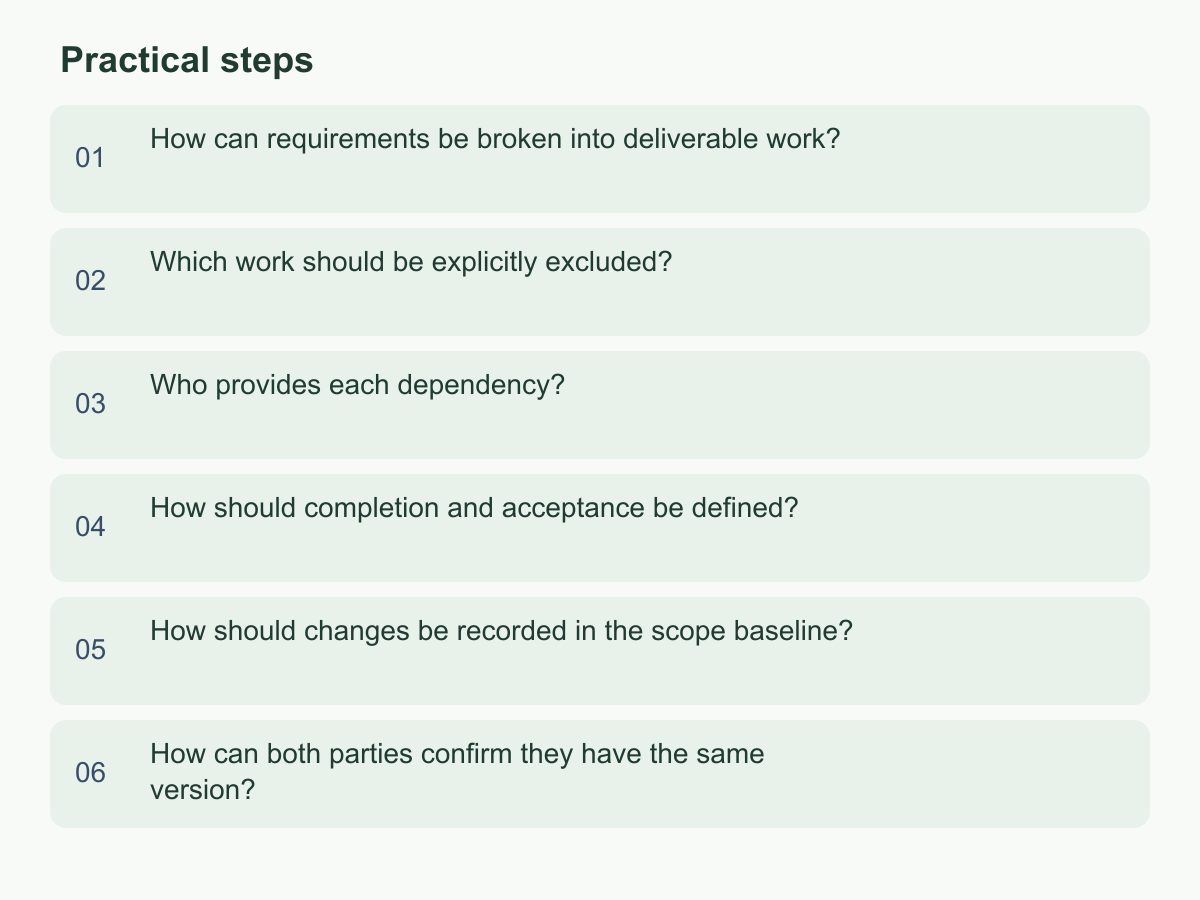
How can requirements be broken into deliverable work?
Start by turning a broad goal such as “help us establish ourselves in an overseas market” into deliverables, rather than copying it into a to-do list. Ask who will use each result and what decision it should support. Then define the market, audience, time period, delivery language, available inputs, and format. If a client says the goal is to be “ready,” ask what observable state would show that, such as a requirements summary, process sketch, or list of open questions. If the answer remains “support,” “follow up,” or “improve,” ask what material can be handed over and how it will be judged. The intended use matters too: a discussion document, an internal decision aid, and a handover to the next person may require different levels of detail.
For a hypothetical example, suppose Party A wants to assess entry into an overseas market. The parties could separate an interview summary, a missing-information list, a draft process, and a decision log into distinct deliverables, then state the inputs, preparer, reviewer, and format for each. The summary would help check the current situation; the process draft would support discussion of responsibility handoffs; and the decision log would identify choices made by Party A. If Party A has not provided product information, Party B should leave related questions open instead of inferring product conditions from a blank file. This example illustrates how to divide work; it is not a commitment to provide a particular service.
Put the deliverables in sequence and identify prerequisites, discussions that need both parties, and the person who receives each result. Different owners, dependencies, or acceptance conditions are good reasons to create separate work packages. Do not treat internal hours or meeting counts as customer outcomes, and avoid listing the same deliverable in several places. Give each package a stable identifier and use it to connect related exclusions, assumptions, and acceptance criteria. If two tasks share an input but produce different results, state each task’s owner and completion conditions separately.
Which work should be explicitly excluded?
An exclusion should name work that has not been committed to and show how it differs from the included deliverables. “Other items to be discussed” is too vague: each party may imagine a different boundary. List relevant work types one by one, such as the extent of market research, external outreach, filing documents, third-party charges, translation, ongoing maintenance, or on-site execution. For anything excluded, state who will decide, provide, or arrange it. For legal, accounting, tax, company-registration, or bank-review matters, clarify whether the project only organizes questions and information. External professional judgments and decisions made by institutions should not be left hidden inside the word “assistance.”
For example, a hypothetical scope that covers requirements gathering and a process draft could explicitly exclude filing documents on a client’s behalf, making decisions for the client, obtaining permits, or guaranteeing a bank account opening. These examples describe possible scope boundaries; they do not mean that a particular brand provides those services. When a client asks for additional work, first decide whether it is a necessary correction to an existing deliverable or a new deliverable, audience, region, or responsibility. Record the related package identifier and the reason for the request so that a verbal “yes” does not leave the parties with different ideas about what was agreed.
Pair exclusions with a route for handling them. If outside expertise is needed, identify which party will find and engage the professional. If third-party information is required, assign someone to obtain it. If the work may later be added, define its deliverable, owner, dependencies, and acceptance criteria first, then assess schedule and cost effects. A long disclaimer is not a substitute for a usable boundary. Review each item by asking: “Who is doing this now? If nobody owns it, is it excluded, still to be confirmed, or the subject of a separate proposal?” Record the answer in the scope baseline so new expectations have a clear place to go.
Who provides each dependency?
A dependency is information, a decision, access, a response, or third-party cooperation needed before work can start or finish. Avoid writing only “client cooperation.” For each dependency, identify what is needed, who will provide it, why it is needed, when it is expected to be available, and who will receive it. Product information, existing processes, a target-market choice, a contact person, and internal approval may affect the work, depending on the project. For each package, ask: “What input would prevent this work from starting if it were missing? Who will confirm that the input is usable?” This turns hidden assumptions into items the parties can track.
Suppose a process draft requires Party A to confirm its current approval roles. The baseline could say, “Party A provides the current role list for checking the process draft,” and mark unconfirmed roles as outstanding rather than guessing. If information must come from an outside organization, record the contact person and whether it has been received. Since the project team does not control an external response, do not describe that response as a guaranteed deliverable. This hypothetical example sets no actual deadline. The parties should enter a workable date based on their own schedules and name who will follow up and receive the information.
Give each dependency one clear owner, even when several people help assemble the information. Link it to the affected work package and state what happens if the input is late, incomplete, or inconsistent. The parties might pause the affected work, agree on a temporary assumption, or continue with parts that do not depend on the missing input. Whenever they use a temporary assumption, record who proposed it, whether it has been confirmed, and its possible effects; otherwise, an assumption can quietly turn into an apparent fact. In regular reviews, focus on dependencies that remain incomplete or have changed, so attention stays on items that may affect delivery.
How should completion and acceptance be defined?
A completion definition should let the recipient judge the deliverable against the agreement without guessing what its author meant. For each result, state its content, file or presentation format, required fields, language, related requirement, and reviewer. For an analysis summary, identify which supplied materials it covers and which questions remain open. For a process draft, say which roles, steps, and handoff points it must show. Words such as “complete,” “professional,” or “fit for purpose” are not enough on their own; break them into conditions that can be checked one by one.
Also distinguish delivery, review, and approval. Sending a file means it has been submitted; the recipient can confirm that it meets the agreed conditions after reviewing it. Content that still needs a decision from Party A should remain marked as pending, rather than being filled in with Party B’s guess. The parties can agree on how review will happen, who proposes a response date, and which unmet condition or missing information feedback should identify. If revisions are included, record their scope and how the updated work will be returned. A new request does not automatically become part of the original scope just because it appears in review feedback.
For example, a hypothetical requirements summary might be accepted when it lists the roles interviewed, records the current situation confirmed by participants, separates missing information, and uses the language agreed by both parties. A reviewer could point out a missing role, a statement with no source, or an open question incorrectly written as a conclusion. That makes the next action clearer than saying “it looks fine” and preserves the actual status when external information is unavailable. Acceptance criteria need not be lengthy specifications, but each work package should have at least one observable basis for review and a response.
How should changes be recorded in the scope baseline?
The baseline should absorb new information during delivery instead of becoming a document that nobody updates after initial sign-off. When a new request arrives, record who raised it, when, the problem to solve, the related package, and the expected result. Then classify it as a clarification, correction, changed dependency, or new work. A spelling correction may leave the deliverable unchanged; changing the market, audience, language, decision-maker, or output format could affect inputs, work sequence, and acceptance. Write down the reason for the classification so the parties can discuss the same change instead of arguing only about whether it is “in scope.”
Next, assess the effects: which existing deliverables need rework, who must provide information, what can continue, and whether the schedule or cost needs adjustment. If the effect cannot yet be determined, list the missing information instead of promising an unassessed date or result. After the requester and affected owners confirm the change and next steps, update the work packages, exclusions, dependencies, acceptance conditions, and version history. Until then, mark the request as being assessed; a message should not be mistaken for a formal instruction. Work unaffected by the request can continue under the existing baseline, so the entire project need not stop.
Suppose the original scope covers requirements for one market and someone later proposes adding another. First clarify what the new market deliverable should contain, who will provide information, and which parts of the original summary need rework. Record the added work separately from the original scope and arrange it after both parties confirm the effects. A chat reply saying “that’s fine” without a baseline update may leave the delivery team working to the old scope. Keep earlier versions and the reason for each change so the differences are visible. Record rejected or deferred proposals too, so they are not later mistaken for approved work.
How can both parties confirm they have the same version?
Keep one master version of the scope baseline that both parties can find. Identify the document, version, update date, maintainer, and confirmation status. Emails, meeting notes, and chats can preserve discussion context, but agreed changes should be written back to the master and linked to the relevant decision record. For every update, list the affected packages, the reason for the change, and any affected dependency or acceptance condition. Changing only a filename or date without describing the content change makes it hard for a recipient to tell whether they are looking at the same agreement.
When confirming a version, both parties should check the work packages, exclusions, owners, dependencies, acceptance method, and unresolved items, then confirm the specific version in a traceable written form. Each open item needs an owner and a next step; silence should not stand in for agreement. If someone still has an old copy, identify which version superseded it and notify them to update it. When handing the baseline to a partner or a new team member, point out where the master version lives and what remains to be handled. This is not merely a receipt; it lets the next person begin from the same conditions.
Before kickoff, one party can read out the items that remain unconfirmed while the other checks them against the document. Then confirm the single master version and the contact person. Later meetings do not need to reopen the entire scope: refer to the version and package identifier, then record decisions in the baseline. Start with the vaguest requirement at hand and write it as a work package with a deliverable, exclusion, dependency, and acceptance condition. Review each item with the other party. For more information about the brand, visit the Chan & Chung homepage.