
When an overseas client sends an RFP, delays often arise because teams interpret requirements differently, evidence is scattered, or answers conflict in the final submission. Turn each requirement into a traceable work item: what must be answered, which evidence supports it, who owns it, and who approves it before the deadline. The examples are illustrative; adapt the fields and judgments to the actual RFP.
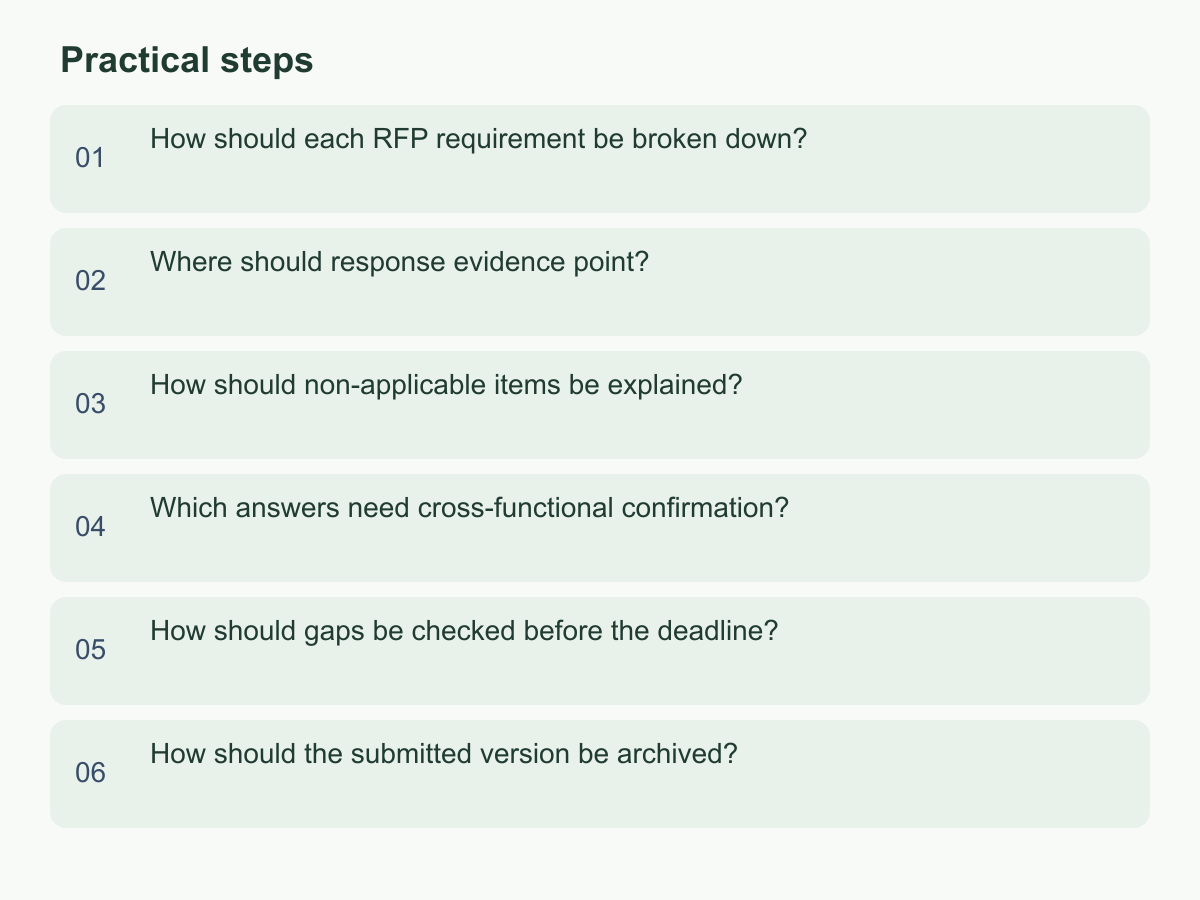
How should each RFP requirement be broken down?
Create a separate row for each commitment a buyer can assess independently. Keep the RFP section, question number, and original wording, then identify the action, subject, scope, conditions, deliverable, and timing. Split joined requests so one answer cannot hide an omission: a request covering a solution, testing, and launch support may need three deliverables and acceptance criteria.
Use team-understood labels such as mandatory response, scored item, conditional requirement, or background information. Preserve the buyer’s mandatory labels and scoring weights. Useful columns include question number, concise requirement, status, draft answer, evidence location, owner, approver, deadline, and clarification needed. Mark unfinished work as pending, not blank.
For example, split requests for monthly reports, a named support contact, and onboarding training into three rows. Operations checks report fields and a sample; the service owner confirms support hours; the delivery lead confirms training participants and materials. This exposes capability and approval questions without promising that every request can be met. Link each row to its source. Use sub-rows such as 4a and 4b when question 4 asks for technical details and commercial terms, and mark both necessary. Record separate deadlines and preserve exceptions or negative wording.
Where should response evidence point?
More attachments do not automatically strengthen a response. A reviewer should trace each answer to material supporting its claim. For each reference, record its name, version or date, page or section, data owner, and access permissions. Explain how a specification, process, or prior delivery record supports the requirement. Keep the buyer’s question numbers and required format.
State the answer, then its evidence and limits. If asked whether a monthly report includes refund details, say whether it can be supplied with agreed fields and point to the sample’s version and worksheet. If the sample lacks a refund field, it cannot prove the field is included; state that final fields remain subject to project agreement. For missing evidence, name the material, provider, and due date.
Before sharing, confirm recipients can open links and attachments do not expose customer information, personal data, pricing, or internal comments. Keep the submission separate from working files and redact sensitive details without hiding relevant evidence. For each name, number, or commitment, record its source and passage; map shared sources to each answer. Reopen each item to verify access and version. Qualify unsupported answers and request evidence from its owner.
How should non-applicable items be explained?
Classify each item as out of scope, conditional on an unmet trigger, awaiting information, or needing buyer clarification. The statuses differ: N/A records a scope decision; pending trigger names the condition and review point; pending information names an owner and due date; clarification required means the buyer must answer first. Never leave a field blank or use N/A to hide uncertainty.
Record the question number, reason, basis, impact, owner, and next action. Suppose a question asks for arrangements at a local office outside the proposal. Mark it for clarification and ask whether the office is mandatory. Until the buyer responds, do not imply it exists or promise to arrange one. If an item is outside the engagement, state the boundary and have an authorized person approve it.
Escalate judgments affecting price, eligibility, delivery, or responsibility. Do not invent substitutes. Distinguish current capability from work needing assessment and options not yet committed. If only yes or no is allowed, use an allowed comment field; otherwise ask for clarification and retain the answer. Keep impact, approver, and next action in the matrix; make the external answer understandable on its own.
Which answers need cross-functional confirmation?
For each answer controlled by others, assign a drafter, data owner to verify facts, and approver for the external commitment. A small team may combine roles, but each row needs a named owner. For high-impact commitments, the drafter should not approve their own wording. Add a backup and escalation contact.
Match reviewers to the facts: operations confirms delivery scope, finance checks pricing and payment terms, the relevant owner reviews security, data handling, and confidentiality, and the service team verifies support hours. For third parties, subcontractors, regional coverage, or customer data, confirm the arrangement and permitted disclosures rather than copying an old proposal. Have qualified professionals engaged by the company review legal, tax, or regulated-service commitments; an operational response is not professional judgment.
Set deadlines before internal lock, naming date, time zone, deliverable, and response method. Preserve the RFP time zone and convert it for the team calendar if useful. If facts are missing, the owner reports the gap and options; the approver chooses a qualified answer, clarification, or no commitment. Do not guess. Name one coordinator when multiple departments must reconcile input. Keep the item pending until approval, then copy only the verified response into the external version.
How should gaps be checked before the deadline?
Freeze a working version and review each row against the original RFP. Confirm every requirement has an answer or status; the answer covers requested action, scope, and conditions; cited material opens and supports it; and each clarification or N/A decision has reason and approval. Check appendices, continued tables, checkboxes, signature fields, and separate delivery instructions.
Check terminology, scope, dates, quantities, locations, and owners across response and attachments. Verify each number’s source, unit, period, and version. Ensure evidence supports every claimed capability. After formatting, recheck page numbers, clipped tables, filenames, and references. Ask a business-familiar reader to check the English: “can be assessed” differs from “is committed,” so state conditions clearly.
Have someone outside drafting follow each question to its evidence from the buyer’s perspective. Log omissions, contradictions, unapproved items, and formatting issues with owner and status. After changes, recheck affected answers and attachments. If time is short, prioritize eligibility and mandatory items, then price and responsibility, delivery scope, and general information; this internal order does not change buyer scoring. Record checker and time. Lock only when every requirement has status, external commitments are approved, and evidence is readable.
How should the submitted version be archived?
Archive the exact submitted package so the team can reconstruct what was sent. Keep the original RFP, completed matrix, final response, attachments, clarification exchanges, and approvals. Use names that identify project, document type, version, and date. Store a read-only submitted copy or controlled folder apart from working drafts.
Record submitter, recipient, channel, timestamp, and time zone, plus the filenames actually uploaded. Save the portal receipt or success screen; for email, retain the sent message and attachment list. Mark the response received only with a recognizable acknowledgment. If none is available, record submission with receipt unconfirmed and assign follow-up.
For a later clarification or revision, create a new version and record changed question numbers, reason, approver, and resubmission time. Keep the earlier version. Group follow-ups as answered, awaiting confirmation, or requiring a commitment change, with an owner and next review point. If resubmitting, send a complete approved package and confirm which attachments it replaces. Set retention by company policy, contract terms, and applicable requirements. Add an index with archive location, version, status, and follow-up owner so handoffs do not depend on one person’s inbox.
To begin, copy each RFP question into a list, then fill in one requirement’s answer, evidence location, and owner before applying the same format to the rest. Learn more about Chan & Chung on the English homepage.