Published · Updated

When a SaaS team expands overseas, payment processing, collection, tax handling and a Merchant of Record (MoR) may appear on the same shortlist. Similar labels do not mean the legal roles are the same, and a provider’s sales page is no substitute for its contract. For a Hong Kong company selling subscriptions, establish who sells each transaction, what the provider handles, and how money, fees and data are handed over. This affects the seller customers see, renewals, refunds, support and reconciliation. Compare contractual duties with daily operations, not just integration speed or checkout design. These are common market arrangements; their scope cannot be inferred from a name.
Distinguish a payment processor from an MoR
A payment processor typically helps authorise, process and route payments. Using one to collect money does not, by itself, make it the seller. Depending on the arrangement, an MoR may become the legal seller for a transaction and take on billing, refunds, tax or chargeback duties stated in the contract. Shopify’s explanation concerns retail transactions and says the provider agreement defines the exact responsibilities; it is not a universal legal definition for every SaaS product or jurisdiction. Shopify, updated August 15, 2026
Start a checklist with target markets, buyer type (business or individual), product type and billing model. Check checkout terms, order confirmations, receipts or invoices for the seller’s legal name. A payment-statement descriptor is a clue, not proof. Put documents and payment records in one dated matrix, noting the market, entity names and open questions. Map the flow from order through collection, fulfilment and settlement, recording the contractual party and actual operator at each step. If they differ, ask the provider for a written explanation. Keep dated copies and name a record owner. Note whether the product is digital or physical, whether a third party deducts funds, and whether the customer-facing name matches the contract. Without an MoR agreement, mark seller identity unconfirmed.
Verify the seller and scope against the actual contract
Before signing, verify the contracting party, seller for each transaction, and the countries, products and transaction types covered. Confirm who handles collection, refunds, chargebacks, transaction-tax calculation and filing, customer notices, data access, and subscription or data transfers after termination. The MoR label does not prove coverage for your product, market or liability. Shopify distinguishes an MoR from an importer of record; for physical goods, allocate customs declarations and import duties separately. Shopify’s explanation of MoR responsibilities
Build a matrix with contract version, effective date, markets and product categories. Mark each task “provider”, “company”, “shared” or “not stated”, with its clause or written reply. Record separately the contracting entity, collecting entity, subscription provider and issuer of customer documents. If they differ, note the relationship and basis, and check that customer terms disclose the transaction party. Resolve conflicts between website copy and formal terms in writing; leave unstated duties open. For multiple brands or subsidiaries, confirm approved trading names, contracting entities and change-notice requirements. If the provider says it handles tax, ask in whose name, for which markets and buyer types, who corrects errors, and what records your company must supply. “Tax handled” alone does not define scope, exceptions or cooperation duties.
Compare subscriptions, refunds, tax and data handover
Assess the full subscription lifecycle: renewals, retries after failed payments, cancellation timing, prorated refunds, disputes, tax documents, customer-data exports and subscriptions due to renew after termination. An external service may cover only some steps; confirm capabilities and exceptions for your product and markets.
Prepare the plan, billing interval, buyer markets and B2B/B2C mix. List duplicate charges, cancellations, disputes and service suspensions. Ask which data fields can be exported, in what format, for how long they are retained and delivery time. Confirm whether the next charge date and payment authorisation can transfer. If customers must consent again, record notice timing, the remedy for an incomplete move and the follow-up owner. Test payment, failed renewal, cancellation and refund; compare notices, account access, records and export files. If no test environment exists, request written instructions. Check payment status and service access stay in sync. Confirm refund authority, support channel and escalation route. Log each event, owner, evidence, untested item and next step. Check who holds records and whether exports include customer IDs, subscription status, refunds, tax and failed-payment fields. An export does not prove a payment token or old authorisation can be reused; confirm portability and obtain renewed consent where required.
Use a hypothetical transaction to compare total cost
Compare self-managed collection and an MoR using the same volume, prices, refund assumptions and period. For illustration, assume 100 monthly subscriptions at HK$150 each: gross collections are HK$15,000. Five full refunds total HK$750, leaving an arithmetic balance of HK$14,250. This is not a provider settlement quote; it excludes fees, collected taxes, chargebacks, FX differences and reserves. The assumed price is only a calculation input, not a market rate or recommendation.
For each option, record currency, transaction count, unit price, refund and chargeback assumptions, settlement currency, fees, reserve terms, integration cost and staff time. Note fee basis, refund treatment, FX rate and settlement cycle. Separate service fees, refund and chargeback losses, FX impact, delayed funds and internal labour. Mark unavailable rates and time estimates unknown. Reconcile payments, refunds, collected tax, fees, reserves and net settlement, recording amounts, currencies, expected and actual bank dates. Keep unclear reporting or FX rules open. Compare multiple markets separately so local payment methods, currencies and refund patterns remain visible. Both models need identical assumptions, and every cost needs a source or an “unconfirmed” label; do not present estimates as guaranteed savings.
Destination-country rules and company obligations do not disappear
An MoR may take on transaction duties under its contract, but this does not establish that destination rules or the Hong Kong company’s own obligations disappear. Taiwan’s Ministry of Finance says offshore sellers with no fixed place of business there must register, file and pay business tax when selling electronic services, including software, apps or e-books, to individuals if annual sales exceed NT$600,000. The threshold took effect on April 7, 2025. This rule concerns a defined seller, buyer and service type, not automatically B2B sales, physical goods or other markets. Taiwan Ministry of Finance: threshold for cross-border electronic services Consumer guidance on overseas digital services
Hong Kong profits-tax sourcing depends on profit-generating activities and case facts. The Inland Revenue Department’s current overview says whether business is carried on in Hong Kong and whether profits arise in or derive from Hong Kong are largely questions of fact. Its territorial-source guide, published in March 2011, discusses which operations earn profits and where they take place; that older general guide alone is not a complete current conclusion for a SaaS case. IRD: Profits Tax IRD: territorial source principle guide, March 2011
Build a matrix by market, buyer type, contractual seller and tax handler. Record transaction data, actual company activities, document custodians and dates. Assess destination indirect taxes separately from Hong Kong profits tax, supporting conclusions with contracts, official guidance, provider replies or internal records. Do not apply consumer rules automatically to business customers; an MoR named as seller for one sale does not take over the company’s other income or activities. If registration, scope or profit source is unclear, seek advice on the specific facts and revisit the matrix when rules or operations change. For adjacent company-secretary and compliance context, see the English company website; that topic does not establish MoR responsibility.
Validate settlement and operations with one product line
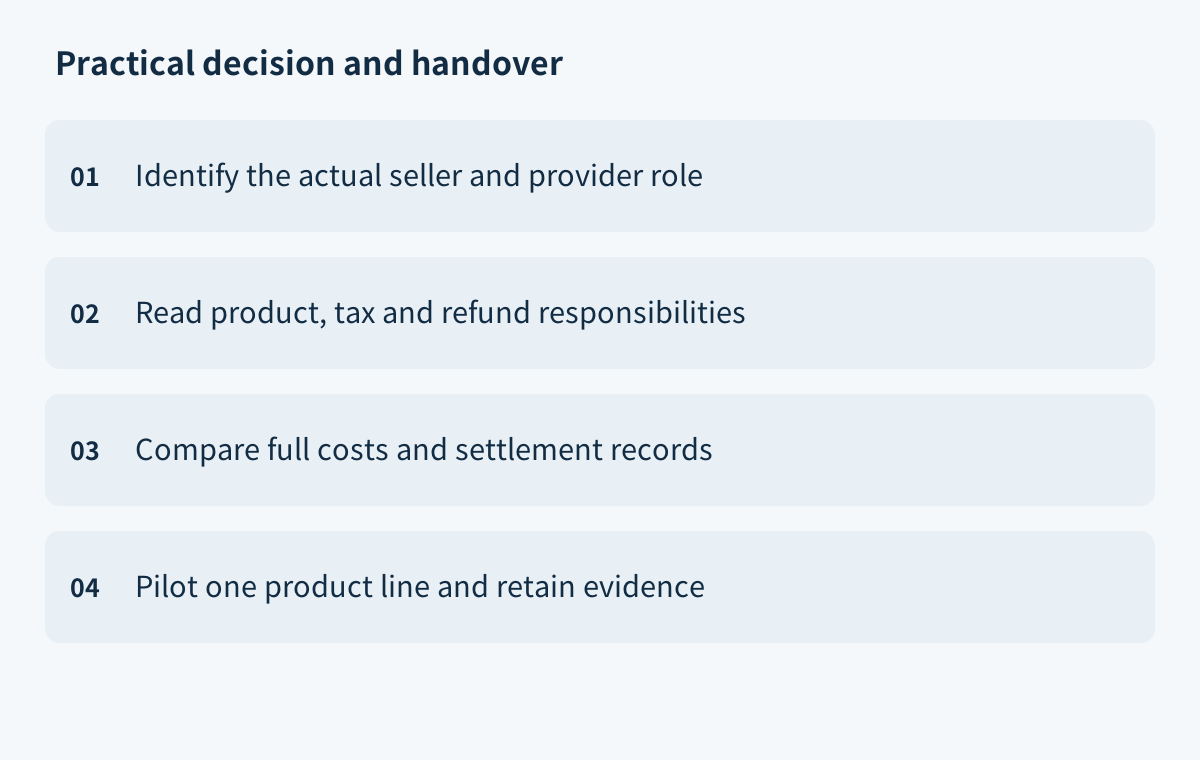
Choose one product line, destination and buyer type. Confirm contract coverage, then run a test transaction or controlled pilot. Obtain applicable terms, fees, settlement cycle, refund rules, export method and support contact first. Get written confirmation if the product or buyer type is outside scope.
Record payment, renewal or failed charge, cancellation or refund, reconciliation and data export, with the responsible party and evidence for each event. Compare the order, refund, provider report, bank deposit and accounting record; list mismatches, delays, reserves and unresolved customer issues. Define pass evidence: the order matches its receipt, refunds agree across reports and accounts, settlement differences are explained, and a named person can retrieve the data. Keep incomplete transactions, late reports or unexplained differences open with an owner and next action. One successful payment does not prove handover readiness.
The final record should state the contractual seller, operational owners, payment and refund details, data location, unconfirmed limits and follow-up owner. Product, finance and operations should confirm exception handling before expansion. Track failures to closure, including duplicate refunds, access remaining active after a failed payment, or missing export fields. Compare with the current flow only using the same market, currency, refund assumptions and observation period. Keep the test date, operator, report version and exception outcomes so the decision can be reproduced.
For case-specific analysis, submit a question through the contact options on the English website. This article is general information, not legal or tax advice, and makes no promise of results.