
When comparing overseas suppliers, the problem is often inconsistent information, not too few candidates: quotes may use different specifications, lead times may start at different points, and sample inspections may not share a record. Give every candidate the same comparison fields and separate confirmed facts, open questions, and decision reasons. Procurement, engineering, and operations can then work from the same evidence.
This scorecard makes differences traceable, gives each unknown an owner, and records why a choice was made. It is a discussion aid, not a precise ranking. The six steps cover requirements, quotes, lead times, samples, scoring, and follow-up, with hypothetical examples.
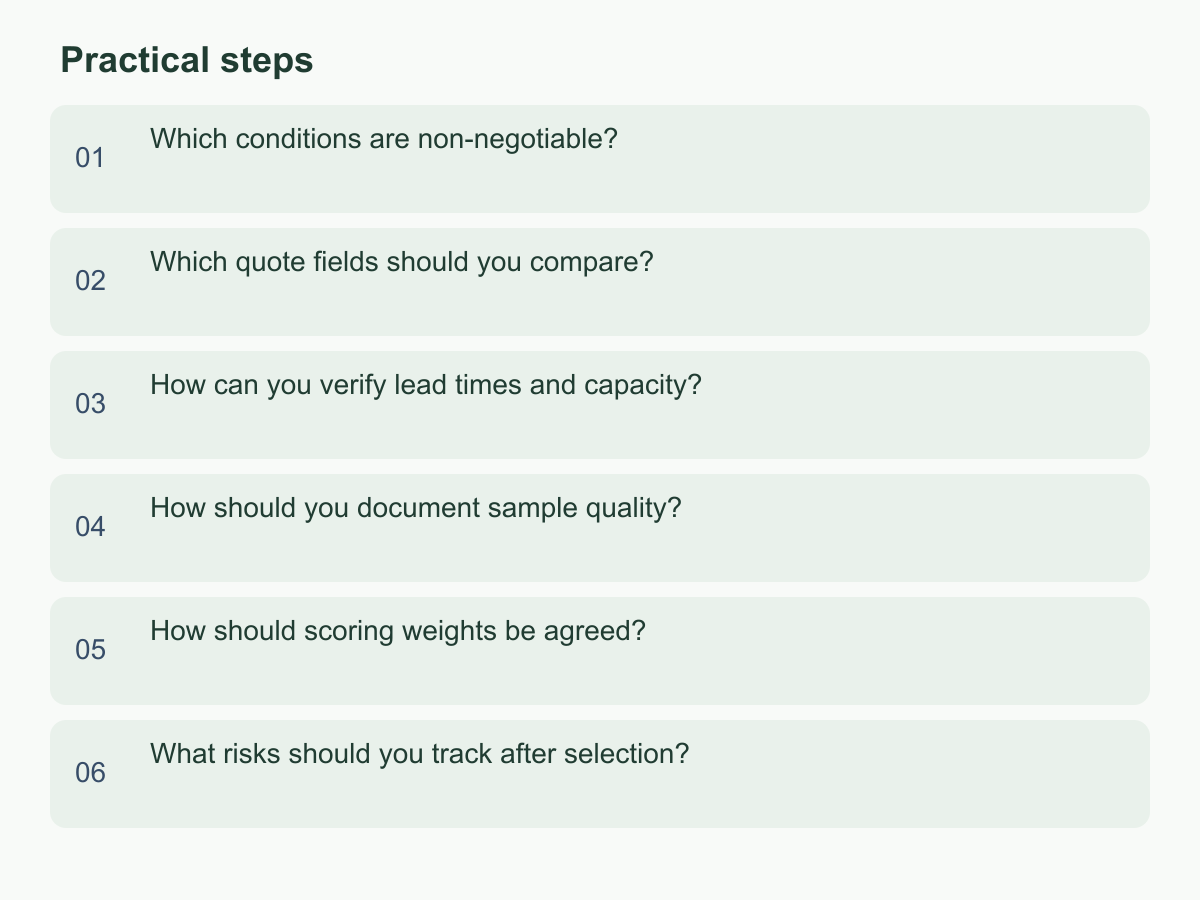
Which conditions are non-negotiable?
Start with one specification sheet that every candidate can answer. Sort requirements into three columns: pass/fail gates, scored criteria, and items to confirm. Reserve gates for unacceptable conditions, such as material or dimensions that do not match the drawing, missing required documents, or a delivery location outside the acceptable area. State the evidence needed to judge each item—for example, a drawing number, measurement method, or delivery address. Avoid vague terms such as “good quality” or “easy to work with.”
Check whether each specification has an acceptable alternative, and record which differences are allowed and who can approve them. Otherwise, a lower quote may omit an accessory or assume a different material. Mark each requirement mandatory, preferred, or negotiable. Ask suppliers to reply “meets,” “does not meet,” or “more information needed,” with the document name, revision, and commitment date. A blank is unknown, not a pass; assign an internal owner to follow up.
For example, if a carton must carry a batch number, list the label position, content, language, and sample artwork for confirmation. Do not impose a standard the supplier has not agreed to. If packaging color can vary, mark it as preferred and name the approver. Keep the original requirement beside each reply; add a dated revision if it changes. Request quotes against the same revision. Record why a candidate fails a gate and stop scoring it; a low price cannot offset a mandatory mismatch.
Which quote fields should you compare?
Compare every quote against the same specification, quantity, destination, and delivery terms. Fix the currency and quote-validity conditions first. Record unit price, minimum order quantity, one-time charges, packaging, samples, molds or fixtures, freight, insurance, inspection, payment milestones, and exclusions. Mark unprovided values as pending, not zero. For different currencies, retain the original amount and record the date and internal conversion basis, so an exchange-rate change is not mistaken for a price difference.
The table is an explicitly hypothetical comparison: same currency, specification, and destination; 100 units per order; freight and inspection fees are totals for the shipment. Unquoted items are excluded, so these subtotals are not actual landed costs.
| Comparison item | Supplier A | Supplier B |
|---|---|---|
| Unit quote | 100 | 94 |
| Quantity | 100 | 100 |
| Freight | 1,200 | 2,000 |
| Inspection fee | 300 | 0 |
| Assumed subtotal | 11,500 | 11,400 |
Calculate the subtotal as unit price multiplied by 100, plus freight and inspection: A is 100 × 100 + 1,200 + 300 = 11,500; B is 94 × 100 + 2,000 = 11,400. The difference is 11,500 − 11,400 = 100. B is lower by 100 under these assumptions, but that does not prove it is better value. Confirm that inspection scopes and delivery terms match, identify unquoted items, and ask suppliers to fill gaps in writing. Compare cost and risk once the quote is complete, and keep each original revision so later changes can be explained.
How can you verify lead times and capacity?
Define the start and end of the quoted lead time. Does the clock start when a deposit is received, a sample is approved, a drawing is approved, or materials are ready? Does it end at production completion, handover to the carrier, or delivery to the named destination? Record the starting event, intermediate milestones, and delivery scope. If materials need advance preparation or a process is subcontracted, place it on the timeline and identify buyer documents or approvals required.
Then ask what supports the supplier’s stated capacity. Beyond “how many per month,” ask which product, shifts, equipment, and subcontracting arrangements the estimate assumes, and whether current orders may affect the schedule. Request a redacted schedule screenshot, production-line outline, or milestone records from a recent comparable order. If those are unavailable, ask for alternative evidence you can verify and record its limits. Treat verbal commitments as unverified, and do not request confidential information beyond what the decision requires.
For example, A says it will ship 30 days after drawing approval, while B says it will finish production 30 days after receiving a deposit. Their start and end points differ, so the estimates cannot be compared directly. Ask both suppliers to use one table for expected dates for drawing approval, material preparation, production, inspection, and carrier handover. Ask when they will report delays and who will update the schedule. Mark uncommitted milestones as pending; if a supplier gives only a total duration, make one follow-up request for the missing detail. Keep the replies, verification method, and unproven items with the decision record.
How should you document sample quality?
Begin with repeatable acceptance criteria. At receipt, record the supplier, date, lot or sample ID, drawing revision, and intended use. Photograph the product, packaging, and labels. For each dimension, material, function, or marking, record the expected value, measured or observed result, judgment, and evidence location. If an item cannot yet be tested, explain why and how it will be checked later; do not mark an unchecked item as passed. This lets later samples be compared item by item before production.
When you find a difference, record what happened, the affected scope, the supplier’s explanation, disposition, and recheck result. Keep photos, measurements, and correspondence in one purchasing folder, with filenames that identify date and revision. Label physical samples to avoid mixing candidates. If you accept a deviation, state its permitted scope, approver, and applicable batch. Test a proposed substitute material or process under a new revision rather than assuming the old sample record still applies.
For example, if the drawing specifies the distance between two hole centers, record the drawing revision, measurement method, actual result, and photo reference—not just “dimensions OK.” Mark any discrepancy and ask whether the supplier will correct it, submit a replacement sample, or request deviation approval. Keep the approval record and have the purchase order or follow-up confirmation refer to the same revision. This helps prevent different interpretations of what was approved when production begins.
How should scoring weights be agreed?
Before scoring, ask the departments that will use the result to select a small number of decision-relevant criteria, such as quality conformance, delivery reliability, total cost, and completeness of communication. Have participants explain why each matters, then agree on weights that add up to 100%. Define what evidence earns each score from one to five. Shared anchors prevent one person’s “4” from meaning something different from another’s. Judge pass/fail gates separately; a high total cannot cancel a failed requirement.
Here is an explicitly hypothetical scoring example: quality 40%, lead time 30%, total cost 20%, and communication 10%. A scores 4, 4, 3, and 5. The calculation is 4 × 40 + 4 × 30 + 3 × 20 + 5 × 10 = 390; divided by 100, that is 3.9. B scores 5, 3, 4, and 3: 5 × 40 + 3 × 30 + 4 × 20 + 3 × 10 = 400; divided by 100, that is 4.0. These scores organize discussion under the example assumptions; they do not prove either supplier’s objective quality.
Link each score to evidence, such as a quote revision, lead-time reply, sample record, or meeting summary. If evidence is missing, mark the item pending instead of scoring from memory. If B leads but its delivery evidence is incomplete, verify it before ranking the candidates. When scorers disagree, identify whether the difference comes from weights, evidence, or interpretation of requirements. Record the weight-setting date, participants, open questions, and decision rationale. If requirements change, start a new revision and score again instead of adjusting old scores to fit a decision already made.
What risks should you track after selection?
After selection, track anything that could still change the decision. For each risk, record its description, possible impact, trigger, owner, next action, expected response time, and latest evidence. Common items include drawing or material changes, missed milestones, unresolved sample deviations, reliance on a single source for a critical component, and unconfirmed quote costs. “Watch the lead time” is not actionable: specify the missing date or update, who will ask whom, and when the status must be refreshed.
Set follow-up frequency according to impact and reversibility. Confirm any outstanding specification approval that blocks production before release; assign issues affecting later orders for review before the next order. For a delay or quality mismatch, preserve photos, timestamps, batch details, and correspondence. Ask the supplier for the cause, an interim response, and a corrective action. Decide internally whether to pause the next step or assess an alternative. Close the item only after recording who approved closure and on what evidence, not merely because a reply arrived.
For example, if a production schedule is due by an agreed milestone date, record the agreed and actual receipt dates, whether the schedule covers each stage, the delay impact, and the next update date. If it does not arrive, the owner follows up and updates status. If dates change, keep both schedule revisions and note whether purchasing or delivery plans need adjustment. Use the same scorecard for two or three candidates, then assign owners to open questions. For information about business operations and overseas business matters, visit the Chan & Chung website.