
Overseas teams often discover a handoff problem only when a claim needs approval or payment: the employee remembers the purpose, the manager remembers the trip, but finance cannot find the receipt or payment basis. Give each employee-paid expense a traceable request, approval, exception, and payment record. Adapt the fields below to your team. When a receipt is missing or a conversion needs confirmation, preserve the original claim and state what remains unresolved so the next person knows what to do.
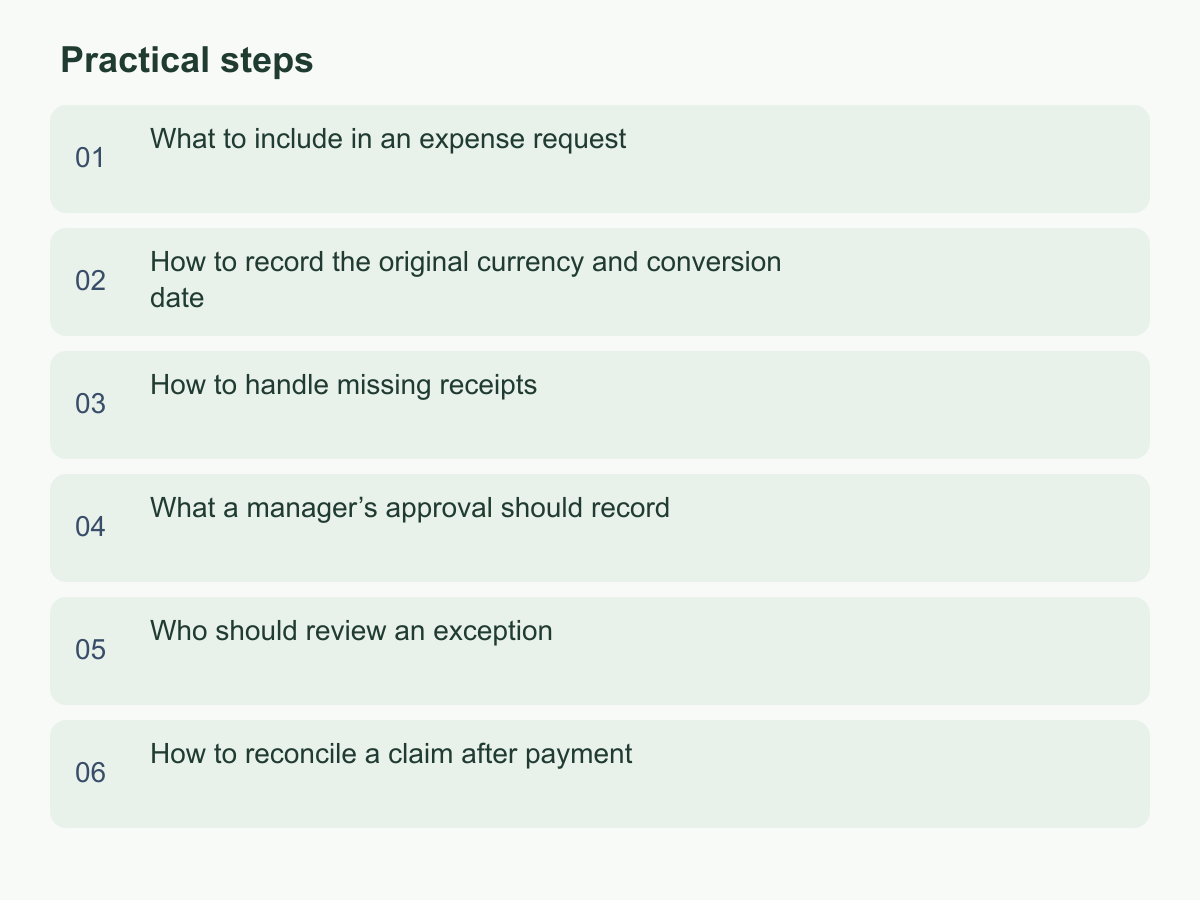
What to include in an expense request
Treat each expense as an item traceable to a person, business purpose, supporting document, and payment outcome—not just a receipt or a total. Capture the employee’s name or ID, team, expense and submission dates, merchant, category, project or client, original currency and amount, payment method, whether a company card was used, receipt file, and notes. Use categories finance can route, such as transport, lodging, meals, software subscriptions, communications, or office supplies. Split a receipt covering different purposes into line items. The employee should state the business purpose and who benefited so the manager can assess its work connection.
Separate basic fields from those needed only in some cases. Date, currency, amount, purpose, payer, and receipt status are basic; travel companion, destination, client, or project code apply only when relevant. Record whether the expense was paid personally or by company card. Finance should collect account details securely; do not put full sensitive details in notes visible to a broad group. Assign a unique claim ID and use it for every later request, approval, payment, and reconciliation.
For a personally paid ride abroad, the record should show the employee, date, destination, route or merchant, original amount and currency, and payer. Mark company-paid lines so they are not reimbursed again. Before launch, complete a typical travel claim and a subscription claim to confirm the form captures what each needs. For teams in several locations, standardize date formats, employee IDs, and project names. Let employees preview the manager’s view, and use “not applicable” rather than zero for irrelevant fields.
How to record the original currency and conversion date
Keep the currency and amount actually charged, with any converted amount in separate fields. Record the transaction date, posting or card-debit date if different, original currency and amount, converted amount, rate or conversion basis, source, conversion date, and person entering it. A card statement may show the reporting-currency debit after the issuer converts the transaction; retain both that amount and the original transaction details. For cash, keep available conversion evidence and label the amount as estimated or based on an actual exchange.
Set one consistent basis in the internal policy, such as a transaction-date reference rate, the actual card-statement debit, or another finance-selected source. Explain how to handle weekends, refunds, split claims, and bank fees; employees should not choose a date that gives a more favorable amount. Keep transaction date and conversion date separate. If using the statement debit, record its date and amount and label the rate as finance-calculated or not applicable rather than deriving false precision. If using a reference rate, retain the source and lookup date so a reviewer can reproduce the result.
| Field | Hypothetical entry | Purpose |
|---|---|---|
| Original amount | JPY 4,800 | Confirms the reported amount |
| Conversion basis | Assumed rate: 0.052 | Shows the basis |
| Date and converted amount | Assumed transaction date; HKD 249.60 | Allows a check |
These are illustrative figures, not a market rate. Link a refund to the original claim, retain its date and currency, and record the difference under internal policy instead of offsetting an unrelated expense. If sources disagree, note the temporary basis and who must confirm it; do not close the item with an unsupported figure.
How to handle missing receipts
A missing receipt does not by itself prove an expense invalid, but it does not remove the documentation requirement. Mark the claim as awaiting documents or a decision and keep the original request; do not open a replacement that breaks the trail. Ask the employee what is missing, when they noticed, how they tried to obtain the receipt from the merchant or platform, and what alternatives they can provide.
Depending on the transaction, alternatives may include a payment notification, order confirmation, itinerary or attendance record, card statement, email, or merchant correspondence. Each supports different facts: a payment record does not establish business purpose, and a calendar entry alone does not prove the amount. Separate original receipts, alternatives, and still-missing information so the reviewer can see what the evidence does and does not show. Finance should check which alternatives policy permits and who may approve an exception, then specify what the employee should provide. Do not request a file already on record or create receipt details that never existed.
If only some lines lack documents, list the complete and unresolved lines separately. Follow policy on whether supported lines can proceed, and do not mark an unapproved amount payable. For example, on a two-ride trip with one lost receipt, the employee might provide the other receipt, a payment notification, and a short explanation. The manager confirms the trip connection; finance decides whether this meets internal rules. Record what was requested and received, whether accepted or returned and why, who decided, and when. If the evidence remains inconclusive, name who must provide what next. Preserve original files, later versions, and receipt times rather than replacing earlier material.
What a manager’s approval should record
Record a readable decision, not just a checked status or “looks good” in chat. Include the claim ID, approver, role or delegated authority, decision time, approved scope, returned or partly approved lines, conditions, and brief reason. The manager should consider purpose, project or beneficiary, date, category, and relevant policy. If the expense is outside the manager’s authority, route it to an authorized decision-maker; a small amount does not make a policy issue disappear.
If the employee changes the amount, currency, purpose, or receipt after approval, preserve old and new values and identify who reviewed the revision. An earlier approval should not silently carry over to changed information. For a delegate, record when they took over, the claim types or limits they may approve, and who authorized them. Set boundaries in policy rather than letting claimants choose reviewers.
Keep approval and payment checks distinct. The manager assesses business purpose and policy exceptions; finance checks documents, amount, currency, payee details, and duplicate-claim risk. For example, approve lodging but return an unclear meal line for clarification, recording each result separately. Each return should identify the next action, owner, and question to answer. If several managers review different lines, record each scope and keep the basis for delegated authority on file; a previous case does not grant authority for the next one.
Who should review an exception
Exception fields should route a claim to someone who can act. Capture the exception type and trigger, affected lines, missing information, responsible role, current handler, next action, party expected to respond, whether payment is paused, decision, and closure date. Categories may include a missing receipt, amount outside internal policy, incomplete conversion evidence, unclear business purpose, company-card and personal expenses in one request, or a refund found after payment. Categories organize work but do not replace case review. Each status should show who has the next move, what is missing, and when to revisit it.
A simple role map can send the employee to clarify purpose or provide documents, the direct manager to confirm the business connection, and finance to check amounts, conversion evidence, and documentation against internal rules. A policy exception beyond the manager’s authority goes to the role designated in that policy. If the question needs expertise outside normal expense review, identify the appropriate external professional and pause the affected line; routine approval is not a substitute for that advice.
If a claim currency differs from the card statement, finance can record both amounts and the debit basis, then request the statement or transaction details. If the difference remains unexplained, route it to the finance lead to select the policy basis. Whether complete lines can proceed while one is pending depends on team rules, and the decision should be recorded. Have the designated owner review exceptions weekly or at each close, updating the delay reason, contact, and next action. A team-set tracking interval is an internal management target, not a statutory deadline. Repeated exceptions may show where the form or guidance needs improvement.
How to reconcile a claim after payment
Approval does not mean payment has happened, and sending payment does not mean every line is reconciled. Under the same claim ID, record the payment batch or transaction reference, payment date, actual currency and amount, method, payee, remittance or card-settlement record, and reconciler and date. If payment differs from approval, note the difference, reason, and treatment. Link refunds, cancellations, and returned transfers to the original claim. For batch payments, record each claim’s allocation; for installments, record each payment so an approval is not paid twice in full.
Compare each line with the request, decision, original-currency details, conversion basis, receipt status, and actual payment. Show unpaid, partly paid, paid, awaiting refund, and awaiting documents as distinct states, and check for duplicates. For example, JPY 4,800 at the assumed internal rate of 0.052 HKD per JPY calculates to HKD 249.60. This is an arithmetic illustration, not an actual rate. If the posted amount differs, record the statement or conversion difference and internal treatment without overwriting the original claim. If the payment cannot be matched to a payee, amount, or claim ID, mark it for investigation; “payment submitted” is not “reconciled.”
At close, hand over an open-items list with each claim’s owner, missing evidence, completed steps, next action, and latest status date. The incoming person can follow the same IDs through request, approval, and payment. Unpaid claims also need an owner and next review date.
Start with one recent employee-paid expense and one company-card charge. Run both through these fields, then add the applicable internal policy to the form guidance. For more about Chan & Chung or to raise a case-specific question, visit the English homepage.