
When an overseas warehouse count shows a discrepancy, do not immediately change the system total to match the physical count. Check whether quantities agree for each SKU, location, batch, and cut-off time, separating transfers, returns, and status changes still in progress. The aim is a traceable workpaper that explains the variance, review responsibility, and approval for any adjustment.
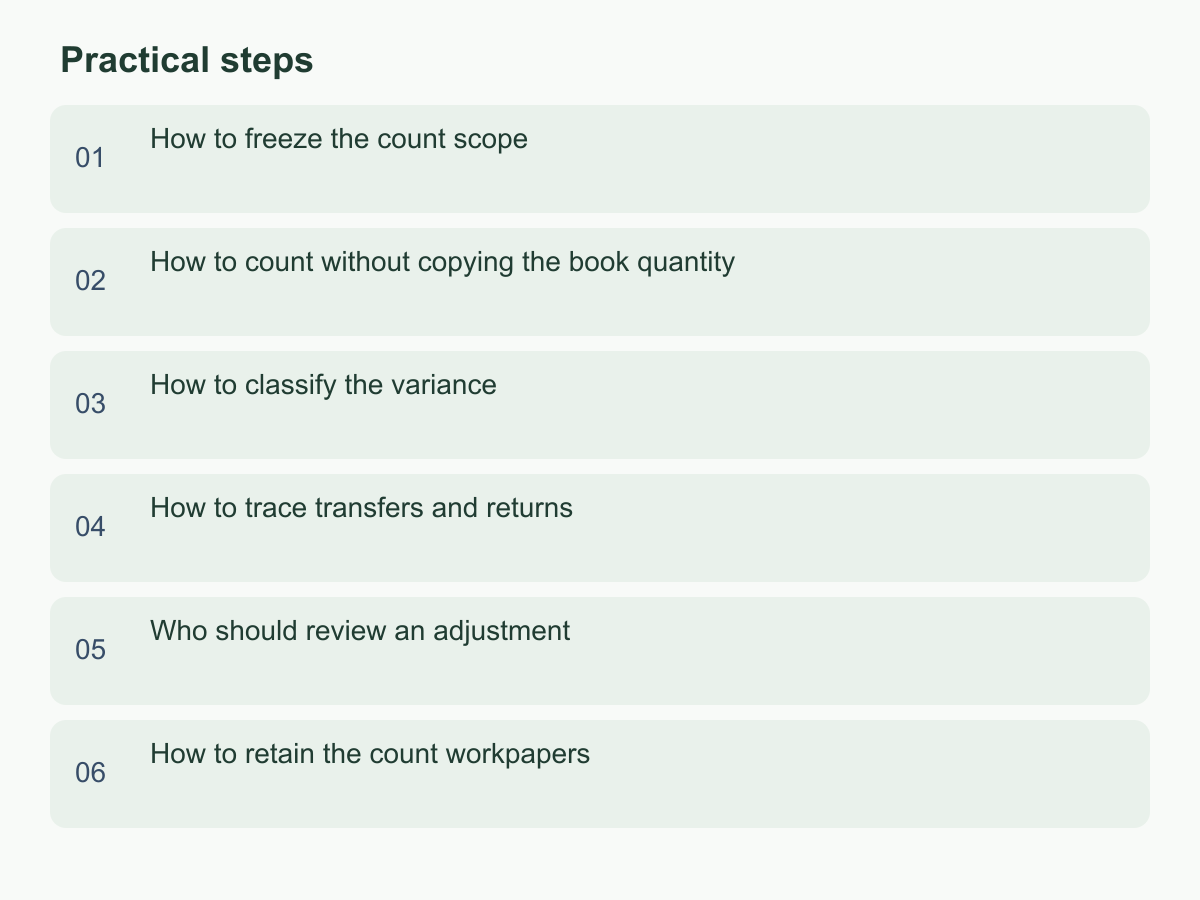
How to freeze the count scope
Specify the warehouse, zone, rack or bin, SKU range, and the time represented by the system inventory. Keep location and batch detail rather than exporting only a SKU total. Separate batches by status, such as available, awaiting inspection, or damaged, so a variance can be located.
Agree on a cut-off time and export a timestamped book snapshot. Record its data source, unit of measure, and conversion basis. Ideally, pause receiving, picking, and movement in the area. If operations must continue, log each receipt and issue with time, item, batch, quantity, origin and destination, and handler. Do not combine transactions from before and after the count into one variance.
List out-of-scope goods, such as third-party consignment, returns awaiting inspection, or quarantined stock, with their location and custodian. Show counted and active locations separately; for example, the same SKU in a picking bin and returns area must retain each location and status. If the system shows only warehouse totals, add identifiable location or batch details before investigating.
Have one person confirm the list covers the agreed area and another check the snapshot against open transactions. Mark blank batches, unclear units, and nonexistent locations as unresolved. Retain a read-only original snapshot. Record each warehouse’s time zone and local cut-off, and check for duplicate location codes so transactions around midnight are assigned consistently.
How to count without copying the book quantity
Use a blind count sheet that hides book quantities. Record SKU, batch, location, unit, physical quantity, time, and counter for each row. Enter zero for an empty location; never leave it blank, since that could mean a missed count. Where cartons, packs, and individual units are mixed, confirm the conversion and record the underlying unit count.
Follow a fixed route and mark completed locations to avoid skips and duplicate counts. Sealed cartons may be counted from reliable labels, with sample checks that packaging matches; count loose units individually. Record unclear batch labels, mixed batches, and items in holding areas separately, with label and location evidence where permitted. Do not infer a batch. Barcode scanners and mobile counting apps are external tool options for reading identifiers; a scanned code does not verify the carton’s contents.
For a discrepancy, have a second counter recount without seeing the first result and retain both figures. If they disagree, a third person and the warehouse lead should count together and record the resolution. Use weight estimates only when unit weight is stable and the scale works; label the quantity as estimated, separate from a piece count. Do not change system quantities during the count.
If a physical label differs from the list, record the label, scanned identifier, and location, then ask the data owner to check the item-master mapping. Keep uncertainty on a pending list. Before closing, the area lead should account for counted and uncounted locations, pending items, and in-transit holding areas. Preserve first-count and recount fields and both sign-offs; do not erase original figures.
How to classify the variance
Calculate each variance as physical quantity minus book quantity and keep its sign. Classify only to a verifiable cause. Investigation leads include receipts not posted, dispatches not deducted, transfers completed at only one end, returns awaiting inspection, damaged or quarantined stock placed in an available location, duplicate scans, unit conversions, and batch errors. Confirm a cause with transaction records, labels, or physical evidence; a shortage alone does not prove loss.
Summarize by SKU, batch, and location. Matching SKU totals can still hide a batch error if one batch is short and another over. The figures below are hypothetical and illustrate the arithmetic only.
| Hypothetical item / batch | Book | Counted | Initial lead |
|---|---|---|---|
| A-01 / batch 07 | 120 | 114 | Short 6; check dispatch or movement |
| A-01 / batch 08 | 48 | 50 | Over 2; check return receipt |
| A-02 / batch 09 | 30 | 28 | Short 2; check damage or quarantine |
The book total is 198 units; the physical total is 192, a net shortage of 6. Investigate each row separately, since a net amount can hide a batch misallocation. Even if one line is short 6 and another is over 6, equal totals do not resolve the location or batch error.
For each variance, record a cause code, evidence, provisional or confirmed status, owner, and next step. Mark unsupported causes pending. If several variances point to delayed receipt posting, identify and check each related transaction; do not assign one transaction to two causes. Convert system quantities and labels to a common unit before comparison and retain the conversion basis. Show carton and loose-unit counts separately.
How to trace transfers and returns
For each transfer, compare source and destination warehouses, SKU, batch, quantity, and event sequence. Check the request or pick record, physical handover, destination receipt, and system posting. A system document alone may not show that both ends were completed, that goods arrived in parts, or that a transaction was posted twice. List transfers still open at the cut-off as in transit or pending, noting physical location and custodian; apply the company system’s existing status rules to the book balance.
For example, assume the source records 20 units dispatched, the destination confirms 18 received by the cut-off, and handover staff still hold 2. Show “20 dispatched by source,” “18 received by destination,” and “2 pending confirmation” separately. Check the handover time, destination receipt, and actual location of the two units. Do not count all 20 at destination or adjust inventory just because two are unaccounted for. Record each partial delivery with its quantity and receipt time.
Trace a return from arrival through inspection and posting. Check its identifier, original SKU and batch, received quantity, condition, quarantine location, and whether it moved from inspection to available stock. Distinguish an item shipped but not received, received but not inspected, and approved for restocking. Record its actual status: an in-transit return is not available stock, and a return awaiting inspection is not automatically a loss.
If goods moved without a matching system record, ask the handover, receiving, or returns owner to reconstruct the timeline. Retain source documents and supplemental explanations; do not guess a transaction time. Show in-transit, inspection-pending, restocked, and unresolved quantities separately, with a source record and owner for each. Link both sides with the same transfer reference rather than matching by nearby dates.
Who should review an adjustment
Separate investigation from approval. The counter submits the original count; the investigator assembles evidence and a proposed cause; the warehouse lead confirms location and handling; the inventory or finance data owner checks the accounting impact; and an authorized manager approves under the company’s existing rules. Even when duties overlap in a small team, retain a traceable second reviewer. One person should not count, determine the cause, and approve alone.
The reviewer should confirm that scope and cut-off are clear; the variance recalculates from snapshot and count; batch, location, and units agree; receipts, transfers, returns, dispatches, and quarantine records support the conclusion; and each proposed change matches a stated cause. If a transaction was merely delayed, check how it appears in the book before adjusting, to avoid duplication. Keep unknown causes open for a manager’s decision; completing the count is not itself a reason to change stock.
An adjustment request can list SKU, batch, location, book quantity, physical quantity, difference, proposed adjustment, cause, evidence link, preparer, reviewer, and approval time. For example, if the book shows 50 units and the count is 47, and quarantine records identify 3 damaged units, explain their treatment under the system’s status rules. If quarantined goods still count as inventory, “not for sale” alone does not justify reducing the total.
Prioritize review based on quantity, scope, cross-batch impact, or recurrence, using thresholds defined by the company rather than an assumed fixed amount or percentage. If a request is returned, record missing evidence and its owner. After approval, retain before-and-after quantities and the system transaction identifier so the count, management decision, and posting remain traceable.
How to retain the count workpapers
Give each count a unique work reference. Keep together the scope, timestamped original snapshot, blank or blind sheets, each round of counts, variance list, investigation evidence, review comments, and approval. Index files by warehouse, area, cut-off, and version. Keep the original read-only; save revisions separately with editor, time, and reason. Workpaper totals should reconcile to the snapshot and count sheets, not just a final report with overwritten figures.
Link each variance to retrievable source material, such as receipt or transfer records, return inspection, quarantine lists, label photos, or approval. Photos should identify label, location, SKU, batch, and variance reference. Where photos are prohibited, use a traceable written description and document index. A single variance reference can connect the main list, receipt evidence, and reviewer sign-off.
At close, confirm that every location is marked counted, uncounted, or excluded; each variance has a confirmed cause or an assigned follow-up owner; and each adjustment has review and approval evidence. Reconcile in-transit transfers, pending returns, and quarantined quantities to their supporting lists. Keep unresolved items open with the next reviewer and checkpoint. Follow the company’s data-retention and access policies rather than assuming a retention period.
A useful first exercise is one SKU, one batch, and one location, confirming that the blind count, investigation, and approval fields connect before expanding. For Chan & Chung information, visit the Chan & Chung website. Version paper scans too, so they remain retrievable.