
When an overseas employee leaves, managers need a checklist that tracks who owns each task and what proves completion: who takes over the work, collects equipment, handles access, and confirms outstanding payroll records. This guide covers people and operational handovers before and after departure. Employment, compensation, and tax requirements vary by location and case and should be checked separately. Appoint a coordinator and assign work to the manager, HR, IT, and finance.
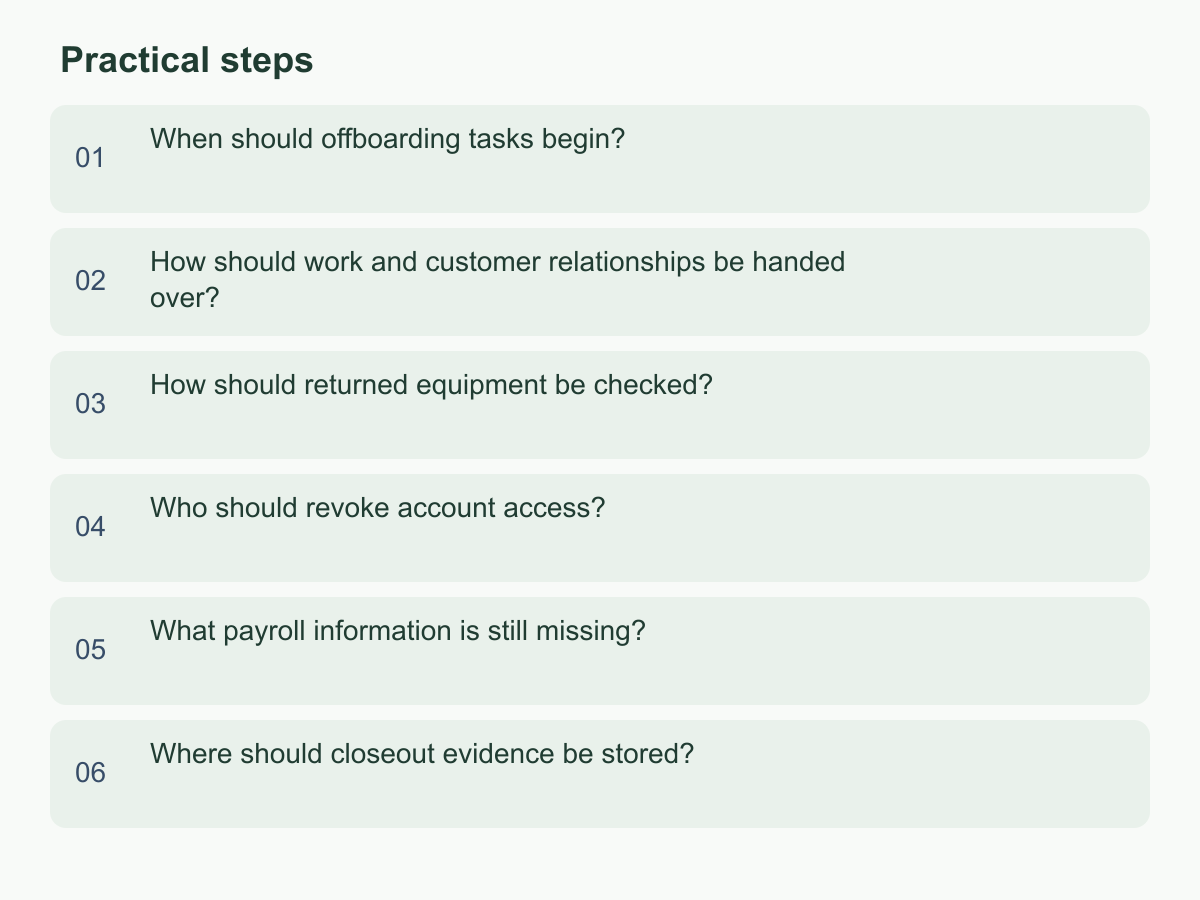
When should offboarding tasks begin?
As soon as a departure is known, confirm the final working day, role, work location, and any necessary departure category. Start a shared tracker rather than waiting until the last day. The manager lists responsibilities, customer commitments, recurring work, and the next owner; HR checks departure documents and notifications; IT inventories accounts, devices, and shared resources; finance gathers outstanding payroll records, expenses, and advances.
Each row should show the task, owner, deadline, status, blocker, completion evidence, and reviewer. If there is no dedicated HR team, appoint a coordinator. Limit sensitive payroll details to finance and authorized staff. Because the departure type may affect notice order and handover time, HR should check the contract and local process before scheduling; this checklist is not a legal determination.
For a cross-time-zone team, record both time zones and confirm the final access window. If the employee leaves Friday and the successor starts Monday, name an urgent contact and weekend backup. Mark dependencies, such as moving files before collecting a device or assigning a new owner before transferring a shared account. If deadlines conflict, prioritize by customer impact and security risk and escalate early.
At kickoff, flag work that cannot pause, undocumented knowledge, and handovers needing customer or third-party help. If the departure date moves forward, narrow the scope, preserve critical process notes, and assign owners to open items. For example, if finance will verify payroll records on Monday after a Friday departure, arrange another person to provide them; do not leave the former employee’s account active until then.
How should work and customer relationships be handed over?
Make the tracker useful to the successor: list recurring duties, active projects, unanswered customer messages, commitments, pending approvals, exception handling, and file locations. For each item, record status, next action, due date, internal owner, and whether the customer needs an update. Keep customer records in approved company systems with appropriate access, not personal address books or private cloud folders.
In a handover meeting, the departing employee can demonstrate a task, the successor can perform it, and the manager can confirm the result. If a task cannot be completed then, document the steps, decision rationale, common errors, and escalation contact.
For example, for a quotation awaiting a customer reply, record its version, validity period, promised conditions, and next follow-up date. Have the new owner accept responsibility to prevent conflicting replies. Send unapproved commitments, disputes, or unusual payment arrangements for manager review; do not pass them on with a vague instruction to continue as before. Include only needed customer data and confirm the successor’s access.
After the meeting, outgoing and incoming owners update the tracker. The manager resolves blockers and unassigned items. Distinguish “handed over” from “successor can handle independently”: the first requires a list and files; the second requires the successor to complete a real task. Record the impact of leaving an item undone and whether it can pause. If nobody can take over, name an interim owner and update the external contact. Schedule low-risk routine work for document review and later follow-up.
How should returned equipment be checked?
Before return, send the employee and receiver an inventory of company-issued laptops, phones, access cards, chargers, storage media, and other equipment. Record asset or serial number, accessories, quantity, return location, delivery time, and receiver. At collection, match items to the list; check condition, power-on status, and accessories, noting damage or items not tested. Avoid vague “equipment is fine” entries and assumptions that ordinary wear is the employee’s responsibility.
For remote returns, keep the pre-packing list and shipping details, and have the receiver record what arrived, for example with photos. If a parcel is delayed or lost, assign an investigator and follow-up date. Move work files to an approved company location. IT should confirm necessary files are readable before erasing company data or resetting the device under company procedure. Handle personal photos and accounts under company policy and local requirements; do not browse or copy them casually. Check for loaned peripherals, test devices, or backup phones as well.
If the list shows a laptop, power adapter, and access card but the card is missing, record “partially returned,” name who will follow up, and set a response date. Do not mark it complete. For damage, loss, or data that must be preserved, record the facts and notify the manager and IT contact; do not promise an immediate wage deduction or charge. Use statuses such as “received,” “to be located,” “needs repair,” and “unable to confirm,” and have both parties acknowledge discrepancies. Both the returning employee and receiver should confirm the list; update the company asset register afterward.
Who should revoke account access?
Cross-check the staff roster, single sign-on platform, team password manager, device inventory, software charges, and system administrator lists. Include company email, file storage, customer-management and finance systems, code or project tools, advertising platforms, cloud hosting, support channels, building access, and multi-factor authentication devices.
For each entry, record the account holder, data or asset owner, administrator, successor, access level, disable time, and person making the change. Mark uncertain accounts for manager and IT review; absence from the first list does not prove an account does not exist. Remove personal logins, active sessions, and credentials that should no longer be used. Before removing access from a shared mailbox, schedule, billing account, or automation that must continue, assign a successor and verify the needed access. Check that a service will not lose its only administrator or interrupt essential work.
For an account that cannot be transferred, follow company procedures to preserve company records or update ownership. Never share an employee’s personal password. If the employee has recovery codes, hardware keys, or an authentication device, collect what is appropriate and have an administrator confirm access has been updated. If transfer is delayed, record the interim control and the risk management accepts. A manager should spot-check sign-in and ownership for high-impact systems, update emergency contacts, and investigate and add unknown accounts. Confirm deactivation scope and timing against local requirements, company policy, and system capabilities. The tracker records responsibilities; it does not replace a security or regulatory assessment.
What payroll information is still missing?
Separate records into four groups: verified and ready for finance, awaiting employee documents, awaiting manager approval, and requiring confirmation against local rules. HR and finance can review the final working day, recorded hours, leave or shift data, fixed and variable pay items, approved commissions or bonuses, expenses, advances, and records of company property not yet returned. Whether an item affects pay depends on the employee’s actual work location and arrangement; do not apply another country’s calculation by default.
For each entry, record the source document, period, currency, amount, approver, and whether it is included in the current reconciliation. If an approval or receipt is missing, assign someone to obtain it and set a due date. Do not enter an estimate as verified. This hypothetical internal follow-up table illustrates status tracking; it is not a payroll calculation or deduction instruction:
| Item | Illustrative amount | Status and next step |
|---|---|---|
| Approved travel reimbursement | 2,400 | Finance checks receipt, then lists it for processing |
| Unapproved transportation expense | 500 | Employee supplies receipt; manager reviews |
| Business advance already paid | 1,000 | Finance reconciles it and marks it pending review |
Do not offset these entries or treat the unapproved expense as pay. The amounts are hypothetical units illustrating status only; they establish no amount due. After review, finance should record the reconciliation result, unresolved reason, response contact, and next owner under company process.
Confirm payment timing, withholding, and required documents against current official requirements for the employee’s location and arrangement. Refer questions to HR or an appropriate professional; do not infer a deadline or tax result from this guide. For different currencies or periods, retain the original currency and basis rather than calculating final pay. Record employee disputes, the response owner, and expected update date; silence is not confirmation.
Where should closeout evidence be stored?
Keep records in an approved company location with controlled access that authorized staff can find. Create a case number or folder for each departure, not in a personal cloud account or path managed only by the departing employee. Index the checklist version, date, document name, owner, approval or receipt status, access level, and follow-up links. Restrict payroll, identity, and sensitive customer records separately; keep only needed status and file locations in the main tracker.
Evidence may include acknowledged handover lists, file-ownership transfers, equipment receipts, access-change records, outstanding payroll items, and approved exceptions. Each record should show who did what and when. Crop screenshots containing other employees or customers, or use a less revealing record with enough context.
Do not use a closed status to hide unfinished work. Record the risk, interim owner, follow-up owner, and expected response date until responsibility has moved. Check retention periods and access against applicable requirements, company policy, and data type; avoid extra copies or keeping records longer than needed.
Before closing, confirm every task has an owner, equipment has a recorded disposition, access changes have a result, payroll questions have an owner, and evidence is readable by the right people. Mark the checklist closed and tell necessary managers where it is stored, without posting sensitive attachments broadly. Use filenames with date, subject, version, and status; link to the approved repository instead of circulating duplicate attachments. Periodically check that links and permissions work and remove access when it is no longer needed.
A useful next step is a 30-minute internal meeting to fill in owners, deadlines, and evidence fields, then work through the list. For more information about Chan & Chung, visit the English homepage.