
When a confirmed overseas order will arrive in several deliveries, track each shipment’s items, quantity, address, and date while preserving the order total and customer commitments. Record batches against the original order so deliveries, balances, and address changes remain clear.
Use an existing spreadsheet to check shippable items, split quantities, verify addresses and dates, track balances, and reconcile handoff and receipt. This guide covers one order; it does not allocate inventory across platforms or replace customer confirmation. Examples are assumptions; verify arrangements against the order, packaging requirements, and carrier information.
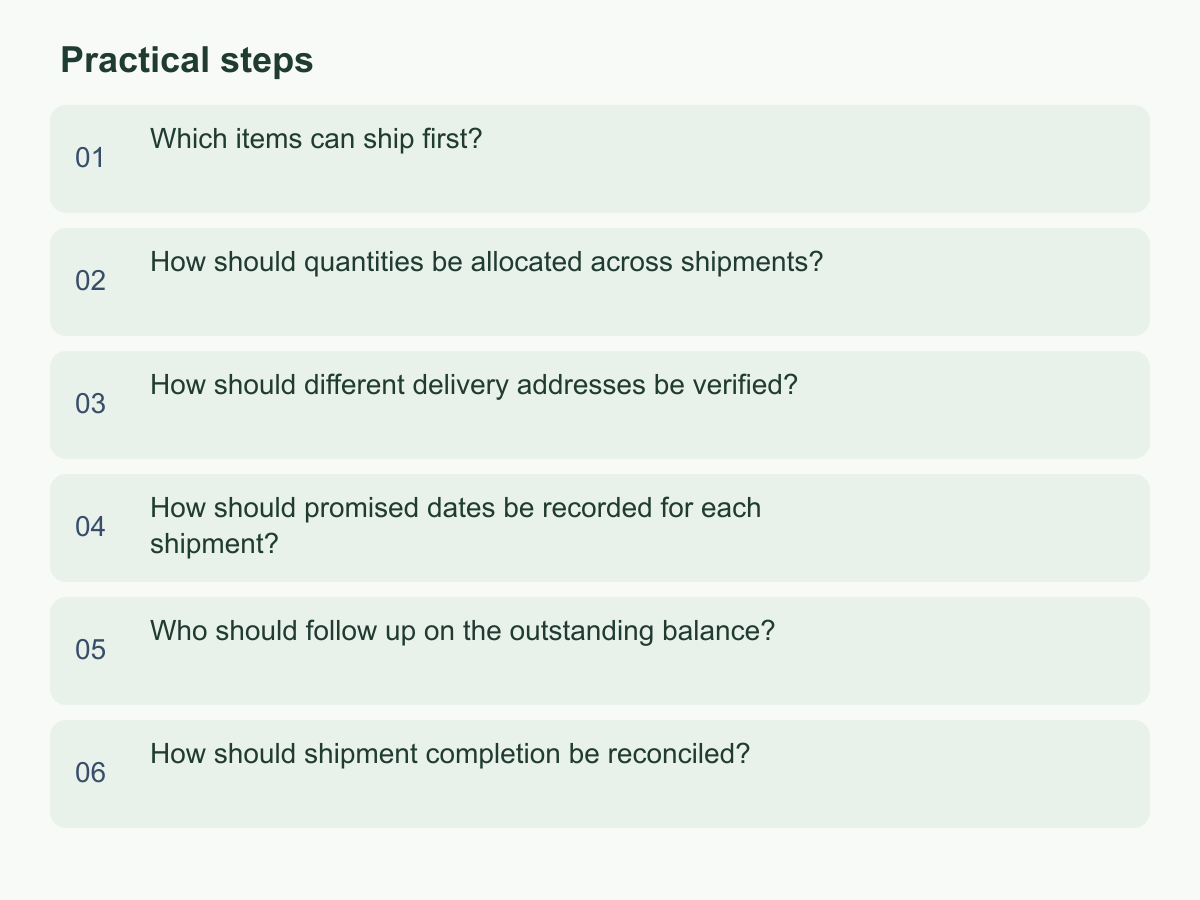
Which items can ship first?
Check each confirmed order line against physical stock. Record the product name or SKU, ordered and confirmed quantities, approved substitute specifications, packing unit, and counted available quantity. List bundle components separately to distinguish order units from warehouse units. An item is ready only when its specification matches, its quantity is counted, and customer requirements for combinations and sequence are met. Confirm acceptance of mixed lots.
Flag indivisible kits, accessories that must accompany the main item, products needing expiry-date or serial-number checks, and substitutes requiring written approval. If two colors must arrive together, mark them as awaiting confirmation. If an accessory may arrive later by agreement, record who agreed, when, and what it covers.
For example, a 40-set order includes one main item and two fixed accessories per set. With 32 main items and 80 accessories on hand, only 32 complete sets can ship; eight must wait. Have the picker recount and the order owner match the batch to the original order. Record the count time and discrepancies. Keep expected arrivals separate as projected, even when supply and timing are confirmed.
How should quantities be allocated across shipments?
Lock the order total and specify the unit—pieces, cartons, sets, or weight—for each line and shipment. Deduct only quantities actually delivered with evidence. Delivered and remaining planned quantities must not exceed the order. Keep undelivered quantities visible; for complete-set requirements, record the condition before scheduling.
For illustration, a confirmed order totals 120 pieces: 50 in the first shipment, 40 in the second, and 30 in the third. If only 48 are ready for the first, revise it to 48 and the balance to 72. Confirm whether later dates must change; do not leave 50 as the apparent commitment.
| Shipment | Originally planned | Verified for shipment | Outstanding afterward |
|---|---|---|---|
| First | 50 | 48 | 72 |
| Second | 40 | 40 | 32 |
| Third | 30 | 30 | 2 |
The first shipment is two pieces short. If the customer agrees to move them into the second, revise it to 42 and the balance after that shipment becomes 30. Record quantities before and after, reason, person raising the change, and customer confirmation. Account for minimum pack sizes, carton multiples, transport limits, and customer priorities. State where any remainder goes and use consistent label units. Keep shortages, damage, and goods awaiting inspection visible. If the order quantity changes, revise it first, then recalculate unfinished shipments.
How should different delivery addresses be verified?
Create one delivery card per shipment. Include the recipient or company name as provided, phone with country code, country or region, state or province and city, postal code, street and building number, floor or unit, contact hours, and latest customer-confirmed version. Link it to the shipment and goods. Do not guess place-name translations or omit department and industrial-park names.
Keep the customer’s original wording beside the shipping-label format. Ask them to confirm spelling, field order, and delivery availability; reformatting must not change the substance. For multiple destinations, get the item and quantity split per address and confirm the sum equals the shipment total. When an address changes, supersede the old version and record when the new one took effect.
Use two-person verification: one person prepares the card from the original instruction, and another checks each label field against the confirmed version. Missing phone numbers or cities, mismatched unit numbers, or uncertain country and postal-code formats stay pending confirmation. Before dispatch, reconfirm the recipient is reachable and able to accept delivery; record the channel and time.
For a 24-piece shipment split between an office receiving 14 and a warehouse receiving 10, use separate lines with address versions, quantities, and contacts. If four pieces are redirected to a third address, recalculate all allocations to total 24, confirm the new split and label with the customer, and retain the superseded instructions and reason. Link each address to its own promised date if dates differ.
How should promised dates be recorded for each shipment?
A customer promised date differs from the warehouse’s expected completion date and the carrier’s estimated delivery date; record them separately. For each shipment, include planned picking and handoff dates, promised delivery date, time zone, address, supporting information, and update owner. If only handoff can be committed to, state that milestone and explain delivery timing depends on confirmed carrier arrangements. Do not present an internal estimate as a definite arrival date.
Set a date only when items are shippable, the address is verified, packing can be scheduled, and required customer information is complete. Otherwise mark it pending. For changes, record old and new dates, reason, time raised, customer response, and who will notify affected recipients. “Delayed” or “as soon as possible” is not a date or evidence of agreement.
Sort by promised date and review shipments due within the coming week: check inspection, labels, carrier response, and recipient availability. If delivery is promised for November 12 but the customer confirms a receiving window only on November 10, check whether the date still works before changing it. Across time zones, include the local zone or city. For a request to arrive by Friday, clarify which location’s time applies and when the recipient can accept it. Keep each shipment’s full date and time zone, even if an overview shows only the earliest and latest dates.
Who should follow up on the outstanding balance?
Assign one overall order owner and name the colleagues responsible for supply or purchasing, warehouse work, customer contact, and carrier coordination. Calculate the balance by order item and unit: ordered quantity minus verified delivered quantity. Show inspection holds, cancellations, and customer-requested pauses separately.
A tracker should show outstanding quantity, reason, next verifiable milestone, due time, owner, and latest customer response. Milestones include supplier replenishment confirmation, a completed warehouse count, customer address confirmation, or carrier collection or delivery. “Keep an eye on it” is not a milestone. If one slips, update the facts, assess the effect on promised dates, and discuss options before the delay surprises the customer.
For example, if 18 pieces remain—10 awaiting a warehouse count and eight paused at the customer’s request—record two lines, not “18 outstanding, waiting for stock.” The warehouse owner reports the shippable amount and discrepancy. The order owner records what will release the other eight and when a response is due. Get customer confirmation before redirecting or cancelling quantities, then update the balance before changing the shipment plan.
Review each shipment before its promised date and update the tracker when replenishment, address, or carrier replies arrive. If there is no progress, set the next follow-up time and record what was communicated. Link handoffs to the original order and shipment numbers so everyone uses the latest confirmed balance.
How should shipment completion be reconciled?
Reconcile against actual carrier handoff and receipt evidence, not completed picking or a printed label. Keep the order and shipment numbers, items and quantities, address version, handoff date and contact, tracking or shipment identifier, and proof of dispatch. After delivery, add receipt confirmation, proof of delivery, or a discrepancy record. Number cartons and link each to its contents list.
Compare planned, dispatched, customer-received, and outstanding quantities line by line. For shortages, damage, refusal, returns, or other discrepancies, preserve the original figures and add the reason, owner, customer confirmation, and next action. Do not overwrite the shipment as complete. Close it only when required items are delivered or the customer explicitly agrees to cancel or reschedule the remainder and records are updated. Close the order only when the balance is zero or each remainder has a documented disposition.
For example, a shipment planned for 30 pieces is picked as 30, handed to the carrier as 29, and signed for as 28. Record 29 dispatched and 28 received, plus one piece not handed over and one receipt discrepancy: two pieces remain to investigate or resolve. Check the carton list, handoff record, and proof of delivery. Once confirmed, follow the customer-approved step—resending, refunding, adjusting, or continuing the investigation—and update one shared balance for customer support and accounting.
Finally, reconcile each item against the order: delivered, outstanding, customer-cancelled, or otherwise resolved with confirmation. Keep address and date changes traceable, ensure the customer has the latest status, and leave unfinished matters open even if one shipment is signed for. Apply these fields to an order and confirm missing quantities, addresses, dates, or owners with the customer. For official Chan & Chung information, visit the website.