
A quarterly review with a distribution partner should give both sides one shared record of what happened, what is blocked, and who will do what next. Before the meeting, align the period, opportunities, orders, delivery issues, evidence, and assumptions. Then resolve differences and assign owners with clear acceptance evidence. A spreadsheet or existing CRM can hold the record; the tool itself does not verify the data.
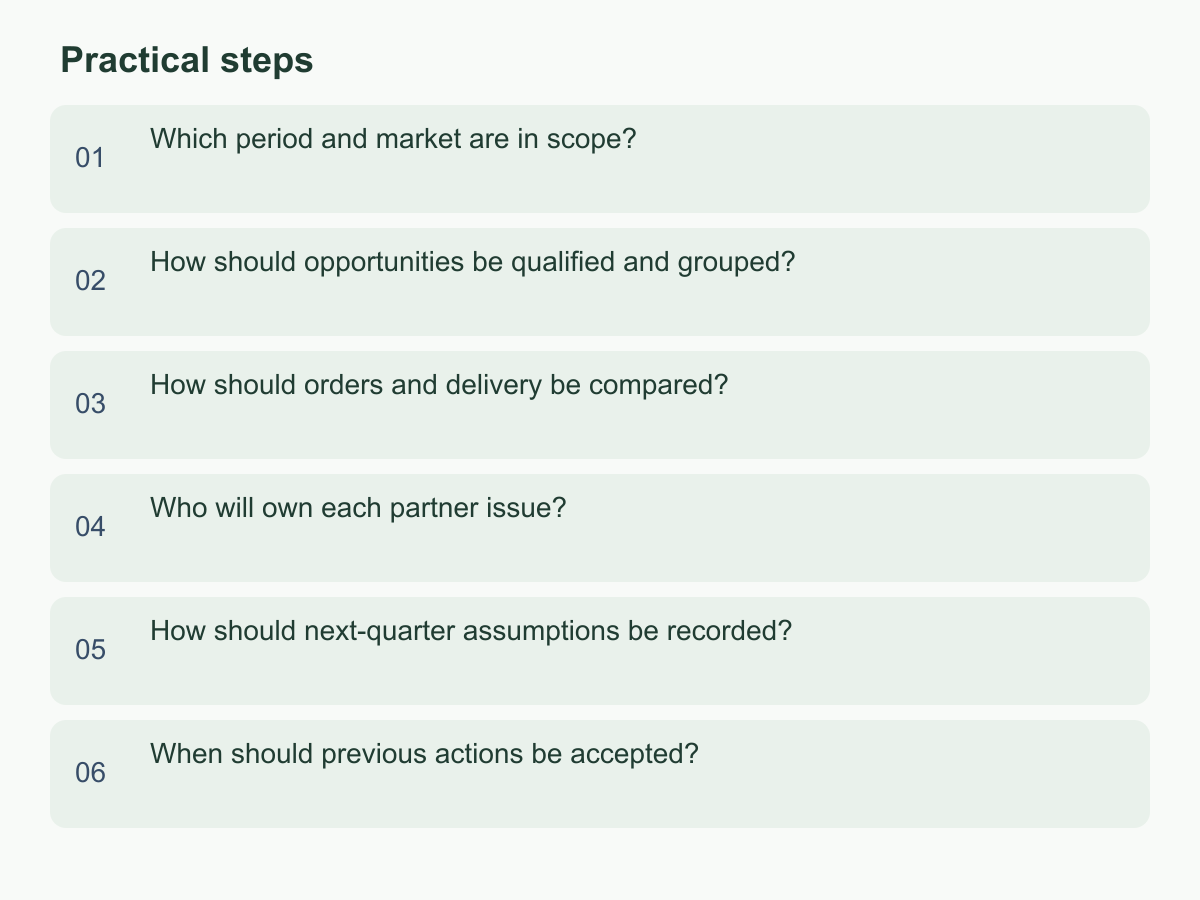
Which period and market are in scope?
At invitation time, state the start and end dates, time zone, meeting date, and data cutoff. For a quarter, specify calendar quarter or agreed sales cycle. Keep “created this quarter” separate from “still active this quarter.” Group opportunities by creation date, orders by order or confirmation date, and delivery issues by event date. The rules may differ; label each field to prevent competing totals.
Set boundaries for country or region, customer segment, channel, and product category. Agree how to list cross-region leads or referrals transferred to another partner, including whether each appears once. Put disputed items in a pending list rather than count them as results. Standardize date format and time zone; save the cutoff export. Keep later additions separate until both sides approve them. Distinguish “not provided” from zero: zero means checked and none found; missing means unknown.
For example, assume new opportunities from July through September are reviewed in early October. Mark September 30 as the cutoff and list October updates separately. If reports use local dates and system timestamps, align the cutoff and assign a contact to reconcile remaining records.
How should opportunities be qualified and grouped?
Verify that every record identifies a customer or project, need, source, and partner contact. Capture entry date, market, need summary, referring party, receiving owner, last interaction, next step, and due date. Keep only contact data needed for follow-up; do not copy a full customer list into the meeting pack.
Set stages together and define evidence for each: a new lead has an unconfirmed need; a qualified need has a customer reply or meeting note; a proposal has a sent date and pending decision-maker; a won or lost record has an agreed outcome and date. Map different stage names before comparing conversion. High value alone is not high priority; check whether the customer is still evaluating and set the next contact date.
| Example stage | Evidence | Next step |
|---|---|---|
| New lead | Referral logged; need unknown | Confirm need and contact |
| Need qualified | Use, timing, or roles stated | Decide on proposal and reply date |
| Proposal pending | Sent date; decision outstanding | Ask about blocker and timing |
| Outcome unclear | Status unknown | Confirm; do not count as won |
These are examples, not a partner policy. Remove duplicates, distinguish separate projects for one customer, flag records with no recent contact, and preserve both views where partners disagree. Review the evidence, missing information, and next check—not just the total.
How should orders and delivery be compared?
Separate opportunity progress from confirmed orders: an opportunity tracks a potential collaboration; an order records agreed terms. Link it to a customer or project with a shared reference; record scope, confirmation date, quantity, promised delivery point, and status. For splits, additions, cancellations, or specification changes, log the date and confirmer. Estimates, proposals, and unconfirmed purchase intent are not orders.
Track delivery separately with simple statuses: scheduled, in progress, delivered, awaiting acceptance, missing information, or exception. Name who verified each status and the supporting correspondence, receipt, or shared record. These are suggested labels, not fixed platform fields. Dispatch does not prove receipt or acceptance; record any open acceptance condition and who must confirm.
Match orders one by one to opportunities using reference numbers. Flag quote-to-order scope differences, date changes, and who approved them. For currency, discount, payment, or recognition discrepancies, preserve both sources and ask responsible contacts to reconcile; never alter figures just to balance the sheet. Record the outcome, missing evidence, and update date.
For example, assume one confirmed order has two delivery batches: the first has a receipt record; the second is unscheduled pending specification. Show both under the order and name the specification owner and reply date. Do not mark the full order delivered.
Who will own each partner issue?
Record issues as events to resolve, not judgments about people. Include date, affected customer or work, known facts, impact, open questions, and action needed from each side. Cite the customer reply, delivery record, or partner report. If accounts differ, preserve both and address confirmed impact before assigning cause.
Assign one lead contact, supporting contacts, next action, due date, and completion evidence. The lead coordinates; both sides may act according to who holds information or controls the work. Prioritize by customer impact, blocked shipment or service, risk of wider effects, and time waiting. Route possible contract, financial, or personal-data matters to an authorized internal contact; exclude unnecessary detail from the general meeting.
For example, a customer reports that received specifications differ from what was confirmed. Preserve the order version and customer reply; mark impact unconfirmed. The party holding the requirements record compares versions while the other checks delivery. If later work may be affected, agree whether to pause and who updates the customer. Keep the suspected cause marked as unverified.
Before closing, mark each item resolved, in progress, awaiting information, or needing escalation, with the next action. Name one lead, not “both sides.” For overdue items, notify the contact, state the impact, and use the partners’ existing escalation process.
How should next-quarter assumptions be recorded?
Write next-quarter ideas as hypotheses, not forecasts or promises. Record the observation, inference, unknowns, a small test, resources needed, and review date. Repeated pre-proposal questions about delivery scope may support a test that clearer scope information could reduce follow-up; this is not a proven market finding or guaranteed sales result.
Assign a joint contact and each side’s action. Define evidence that could support, challenge, or leave the idea unresolved: customer understanding, repeated questions, where progress stops, or whether a handoff was completed. For counts or rates, agree on denominator, period, source, and record owner; with sparse evidence, establish a baseline instead of generalizing from a few cases. Record positive, negative, and inconclusive results.
Record assumptions about staff availability, material ownership, eligible customer groups, and scope limits. Name the authorized person to consult if market, legal, financial, or specialist judgment is needed; keep advice marked pending until received. List dependencies such as unconfirmed pricing, delivery capacity, or customer consent before starting.
Use one page for the hypothesis, evidence, gaps, next step, owner, review date, and continuation criteria. If partners disagree, preserve both views, their basis, and the evidence needed to resolve them. At next quarter’s review, decide whether to continue, revise, or stop and record why.
When should previous actions be accepted?
Open the previous action list and verify each owner, due date, deliverable, and acceptance condition. Use clear statuses: completed, partly complete, not started, cancelled, or awaiting the other party’s confirmation. An email, meeting, or document does not by itself prove completion. If no acceptance method exists, ask the proposer what record, result, or confirmation would count.
Check evidence against the original scope: updated opportunity record, mutually confirmed order version, delivery response, or customer communication. Record source and date. Note any gap; do not invent a percentage without a shared calculation. If the other party has not confirmed it, mark “sent; awaiting acceptance.”
For late items, identify whether information is missing, a contact changed, priorities shifted, a dependency remains open, or the approach failed. Cancel, rewrite, reassign, or retain the item. If retained, set a new due date, needed support, and check-in date instead of copying the expired deadline.
For example, if the prior action was to compile common customer questions, check that the document exists, was shared, is easy to use, and covers the requested topics. If it was sent but not reviewed, record “provided; acceptance pending,” plus a contact and reply date. If needs changed, explain the cancellation and open a replacement action.
Before the next meeting, send both contacts the action list and evidence fields. Use meeting time for disputed, overdue, or decision-ready items. Start a review by assigning a cutoff, source, and owner to every record. Learn more about Chan & Chung on the English homepage.