
For a distribution partnership, each sales asset should answer three questions: who may use it, where it applies, and whether it is valid. Inventory presentations, product descriptions, price lists, case studies, FAQs, and contract attachments, then assign an owner and status. These examples are general assumptions; each party maintains market and product data in its own source system.
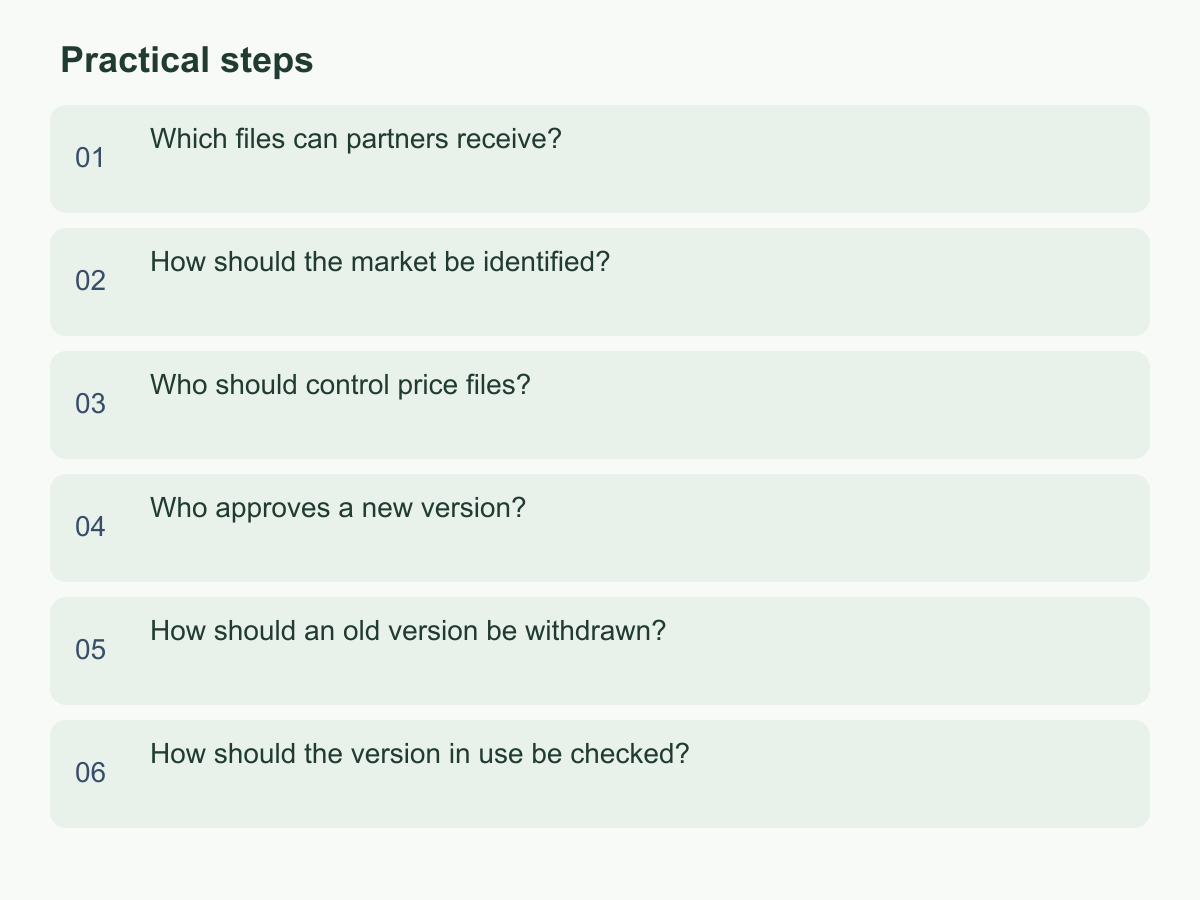
Which files can partners receive?
Separate files partners may share with customers from those used only for internal decisions. This keeps cost estimates, unapproved discount worksheets, and internal records containing personal data out of customer packs. External materials may include a company and product overview, approved specifications, presentations, catalogs, FAQs, quote request forms, and case studies cleared for public use. State the audience and permitted use for each category.
Do not rely on a folder labeled “latest”: downloaded copies lose update notices. Give each asset a unique ID, title, language, market, version, effective date, approver, status, and contact. Show the version and lookup location on the cover or footer. A separate internal register should also record the owner, source file, downstream copies, and withdrawal method.
For a Taiwan channel introduction, provide “Product Overview—Taiwan—Traditional Chinese—v1.2” with approved FAQs and note that a quote requires an application. Set a minimum pack by stage: overview and approved deck for introductions; specifications and FAQs during evaluation; quote request documents after needs are confirmed. Confirm permission for customer-named case studies or results. Define allowed and prohibited uses, give partners one access point, and have them check IDs on emailed files rather than relying on old messages or personal drives.
How should the market be identified?
“Overseas” or “Asia” is too vague. Record country or region, language, currency or quote currency, sales channel, customer type, and conditions needing review. Mark fields “not applicable” or “pending confirmation” rather than blank. Keep language separate from market: two Traditional Chinese documents may differ in content, currency, contacts, or commitment scope.
For multi-market material, list approved markets and anything still requiring local confirmation. If only some paragraphs differ, create separate versions rather than asking partners to assemble them. For example, give “Taiwan / Traditional Chinese” and “Malaysia / English” distinct IDs. The source may be shared; approvals stay separate. Use market, language, and content type in file names and folder filters so downloaded copies stay identifiable.
Do not reuse a neighboring market’s file for an unapproved market. Mark “pending confirmation,” assign an owner to assess differences, and record who decided and when. State whether use is recommended or prohibited; do not rely on color alone. If no approved file exists, name who will assess language, support contacts, currency, and sales restrictions. Until then, partners may explore needs but make no specific commitments. For translations, record the source version; an approver checks key figures and wording before release.
Who should control price files?
Price files may combine list prices, partner terms, discount limits, and internal costs. Separate partner-facing and internal versions by audience; never send the full worksheet expecting recipients to ignore sensitive fields. A named price owner maintains the source and sets distinct view, download, edit, and approval permissions. A quote request does not grant edit access.
For unusual quantities, bundles, or discounts, partners submit customer context for an approver to issue a time-limited quote. They cannot change formulas or reuse another customer’s quote as a price list. Mark shared files with version, market, approval status, and audience. Table values below are assumptions, not actual prices or commercial terms.
| Assumed file | Scope | Version and status | Access |
|---|---|---|---|
| Standard price list | Taiwan / Traditional Chinese | v1.0, approved | Partner may view; no price edits |
| Special discount request | Named customer | Draft, pending approval | Partner submits; price owner approves |
| Internal cost estimate | Internal use | v0.3, unapproved | Designated internal staff only |
Keep the effective date, expiry condition, and approver on every copy. For changed terms, disable the old link, publish and notify partners of the replacement. Tie each exception to date, currency, quantity, or scope; re-export after changes rather than editing old files.
Who approves a new version?
Name an approver; “the team approved it” is insufficient. Content proposes changes; product or operations checks facts; market or pricing confirms scope; a designated approver releases the external file. Small teams may combine roles, but must log checks and the decision.
For each change, record reason, affected markets and sections, source, and whether the old file needs immediate withdrawal. Check specifications, prices, contacts, dates, links, and disclaimers. Compare the candidate with the previous version and list unresolved differences rather than overwriting the approved copy. The record should show version, effective date, approver and time, summary, scope, and next review trigger.
If a presentation gains a market note, the market owner confirms scope, the content owner updates wording, and the approver releases it. If prices did not change, record “not changed in this revision”; a presentation-wide version bump does not reapprove pricing. Update the filename, cover, folder index, and download page together so two files do not both look official.
Log requester, reason, comparison, affected files, reviews, and decision; “received” or a chat reaction is not approval. The publisher checks version marks, links, and download location; if also checking, record both roles. Retain the prior file and a major-change summary so partners can assess active proposals.
How should an old version be withdrawn?
Deleting a file does not remove partner copies. When a replacement takes effect, mark the old file “withdrawn” centrally and record the date, reason, replacement, owner, and partners to notify. Keep an internal controlled archive outside the download path.
Close the old sharing link or remove general access, then update shortcuts, access pages, and templates. Through the formal relationship channel, tell partners the retired file ID, stop-use date, replacement, and how to handle proposals in progress. Include the new location and reply method; ask partners to replace usual copies and confirm. For attachments they cannot delete remotely, ask them to remove or mark the file and report status.
Record a replacement even for a spelling correction; a brief notice is enough. For material price or market changes, identify affected proposals and quotes for the owner to decide on reissue or customer follow-up. Link both versions to notices and replies. Assign follow-up if a partner does not respond or an offline copy is missing; do not assume withdrawal succeeded. Close after updating the central link, notifying affected partners, and assigning owners for open cases. Record actions for unretrievable copies; do not claim deletion from every device.
How should the version in use be checked?
Check files partners use, not just the central folder. Prioritize changes to prices, commitments, or market scope; sample stable overviews during partnership reviews. Select a copy from an active proposal, recent quote, or common template. Record its filename, version mark, source or recipient, and check date, then compare market, language, effective date, approver, and status with the register.
Open the file; do not rely on its name. Check the footer, price conditions, links, and withdrawn wording. If there is no version mark, compare key fields or content fingerprints, ask the material owner to identify the source, and have the partner replace it using the central access point.
If a proposal uses withdrawn v1.0 but quote terms have not changed, record the source, discovery method, owner, and replacement result. If terms changed, pause quote use until an approver decides on customer contact and reissue. Record only necessary check details, not sensitive customer data. Classify results as “compliant,” “replace,” or “needs decision”; record asset ID, partner, result, owner, completion date, and next action. Feed recurring problems into naming, notices, or access rules; adjust check frequency after major changes based on volume and risk.
For further information, visit Chan & Chung.