
Petty cash may be modest, but separate records for payments, receipts and counts make month-end differences hard to explain. Give each cash movement a traceable reference, a responsible person and supporting evidence. Keep the ledger balance separate from the cash counted, and leave unexplained differences open for investigation.
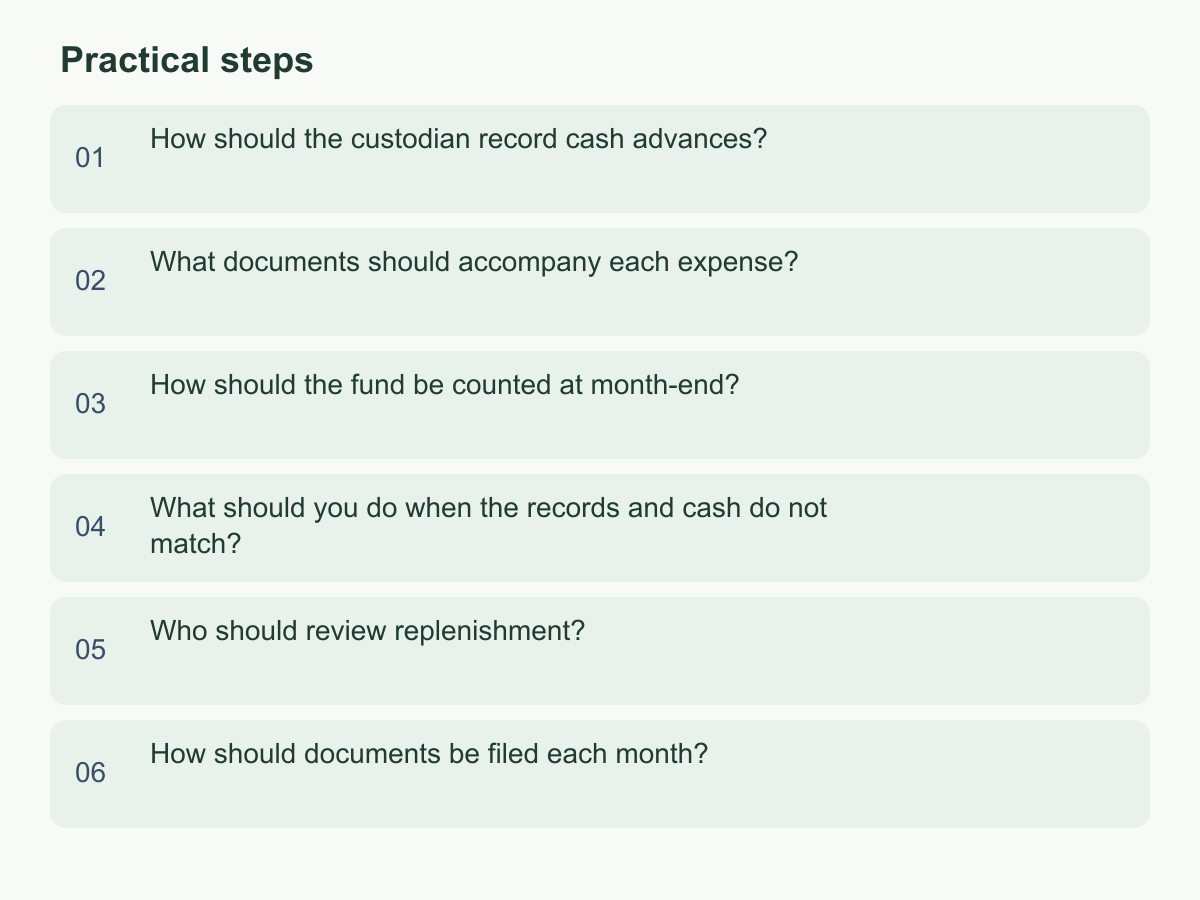
How should the custodian record cash advances?
Treat petty cash as a fund with a set opening amount. Assign a custodian to hold the cash and keep its transaction record. When custody changes, both people count the cash, check receipts not yet submitted, and record the handover date, amount and signatures. Set out who may request cash, who approves it and whether a payment needs advance approval. The custodian handles and records transactions but is not the sole approver by default. Name a deputy, specify the storage place and limit access.
Give every payment a sequential or traceable reference. Record the date, recipient, purpose, amount, expense category, voucher reference, approver and resulting ledger balance. Subtract each payment from the prior balance. Record money added to the fund separately, including date, amount and supporting basis; do not simply change the ending total. Use one row per transaction and avoid vague entries such as miscellaneous expense or records completed from memory at month-end.
Label money advanced before a purchase as temporary, with the holder and expected document date. Settle or return it under the same reference. For example, HK$38 postage paid from an assumed HK$2,000 fund leaves HK$1,962. Record the recipient and mailing purpose, attach the receipt and note any change returned. Track employee out-of-pocket payments under the company’s process so advances, reimbursements and direct petty cash payments remain distinct.
What documents should accompany each expense?
Match each payment with evidence that explains it, such as a receipt, invoice, payment record or company expense form. Check the date, merchant or payee, amount, items and payment method. If a receipt shows only a total, add the purpose to the expense form for the approver to review. One receipt covering several items should have the items listed so the reviewer can connect the total to the business need.
Write the expense reference on the document and use it in the ledger so a reviewer can trace the entry to its evidence and back. Keep all pages of a multi-page receipt together. Retain electronic receipts as readable files, not just payment notifications that omit the items purchased. Describe the work purpose clearly: mailing contract documents is more informative than postage. Before submission, check that the date falls in the period, the amount matches the record and the purpose is understandable to someone not involved.
For a HK$48 document-printing payment where the receipt shows only the shop and total, add the purpose, date, requester and related work to the form for approval. If a receipt is lost, do not create a replacement that resembles a merchant original. Use the company’s permitted missing-document explanation, noting the reason, date, amount, payee and available evidence. If the original is later found, link it to the same reference and note when it was added. Keep the claim pending while information is missing.
How should the fund be counted at month-end?
Set a cutoff time and pause cash receipts and payments. If work cannot stop, list transactions during the count separately so the cash and ledger share a cutoff. The custodian gathers receipts not entered, incomplete documents and the latest replenishment record. A reviewer confirms the cutoff; one person counts each note and coin while another records the results. If only one person is available, note the time, denominations, later sign-off and any witness or reviewer.
List the number and subtotal for each denomination, then add the subtotals. For example: HK$100 notes, 10, subtotal HK$1,000; HK$50 notes, 8, subtotal HK$400; HK$20 notes, 2, subtotal HK$40. Physical cash totals HK$1,440. These figures are illustrative. For sealed bags or a locked box, note whether unopened cash is included and who was present. Use the same method monthly and calculate from denomination counts rather than estimating a total first.
Compare counted cash with the ledger balance. List approved expenses not yet reimbursed and completed transactions awaiting entry separately; timing differences can otherwise look like a shortage or surplus. Retain the opening balance, cutoff, denomination counts, ledger balance, counted amount, difference and signatures. For unresolved items, record status, owner and next step. Do not change original figures to make the form balance. Resume payments after the count and record new transactions in the next period.
What should you do when the records and cash do not match?
Keep the original ledger and counted amounts on the count sheet. Note the time, direction and amount of the difference, then mark it pending. Have another person recount the cash and recalculate the ledger. Check addition, duplicate entries, missing replenishments and cutoff times. Then compare references with supporting documents for a payment not entered, an entry without evidence, change not returned or incomplete handover. Record what was checked and found. Do not put the difference into general expenses or assume the custodian is responsible because the amount is small.
Illustrative example in Hong Kong dollars:
| Count item | Amount |
|---|---|
| Opening petty cash | HK$2,000 |
| Supported expenses | HK$560 |
| Expected cash in the ledger | HK$1,440 |
| Physical cash counted | HK$1,340 |
| Shortage pending investigation | HK$100 |
HK$2,000 less HK$560 equals HK$1,440; the HK$1,340 count is HK$100 lower. Check whether an HK$100 voucher was omitted or cash changed hands without a completed handover. If evidence is found, record its reference, date and how it was discovered, then enter or correct it through the company’s approval process. Preserve the original amount, change, reason and approver rather than overwriting the difference.
If the cause remains unknown, keep it on the pending list with checked documents, next action and owner—for example, ask the requester, review a handover or see whether it recurs next month. Apply the same approach to surpluses and shortages: do not automatically treat a surplus as income or shortage as expense. Refer repeated differences or access concerns to a manager under internal procedures. Close an item based on evidence and approval, not the month-end date.
Who should review replenishment?
The custodian prepares records for someone who can inspect the originals and did not hold that cash. The division depends on staffing and delegated authority. Submit the period, opening cash, payments, evidence, count sheet, ending cash and pending differences. The reviewer checks references, calculations, purposes, approvals and document amounts. Include only supported expenses approved under the company’s process. List missing documents, duplicate references and unresolved differences separately with a follow-up owner.
Opening cash less confirmed expenses should explain the ledger’s ending cash. If replenishment is meant to restore the fund, calculate it under company rules using confirmed expenses. Keep pending differences separate. The reviewer records the approved amount, missing documents or reason for declining; an authorized person then pays. Add the payment date, method and evidence to the records. If the custodian handles payment too, retain proof for a separate reviewer.
In the example, HK$560 may be approved if supported, but the HK$100 shortage is not an expense. Adding HK$560 to HK$1,340 gives HK$1,900, still HK$100 below the assumed HK$2,000 fund. Keep the difference pending. Follow company policy if investigation is required before payment; if undisputed expenses may be replenished, list them separately from the open difference. The custodian confirms receipt, and the reviewer files approval and payment proof.
How should documents be filed each month?
Create a monthly file with the transaction record, vouchers, count sheet, replenishment request and payment evidence, sorted by reference or date. An index can list each reference, date, purpose, amount, location and review status. For items awaiting documents or investigation, add the owner and next step. Keep paper records in order and name electronic files consistently so a reviewer or accounting staff can find the evidence. If both copies exist, identify the original and scan.
Check that scans are readable and files open. Retain originals or formal versions required by the company. Do not mix months in an unsorted folder or erase correction history: keep the original entry and note the change time, reason and approver. Limit access to people who need the records. If an external accountant or service provider handles them, confirm the handover format and transfer method. Filenames can include the month, reference and document type without unnecessary personal information.
Before closing, the custodian checks references against documents and confirms the count sheet has a date and signatures. The reviewer confirms each replenishment and pending item has a status and records the file location. At handover, check the index, inspect one voucher, recalculate a subtotal and confirm each open item has an owner. Use the same fields next month; if purpose or recipient is often omitted, make those fields visible at entry. Start with one month’s opening cash and complete its transaction, document and count records.