
Cross-border orders often describe the same product in pieces, cartons, or bundles, but the chosen unit affects purchasing, inventory, and reconciliation. Start with one base unit and convert every package or combination back to it. Keep each transaction’s original quantity, converted quantity, and the factor version used at the time. If carton splitting, bundle contents, or decimals are undefined, warehouse and finance teams may record the same goods differently. The figures below are hypothetical examples for a unit master that can be recalculated and handed over. This article covers quantity management, not tax or accounting judgments.
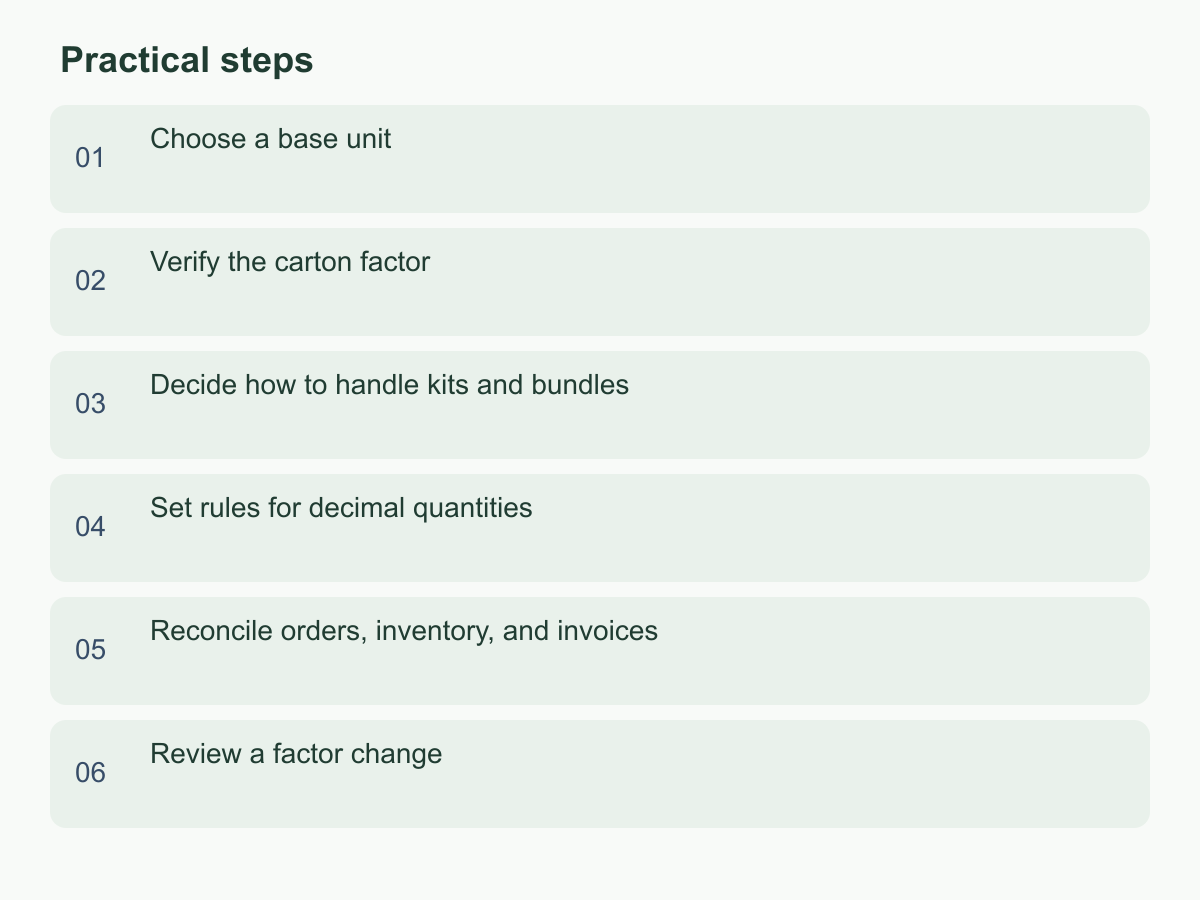
Choose a base unit
A base unit should be the most stable quantity for counting, picking, and reducing stock; it need not be the package used most often for purchasing. If an item can be identified, sold, and returned individually, “piece” is often suitable. For goods managed by length, weight, or volume, use the corresponding measured unit.
Ask whether an opened product remains the same manageable item. If not, the complete kit may be the stock unit, with its components recorded separately. Do not count both a finished kit and its components as available stock and deduct both for one sale.
For each specific SKU and specification, record the product code, specification, base unit, transaction units, whether packages can be split, counting method, and maintainer. Similar names do not prove that pack sizes match, so verify factors separately.
For example, assume an item can be sold individually. Use “piece” as the base unit and “carton” for purchasing and shipping; a receipt of three cartons must update stock in pieces. Give purchasing, warehouse, and finance the same order and ask each team for its base quantity. If answers differ, clarify the definition before activation.
Record why the base unit was chosen, then test it against opening stock, purchasing, receiving, shipping, and returns. If stock shows 96 pieces and an order shows four cartons, the verified factor must explain their relationship. If carton contents vary, do not force one fixed factor. Document how opened cartons and remaining pieces are counted and how each unit appears on documents, so a purchase unit is not mistaken for a stock unit. Have someone outside setup recalculate an order from the master alone; if they need verbal instructions, the definition is incomplete.
Verify the carton factor
Record the direction explicitly, for example, “1 carton = 24 pieces.” A bare “24” can be read either way. Keep the product code, specification, package version, and source together; similar-looking cartons may contain different quantities.
Compare supplier information with the carton label and goods received. If paperwork says 24 pieces but the count is 23, investigate a short receipt, a mixed carton, or a different package version. Record the actual receipt difference; do not change the master factor to make paperwork match.
Have one person enter the factor and another independently recalculate it. Retain the source identifier, verification date, verifier, and applicable SKUs. Write out the multiplication:
| Transaction unit | Calculation | Base quantity |
|---|---|---|
| 1 carton | 1 × 24 pieces | 24 pieces |
| 3 cartons | 3 × 24 pieces | 72 pieces |
These figures are illustrative, not universal. If a carton contains inner packs, verify each level and multiply through the packaging hierarchy; do not mistake inner-pack count for piece count.
When supplier or packaging changes, verify the new information and keep carton sizes as distinct units or versions with clear scope. Recalculate one order and one actual receipt per size to distinguish receiving differences from conversion errors. Confirm carton splitting with the warehouse; sealed cartons are not fractional stock until opened, counted, and relabeled. Retain the calculation for the next maintainer.
Decide how to handle kits and bundles
Decide whether a kit is a distinct finished product or a sales bundle made from existing SKUs. If a fixed kit has its own code, is counted whole, and is not broken apart, “set” may be its base unit. If it draws from component stock, define each component quantity per set and deduct those quantities when sold.
For example, assume a set contains two units of A and one of B. An order for three sets requires six A and three B. This is an arithmetic example, not a Chan & Chung product. Record the bundle identifier, component codes and quantities, version, and effective time.
If substitutions are allowed, state when and who may approve them. Define when components become a finished product: once the warehouse assembles a set, shipping deducts the finished set, not the components again. For returns, inspect whether goods are complete and resalable, then return them to finished or component stock under the chosen counting method.
Test an order for one set and another for multiple sets. Recalculate component totals and confirm they match without duplicate deductions. If contents change, create a new version and preserve the old recipe for earlier transactions, even if the bundle name stays the same.
For customer options, define each combination and confirm it before ordering. When supply changes contents, update the recipe and deduction basis together. Keep sellable components available for other orders unless explicitly reserved. For a missing component, mark the set incomplete or follow an approved substitution rule. Compare old and new sample orders to ensure history keeps its original recipe.
Set rules for decimal quantities
Allow decimals only when the goods and warehouse process can physically support them. If an item ships only as a whole piece, 0.5 piece is not fulfillable; confirm or adjust it before accepting the order. Whether half a carton can be ordered depends on whether it can be opened, counted, and relabeled.
Assume one carton contains 24 pieces. Arithmetically, 0.5 carton equals 12 pieces, but those are loose-piece stock only after the carton is opened and its contents confirmed. It is not stock ready to ship as half a sealed carton. For goods sold by length, weight, or volume, match precision to the measuring tools and operating scale.
The master should state the minimum order increment, split-package conditions, decimal places, and rounding point. Preserve calculation precision, then display the quantity under one agreed rule. Do not round the order first while using an unrounded stock quantity.
Check a whole quantity, a half carton, and a decimal beyond permitted precision. Decide which is automatic, needs review, or must be corrected. If splitting is allowed, record the remainder and whether it can be sold as a full carton again; otherwise require whole-carton increments. Confirm that the warehouse can pick the stated precision.
Agree when rounding occurs. Rounding each partial issue can differ from converting the cumulative quantity, so retain the original amount and apply the same rule at the same step. For split deliveries, check cumulative quantities; preserve the original unit and decimal for returns. If a request exceeds the physical measuring scale, pause automatic conversion and have the responsible person revise the unit or divide it into executable quantities, with a recorded reason.
Reconcile orders, inventory, and invoices
Orders, stock movements, and invoices must use the factor version in effect for that transaction. Keep the original quantity and unit, base quantity, version, and transaction ID. Do not apply the current master to an old order at invoicing.
Assume version V1 defines 1 carton as 24 pieces. For an order of three cartons, retain both “3 cartons” and “72 pieces.” Inventory can be received or shipped as 72 pieces, and the invoice quantity should trace to the same order and factor. This article addresses quantity consistency only; it does not interpret invoice fields, tax treatment, or bookkeeping rules.
Before shipping, check:
- Is the original order quantity and unit recorded?
- Does the stock movement equal the base quantity under that version?
- Can the document quantity be traced to the transaction rather than today’s factor?
For partial deliveries, record each actual quantity and ensure the cumulative total does not exceed the order. Returns or credits follow the original unit and factor, not a new master value. For a short receipt, free goods, mixed carton, or manual adjustment, record what happened and who confirmed it on that transaction. Resolve the stock and document effects there instead of altering a general factor to hide an exception.
To investigate a mismatch, recalculate from the original order, then compare the stock and invoice basis. Check the version, package splitting, and manual review record. If correcting a quantity, preserve the before and after values and reason instead of overwriting the original. Ask finance and warehouse staff to recalculate the same sample independently. For batch reconciliation, check cumulative quantities as well as individual documents so the record shows how each number was produced.
Review a factor change
A factor may change because the package, supplier, bundle contents, or splitting method changes. Identify the product, package, scope, and effective time, then create a new version. Preserve the old value so earlier orders, stock movements, and invoices can be reproduced.
The requester should attach packaging evidence or the revised bundle recipe. A reviewer should independently calculate the new value and list the old and new factors and affected workflows. For example, assume a carton changes from 24 pieces to 20. Three cartons under V1 equal 72 pieces; three under V2 equal 60. Both calculations are correct for their respective versions.
Before activation, test one piece, one carton, and one kit order. Calculate each base quantity by hand and confirm that the order, stock, and invoice use the same version. Check an earlier completed transaction to ensure it was not rewritten. If a transaction crosses the effective time, follow a defined event rule, such as receipt or shipment, and record why that version applies rather than guessing from the order date.
Review record: product and package, old and new factors, evidence, effective time, requester and reviewer, calculations, and rollback method. If counts or tests disagree, delay activation. After switching, check the first new and one old transaction; list in-transit orders and received-but-unshipped goods and identify their package. Two-person approval catches direction errors. If the system cannot retain versions, keep a controlled record of the old value, transaction scope, and approver until history can be reproduced. Activate only after the new package arrives.
For information about Chan & Chung, visit the English website.