
A shipment reaching its destination is only one step in delivery. For a useful handoff, connect the shipment baseline, recipient confirmation, proof of receipt, quantity differences, and closeout decision in a traceable index. This guide covers ordinary physical goods and can be adapted to existing team forms and file storage; it does not cover transport disruptions, acceptance of service results, or legal conclusions. The six tasks are creating a batch record, checking the recipient, reconciling quantities, filing evidence, assigning differences, and linking records for closeout. Note an owner and evidence location at each step so colleagues can follow the history.
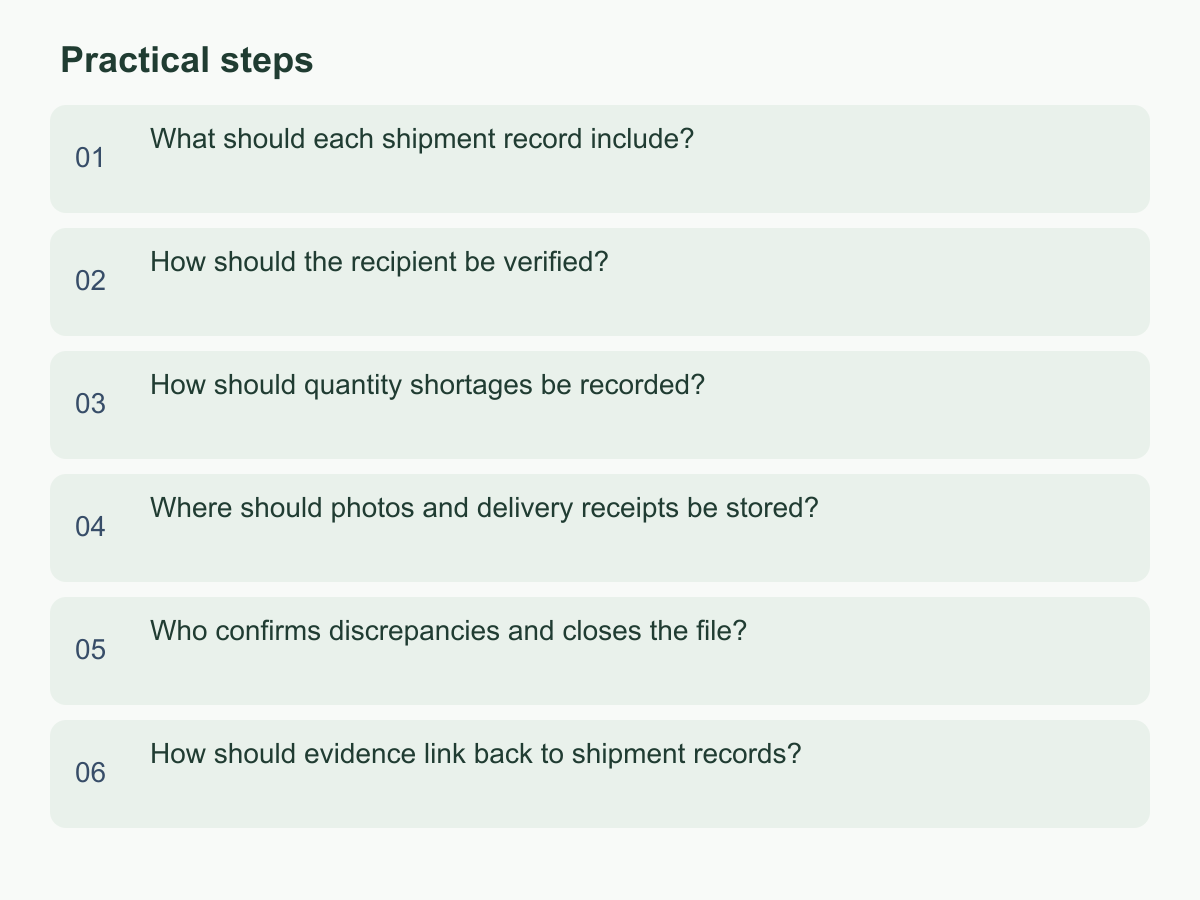
What should each shipment record include?
Assign each shipment a unique batch number and reuse it on the order, packing list, dispatch note, carrier reference, recipient replies, photos, and discrepancy notes. Keep the format consistent, perhaps combining a date, order code, and sequence. If one order ships in separate batches, give each its own number and link both to the order. The index should record its creator and creation time, sender, recipient, destination, expected carton or item count, quantity handed to the carrier, packing-list version, carrier references, and status. Include time zones; leave out currency or value when irrelevant to delivery checking.
At dispatch, separate the ordered quantity from the quantity handed over and state the unit: cartons, items, sets, or pallets. Do not write only “shipped.” Keep revised packing-list versions, editor, and edit time rather than overwriting the baseline. Identify goods by name, item code, or packaging mark. Keep unnecessary personal details out of a broadly shared index; retain full contact details in controlled original records.
For example, if order A-204 is split into batches A-204-01 and A-204-02, list each batch’s count, dispatch date, and receipt evidence, linking both back to A-204. This prevents the first receipt from being mistaken for completion of the full order. Use the order code for the commercial link, the batch code for the delivery, the carrier reference for transport records, and the list version for the reconciliation baseline. Add a customer code or year if order numbers can repeat.
How should the recipient be verified?
Compare the expected company, department, or delivery location with evidence showing the signer, time, place, and delivery method. Fill in only details visible in the original; do not infer identity from an unclear signature. If reception, security, a warehouse, or a collection counter accepted the shipment, record that role and who confirmed through which existing channel that the person represented the recipient. A signature is a delivery clue, not proof that every item was unpacked or inspected. Describe only what the record supports.
Use three columns: expected recipient details, readable details on the evidence, and differences to confirm. If spelling differs but the company, location, and time align, mark it pending recipient confirmation instead of changing the name. If the receipt shows only a signature or stamp, keep the original and note that the text is unreadable. Ask through an existing business channel, such as the order email thread or established contact, and retain the question, reply time, confirmer, and response. If someone else accepted the shipment, request written confirmation of their role, location, department, or another identifying detail. Until a reply arrives, leave the status pending. Record only the company if that is all the receipt shows, mark unseen location details as unknown, and preserve conflicting timestamps with their sources. Label the result “matches,” “partially matches,” or “pending confirmation,” and state the basis.
How should quantity shortages be recorded?
Choose a fixed baseline, such as the dispatch note or a confirmed packing list. Compare the expected quantity, the quantity handed to the carrier, and the quantity supported by receipt evidence, item by item. Record any difference in that batch’s discrepancy field. For example: “12 cartons expected; receipt records 10; 2 to check.” Include the evidence location, recorder, time found, and next owner. Keep the unit and source with every figure. Do not convert cartons to items unless the contents per carton are clear, and avoid vague notes such as “a few pieces missing.”
In this hypothetical example, the list and dispatch record each show 12 cartons, while the recipient’s first reply confirms 10; evidence for 2 is still missing. Record 10 as receipt-confirmed and 2 as pending. The arithmetic is 12 = 10 + 2, but delivery is not fully confirmed. If another receipt later appears, check its batch number, date, destination, and carton labels, then add it as separate evidence and update the confirmed total to 10 + 2 = 12. Keep both receipts. If evidence never supports the difference, leave it pending or assign it to a named owner with a next step and reply date; do not treat a possible split delivery as fact.
Check whether the baseline is complete. Possible explanations to investigate include a revised list, another batch, unclear unit conversion, or recorded repacking; these are questions to verify, not assumptions. A receipt showing only the total number of packages cannot establish the quantity of each item inside. Reconcile listed items one by one and leave unidentified quantities unconfirmed. Add a discrepancy event with when it surfaced, the supporting evidence, and the current owner. Preserve the original expected quantity.
Where should photos and delivery receipts be stored?
Store original photos, scanned receipts, and email attachments in a team-accessible document space with permissions limited by role. In the index, record the filename, folder or link, uploader, date, version, and purpose; do not leave the only evidence copy in personal chat or on one device. Folders may be organized by year, customer, or order, but the batch number must lead from the index to the original files. Use a consistent filename format, such as batch-code_document-type_date_sequence, instead of names like “latest receipt” or “photo two.”
Keep the unedited original photo; save an annotated copy if you need to highlight something, without marking over the source image. Label each file as an original, scan, forwarded copy, or working note so its origin is clear. If access is restricted, record who holds the file, how to request it, and whether it is available. Follow existing access and retention rules; do not expose signatures, phone numbers, or addresses to people who do not need them. Check that files load fully, all pages are present, and images are correctly oriented. If an image is too dark or crops a needed date or signature, request a clearer version and note what was first received. Before deleting duplicates, check whether they are repeat uploads, different views, or supplementary evidence; distinguish them by version or sequence. Confirm the next owner can open protected links, have someone other than the uploader check links periodically, and update the index with a move note if a file changes location.
Who confirms discrepancies and closes the file?
Before handoff, the shipment-record owner organizes the evidence, the discrepancy owner checks each item, and the recipient contact confirms the facts they can verify. One person may handle several roles, but the index should say who did each step. Use clear statuses such as “receipt pending,” “receipt received, quantity pending,” “discrepancy being resolved,” and “reconciliation complete.” Record who updated the status, when, and which documents support it. Mark the batch complete only after the baseline, recipient, quantities, and unresolved differences have been checked under the team’s rules. Filing a receipt does not mean the discrepancy is resolved.
For missing items, unclear names, or conflicting records, assign one follow-up owner. List the exact question, who should answer, the expected reply date, and the next check date. If a date passes, the designated manager decides whether to escalate or keep the item open. The closeout record should show the confirmer, date, evidence used, final reconciled quantity, and how each difference was handled. For a replacement shipment, refund, reshipment, or other commercial action, record the confirmed decision and evidence of completion; a proposal is not completion. If new documents arrive, add the version and correction reason, and reopen the batch when needed so each decision remains traceable. For time-zone handoffs, include the handoff point or next review time. Another colleague can spot-check the calculation and links. If sources conflict, preserve the unresolved difference and name its decision owner. If the team allows a completed portion to be closed, show confirmed and pending quantities separately.
How should evidence link back to shipment records?
Every evidence file should lead back to one batch record; colleagues should not have to rely on filenames or memory. The index can include batch and order codes, dispatch date, destination, recipient organization, expected and confirmed quantities, receipt time, evidence links, discrepancy status, owner, and closeout time. Use existing forms or databases and their exportable fields and access controls; this guide does not require a new tool. When adding a file, check that its batch number matches, open it from the index, confirm that its contents match the description, and make sure access will continue if an individual account closes.
For an order split across batches, list each batch and its status in the main order record instead of using one overall complete field. For several receipts in one batch, list each time, quantity, and source separately to prevent double-counting. At handoff, a colleague should be able to move from the order code to the batch list, from the batch number to receipt and discrepancy evidence, and then to the closeout record to see who confirmed and when. Start with one completed shipment: add its batch number, quantity baseline, original receipt, discrepancy owner, and status, then open each link. For more information about the brand, visit the Chan & Chung homepage: https://chanchung.com/en/.
Choose an index format that fits the team’s existing tools. Keep identifiers stable, fields searchable, changes recorded, and links usable by the next owner. In a spreadsheet, make the batch code unique, protect formula fields, and use filterable discrepancy and closeout fields. In a database or document platform, confirm that batch lists and file locations can be exported. Before adopting the index, ask someone uninvolved in the shipment to answer five questions from its records: how much shipped, who received it, what remains outstanding, where the evidence is, and who closed it. Any unanswered question points to a field that needs attention.