
After terms are signed, the first challenge is putting the agreed reseller scope into daily practice: the right contacts, current materials, and a clear inquiry route. Use this general checklist to assign an owner, status, and traceable record to each item. Set a launch date only after essential contacts, files, and inquiry paths work; for a phased launch, record what is permitted at each stage.
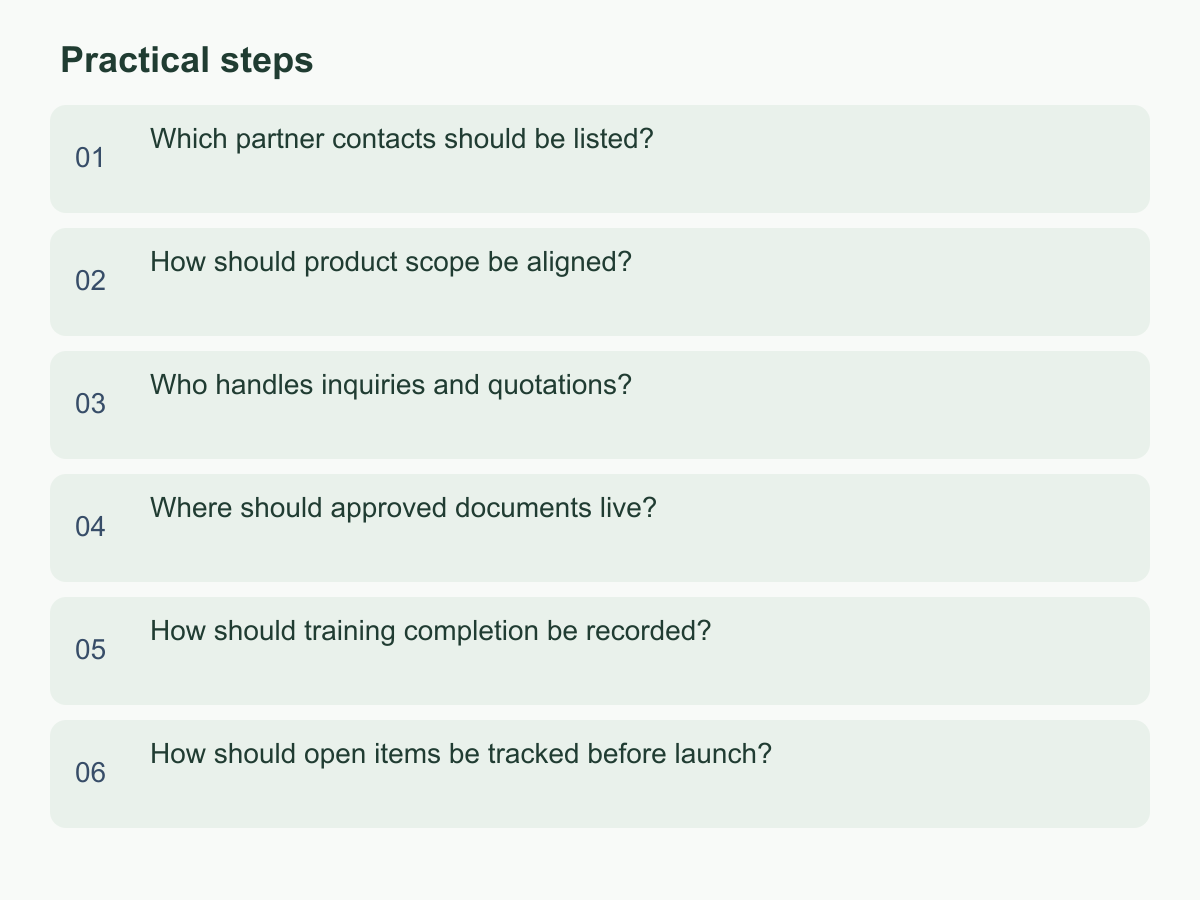
Which partner contacts should be listed?
Use one shared contact sheet to show responsibility, backup, and availability. Each side should list a day-to-day lead and alternate with name, role, company email, preferred channel, time zone, language, responsibilities, and cover arrangement. The brand side should use the same fields, so the partner knows who can decide on prices, delivery dates, and material use.
Separate contacts by task: business for partnership terms and scope changes; product or operations for specifications, stock, delivery, and customer-issue routing; finance for invoices, payment details, and reconciliation; and marketing for copy, images, trademarks, and localization review. When one person covers several roles, record authority for each instead of relying on “main contact.”
Agree on channels for routine questions, urgent requests, and personal data or contract attachments, using a mutually approved secure route for sensitive files. Groups can coordinate progress; formal approvals should remain in traceable email or records. A response target, such as acknowledging receipt within two business days, is an internal agreement, not a resolution guarantee.
Before launch, test email delivery, backup authority, and escalation contacts. If a contact is unassigned, name who will appoint one and by when; a blank field does not mean complete.
How should product scope be aligned?
Record each sellable item, not broad phrases such as “the full range” or “local market.” Include its name, model or SKU, eligible market, language, channel, customer limits, version, shipping or delivery owner, and whether approved descriptions or images are available. Use a unique code where specifications could be confused, so inquiry, quote, order, and after-sales records identify the same item.
Mark each entry “approved for inquiry,” “case-by-case confirmation,” or “not open,” and name the decision-maker and change process. Approval for one model in Taiwan’s online channel does not extend to the range. Keep unresolved items off public price lists and promotions. This fictional example grants no rights:
| Item | Status | Market and channel | Open point |
|---|---|---|---|
| Hypothetical model A | Inquiries allowed | Taiwan, online | After-sales contact |
| Hypothetical model B | Pending confirmation | Undecided | Delivery and materials |
Save the approved version, effective date, and approver; informal chat does not replace approval. For changes to models, markets, or channels, assess effects on quotes, pages, stock, and training before approval. Record permitted names, images, and marks; whether localization or downstream sharing is allowed; and approved language, channel, and reviewer for each market. Download access does not authorize adaptation. If wording or authorization is unclear, pause and ask the listed owner.
Who handles inquiries and quotations?
Set the path: where leads arrive, who logs them, what missing details to request, when to route for pricing, and who approves the quote. A partner may collect requirements, but without explicit authority cannot promise prices, discounts, delivery dates, or stock. Receiving an inquiry and issuing a formal quote are separate roles.
Log the date, customer or case code, market, model and quantity, intended use, language, delivery location, response deadline, owner, missing details, and next step. Collect only what is needed. For personal data, agree on transfer and retention first; keep attachments out of unrelated groups. Mark requests beyond approved scope as pending, not an extrapolation from an old quote.
| Situation | First contact | Next step | Record |
|---|---|---|---|
| Unclear specification or delivery | Product contact | Complete request and check scope | Question and reply version |
| Price approval needed | Business contact | Submit current information | Quote ID and approver |
| Outside agreed scope | Both leads | Escalate for decision | Hold reason and date |
If a hypothetical inquiry lacks model and delivery location, log both gaps and assign follow-up before pricing. A two-business-day target can confirm receipt or identify gaps; completion depends on details and approvals. At each handoff, update the owner and next step, and retain the quote version and outcome for follow-up.
Where should approved documents live?
Use one access-managed shared location; name who may add, approve, or remove files. If email transfer is needed, state where the final copy lives so private drives, chats, and old attachments do not create competing “latest” versions. Put the link, file owner, and access-request route on the contact sheet.
Label each file with title, language or market, version, effective date, status, owner, and scope. Agree on filename and date formats (for example, Specification_Taiwan_TraditionalChinese_v2_Date) and separate drafts from approved files. Organize by specifications, quote references, brand assets, ordering, and training; do not invent missing or unapproved documents.
Mark files Approved, In force, Pending revision, or Retired. Label archived versions “Do not use” and remove them from the daily entry point. List the maintainer, update timing, and missing-file contact. Set access by work need, review it when roles change, and restrict customer or commercial data to those who need it.
For each catalog update, log changes, approver, effective date, and effects on open quotes. Notify both leads with the official link, retired status, and any retraining. Before launch, have the partner open core files and confirm version and market. Assign an owner to inaccessible, incomplete, or conflicting files; close only after confirmation.
How should training completion be recorded?
Define required modules by role: product identification, inquiry details, quote approval, ordering or delivery, issue routing, and approved brand-material use. Assign training to actual duties; people who do not handle pricing or customer data may need a different scope. Set the plan from agreed responsibilities.
Record the module and material version, date, trainer, participants and roles, attendance, practice result, open questions, and follow-up owner. Attendance alone does not show that someone knows the next step. Use a short scenario with missing inquiry details; ask what to request, whom to contact, and where to log it. This is a process check, not certification.
Example (hypothetical): a new partner identifies two models and routes price questions correctly but cannot find the file library. Mark the first two complete, library use pending, and arrange an owner-led walkthrough. Absence, slides, or recordings count as completion only if criteria agreed in advance allow it; define criteria first if none exist.
When a model, price rule, file, or contact changes, identify training to refresh. Track To schedule, In progress, Complete, or Refresher needed, with a next review date. Do not assign core work independently until required training is complete. Distinguish individual gaps from missing files or process gaps.
How should open items be tracked before launch?
Use one action log. Record missing item, launch impact, priority, provider/helper, confirmation date, blocker, completion evidence, and update date. Status: Not started, In progress, Awaiting confirmation, or Complete. Close only when the file opens, access works, or the responsible contact confirms; “sent” is not “received.”
Separate blockers from later improvements. Do not take external orders while scope, pricing authority, file access, or inquiry routing is unclear. Defer an internal diagram only if both sides agree it will not affect current work and set a due date. Pause customer-data transfers until method and owner are clear. A limited trial needs agreed scope, participants, and stop conditions.
Fictional example: the lead’s email is untested; after-sales ownership for one model is unclear; marketing images need updates. The first two block inquiries and customer support. If images are not in external use, track them separately with a due date. Priority depends on agreed work.
At weekly or milestone reviews, check evidence, valid owners, and workable dates. Escalate overdue items to a decision-maker who can adjust the plan, rather than repeatedly extending dates. Before launch, close blockers and run a hypothetical inquiry through routing, file lookup, handoff, and records. Visit Chan & Chung.