
At the end of a service contract, decisions often stall because deliverables are scattered, open items have no owner, or the parties understand dates and scope differently. Put documents, evidence, open work, contacts, renewal terms and handover arrangements in one internal checklist, then verify obligations against signed documents. This article covers general B2B service contract readiness, not SaaS subscription cycles or single-project closeout, and does not replace advice on a specific matter.
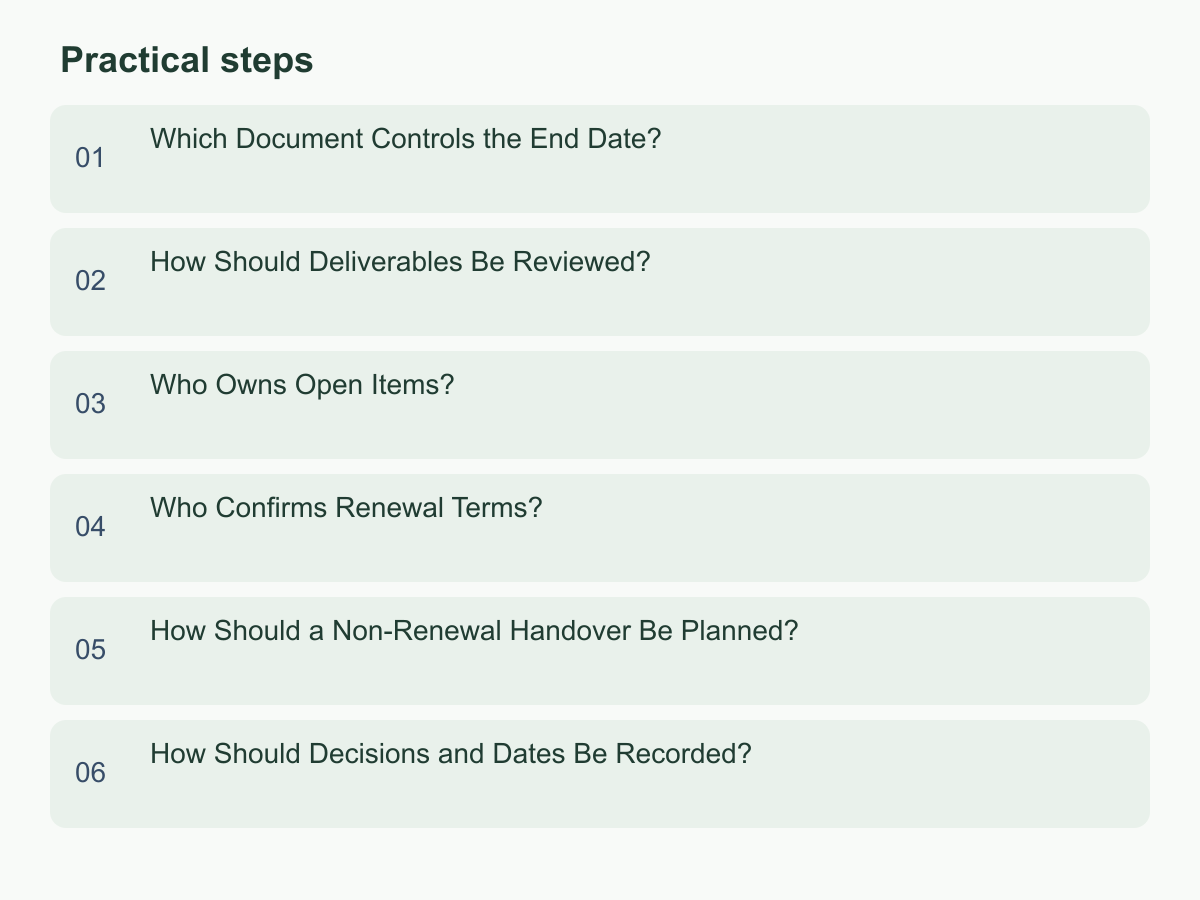
Which Document Controls the End Date?
Separate end-of-term information into the contract term, service period, renewal or non-renewal notice arrangements, payment milestones and acceptance milestones. Check the signed master agreement, statement of work or quotation attachments, orders, and later signed amendments. A file’s latest name or timestamp does not prove which version applies; verify signatures, effective conditions and records of both parties’ confirmation. For draft conflicts, record the difference and verify the controlling document; a chat date is not a formal amendment.
Use one row per document for its name and version, signatories, signature date, effective condition, any document it replaces, storage location and reviewer. Read work-specific attachments with the master agreement. If an amendment changes only part of the arrangement, identify what changed and what remains under the original terms.
Record the service end date, notice timing, and payment or acceptance triggers separately, with relevant wording or page references and a person responsible for checking them. If provisions appear inconsistent, preserve both sources and the question for the contract owner or an appropriate professional.
For example, if a signed master agreement runs through the end of September but an amendment extends one service to mid-October, list that service separately. Do not move every service’s end date; verify the amendment’s scope, fees and acceptance steps. Actual dates depend on signed documents.
How Should Deliverables Be Reviewed?
Copy the agreed deliverables, quantity or scope, delivery method, timing and acceptance conditions from the contract or statement of work, then compare them with what was supplied. Separate accepted work, delivered items awaiting confirmation, work in progress and out-of-scope requests. Expectations absent from the documents remain requests for confirmation, not original commitments.
Attach traceable evidence to each item: file name and version, sending or receipt record, meeting confirmation, acceptance comments or revision history. Note the working folder and required access, or retain a message showing what was delivered, when and to whom. A link alone does not prove acceptance.
A sample table might include the deliverable, assumed agreement or status, and end-of-term check:
| Deliverable | Assumed agreement or status | End-of-term check |
|---|---|---|
| Operations summary | Listed in statement of work | Compare file and receipt record |
| Version handoff | Confirmation required | Check version, date and record |
| New request | Outside original scope | Check for written change approval |
Compare actual work with the agreed scope. For each difference, note who raised it, whether both parties approved it, and which version applies. For partial work, list completed parts, remaining work, dependencies and current status. Follow any agreed acceptance procedure instead of treating an internal delivery date as acceptance. Have the provider and internal requester review the list separately. Mark agreed items complete; preserve disagreements with each view, evidence and a follow-up owner.
Who Owns Open Items?
An open-item list should go beyond a list of questions. For each item, record background, current status, next action, lead contact, collaborators, dependencies, target completion date and completion evidence. Use a contract date or one confirmed by both parties; otherwise mark it pending. For cross-team work, name who owns delivery and who must provide information.
Group items as due before expiry, continuing after renewal, or needing a separate decision. This reveals delivery blockers, work that could be rescheduled, and issues affecting scope or fees; grouping does not change contractual duties. If a task depends on client data, a third party or internal approval, name the blocker and follow-up owner.
A successor needs materials and access as well as a name. Record file location, current version, access holders, and any personal or commercially sensitive information. Access changes should be handled by an authorized administrator under internal procedures and the agreement. Track the action without putting passwords or credentials in the checklist.
For example, if a report is waiting for requester information, name what is needed, who will provide it, who will complete the report, and how delivery will be confirmed. Have outgoing and incoming contacts read the list together. Keep disputed work unresolved with each side’s basis; a spreadsheet update alone does not transfer responsibility.
Who Confirms Renewal Terms?
Before renewal talks, name who sets requirements, approves budget or scope, reviews contract wording, and confirms deliverables for each party. List decision-makers separately from day-to-day contacts. If procurement, finance, information security or another team must review, record its input and owner; an incomplete internal approval is not the other party’s agreement.
Review scope, deliverables, acceptance, responsibilities, fees, payment, term, change process, data and access, and post-term cooperation. Mark each item keep, revise, remove or discuss, and note whether its basis is the current agreement, delivery review or a new operating need. Do not invent targets; agree on the definition, data source and review method for any new measure.
Consider whether results met agreed goals, what open work will cost to resolve, whether the scope is still needed, and whether both parties can meet new responsibilities. A narrower scope, a new negotiation or a non-renewal handover may fit changed needs. These are decision factors, not fixed commercial thresholds or legal standards.
Separate approved terms from proposals and unresolved fees or scope in meeting notes; assign an owner and next step to each. A workable direction is not a final renewal. Complete the writing and approvals required by the agreement, align the scope and responsibilities, and record any condition that could change the decision along with the evidence needed to verify it.
How Should a Non-Renewal Handover Be Planned?
Check the contract for expiry terms, notice method, unfinished duties and obligations continuing after the term. Record the clause and internal owner. Do not infer dates, recipients or delivery method from habit; route unclear terms to the contract owner or an appropriate professional. Plan early for files, access and work transfer without assuming a standard handover period.
The handover list may include completed deliverables and editable files, version notes, workflows, open items, key decisions, contacts and materials still due. For each, specify format, location, sender, receiver and confirmation method. Flag restricted information, third-party licensed material and confidentiality limits for separate review; convenience does not authorize copying unrelated data.
Review account and permission ownership: what the client holds, what the provider manages, who needs access, and when access will change or end. Keep passwords and keys out of shared checklists. Use an approved secure process for transfers and record completion. Handle data return, retention or deletion under the agreement and applicable internal rules.
Have the recipient confirm what arrived and can be opened, then assign missing context or files to an owner. At expiry, distinguish contract work from separately agreed transition support and undecided new work. In a shared-workspace example, sequence inventory, recipient confirmation, access changes and completion evidence according to the agreed end date. A checklist does not settle disputes or erase remaining duties.
How Should Decisions and Dates Be Recorded?
On the checklist’s first page, record the counterparty, contract identifier, applicable document versions, service period, next action date and file locations. For each update, note who changed it, when and why. Mark unverified details as pending and name the reviewer; do not let blanks or precise-looking dates hide uncertainty.
A decision record should state who proposed and approved the outcome—renew, renew with changes, defer or do not renew—and the supporting evidence. Link it to relevant deliverables, open items and documents. Record incomplete conditions, such as approval of new scope or internal sign-off, with an owner and the evidence needed. Keep disagreements unresolved.
For renewal, link the signed agreement, amendment or other effective written arrangement. Check that the new start and end dates, scope and effective conditions match the checklist. For non-renewal, record the contract-based recipient and method, actual send date, receipt evidence and follow-up owner. An internal decision date is not a notice date, and a draft is not a completed notice.
Put key dates in the team’s calendar or work system with their source and reminder owner. Set review, decision follow-up and handover checkpoints from contract terms and confirmed arrangements, not a generic timeframe. Link reminders to the checklist or controlling document; if terms change, update the source record before changing alerts.
Start with one internal checklist: enter the signed document versions and service dates, then add deliverable evidence, open items, contacts and unresolved conditions. Keep the source for every date and assign each next step to a named owner. For companies planning overseas operations through a Hong Kong company, visit Chan & Chung for brand information.