
After production deliveries begin, a supplier’s “corrected” reply does not close an issue. Closure requires evidence for the cause, clear owners and due dates, and a retest that demonstrates the agreed result. A shared tracker separates facts, unverified causes, actions, dates, test methods, and results so procurement, quality, and the supplier can review one record. This is operational guidance, not a universal legal deadline or sampling rule.
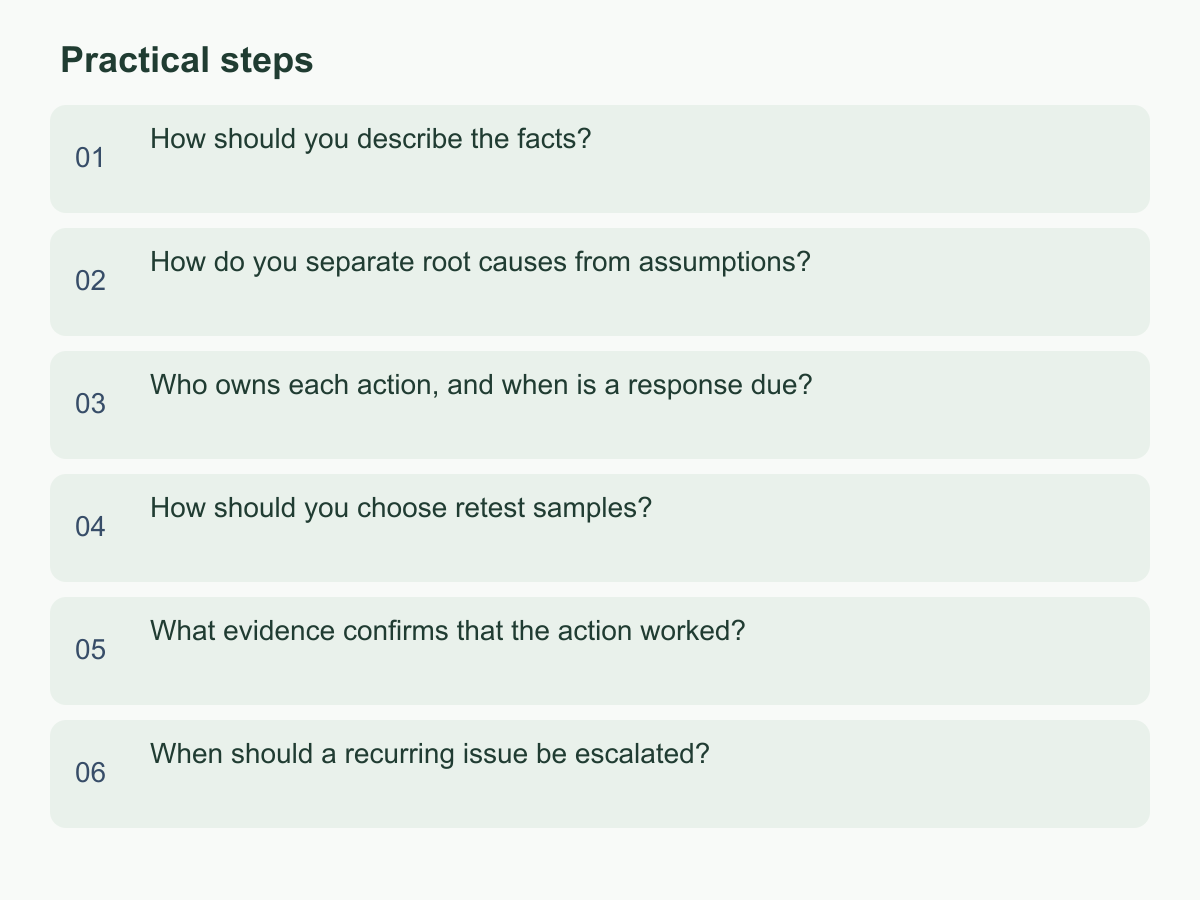
How should you describe the facts?
Record reproducible facts before assigning responsibility. For each issue, capture supplier, part or service, purchase order or lot, delivery and discovery dates, inspection point, denominator, defect count, and interim disposition. Reference storage locations for photos, logs, labels, and correspondence. List each defect separately, even within one lot, so the response and retest address it.
Describe what, where, and how much. For example: “Six of 40 cartons had an outer label with a part number that differed from the order.” Keep carton IDs, compared fields, inspection scope, and quarantined quantity. If impact on carton contents is unknown, say so rather than recording a confirmed loss. Preserve quantities, times, and units. Mark missing fields as unknown with an owner and due date, never zero. Record who approved any hold, relabeling, or conditional receipt.
Retain the original record; log each correction’s time, editor, and reason instead of replacing discovery figures. Add a photo linking label, lot code, and goods. Put the case number in filenames and identify each evidence provider. For complaints or shipment records pointing to the lot, record verifiable counts and dates; list unscreened quantities separately. Standardize defect names and units so cartons and pieces do not mix in a numerator or denominator.
How do you separate root causes from assumptions?
Split causes into “confirmed root cause,” “hypothesis to verify,” and “information outstanding.” Give each hypothesis a check that could confirm or rule it out, an owner, and a target date. “Incorrect label” is an observation; “the revised label did not reach the packing station” is a root cause only after checking versions, issue records, or actual work.
Log a supplier’s proposed operator error, equipment drift, or outdated document as a hypothesis. Ask for evidence, affected lots, and timing; a confident email is not proof. Check materials, methods, equipment, environment, handoffs, and inspection to locate the defect and missed control; record interview dates, roles, and evidence. Choose a low-cost discriminating check, such as comparing shipment labels with the approved sample. Keep ruled-out hypotheses and reasons.
If the cause is unknown, mark it so. Begin reversible containment if needed, but keep permanent action open; “remind staff” does not explain the cause. If procurement, quality, and supplier disagree, list observations and missing information, then assign the next check. Use a timeline to connect specification, label creation and approval, station issue, and shipment inspection. A missing record is an information or control gap, not proof of cause. Match permanent actions to verified causes; otherwise state temporary controls and when to remove them.
Who owns each action, and when is a response due?
Assign one named person to each action; record role or contact, deliverable, calendar due date, and response channel. A generic team name is not an owner. If investigation, containment, permanent correction, or effectiveness checks have different owners, list separate tasks with their own outputs and deadlines.
Agree on specific dates, not “as soon as possible.” Set interim and final dates when work depends on other teams or materials; name who reports delays and when revised dates are due. Schedule by risk, delivery needs, and workload, not a universal legal rule. For example, after a Monday label mismatch, parties might confirm affected inventory by Tuesday, submit causes and actions by Thursday, and provide first-lot retest evidence the following Monday.
Log receipt time, version, and missing items; an email reply is not completion. If the supplier says “next week,” ask for an exact date and owner. For overdue work, record missing deliverables, impact, and follow-ups. Update commitments while retaining original deadlines and delay reasons. Track investigation, action pending, verification pending, and closed separately. For cross-time-zone work, include year and time zone. Log date changes and how both sides agreed. Give the internal verifier a deadline and name a replacement if an owner is away or leaves.
How should you choose retest samples?
Define the claim: correct label fields, updated packing process, or no recurrence in later lots. Each needs different evidence. Map the affected population by part, lot, line, shift, packing position, and time. Do not select only supplier-chosen samples. Include output from an implicated station; track lots or shifts separately.
Agree on the population, sampling method, sample count, inspection items, acceptance criteria, selector and inspector, and due date, based on risk and available stock. A clean sample cannot clear all stock. For safety issues or customer requirements, follow the applicable specification and authorized internal process; isolate goods if required. For example, with three lots available, sample cartons from different positions in each; check part number, revision, and lot code. Keep the selection list and traceability.
If retest fails, record the item, defect, and location; widen containment and reopen cause investigation. Do not swap the sample. Mark supplier-selected display units as limited evidence; arrange sampling from awaiting-shipment or received stock. If access or quantity constrains the check, record the limit and agree on a follow-up method and date. Make the procedure repeatable: name the field, reference order or specification, and pass condition. Track sample holder and photo or seal date. Agree when to review and reduce sampling; ad hoc cuts undermine comparison.
What evidence confirms that the action worked?
Verify both implementation and the agreed delivery result. Implementation evidence includes revised instructions or templates, equipment settings, training records, or a dated photo. Result records identify sampled goods and lot, inspector, date, method, and inspection log. Records show action, owner, date, lots, and result. Documents or assurances alone do not prove quality improved.
Set criteria from the observed defect and risk: fields to inspect, pass condition, sample scope, and response to failure. Baseline: six mismatches among 40 cartons, or 6 ÷ 40 = 15% for that check. If a later retest finds zero in 30 cartons, record “0/30 mismatches found in this sample.” Do not conclude every item is defect-free or, when sample size or source differs, that the defect rate fell to zero. Preserve denominator, source, method, and limits; decide on added checks or later-lot observation under agreed criteria.
Have a verifier compare evidence with source records. Missing fields, unclear sample origin, contradictions, or a failed criterion mean “not passed” or “more information required.” Keep action evidence, retest, approver, closure date, and follow-up checks. Align inspectors with passing and failing examples and retain results if interpretations may differ. Store raw values separately from conclusions. Label supplier self-inspection; cross-check receiving samples if needed, and state what remains unverified.
When should a recurring issue be escalated?
Escalation changes controls, decision level, or follow-up frequency; adding email recipients is not enough. Agree on triggers such as overdue evidence, a repeated defect in retest, expanding affected population, promised containment not carried out, or delivery interruption risk. For each, name who must be notified, the decision needed, and a response time suited to operational risk.
If nonconforming goods may still be moving, notify receiving, warehousing, quality, and procurement through the authorized process. Identify stock under review; consider a hold, release pause, or alternate supply. An authorized decision-maker must assess stopping orders or changing source; a tracker cannot decide. For a repeated defect, compare part, process, lots, and actions to determine whether correction was not implemented, the cause was wrong, or this is a new issue.
Log trigger, scope, existing controls, pending decision, decision owner, and next review point. For a low-risk late reply, request a firm date and missing evidence. If retest confirms recurrence, increase inspection or isolation as appropriate and reassess release criteria. After closure, check later lots if agreed; if the issue returns, reopen the same case with prior actions. Assign one owner to reconcile procurement and quality status in high-impact or multi-lot cases. Verify controls cover affected stock and keep the case open until confirmed.
Choose one open supplier issue. Complete the facts, owner, response date, and retest criteria, then set its next review point. Visit Chan & Chung to learn more.