
A monthly supplier review should compare commitments with receipts using the same rules. Set the unit, committed-date version, receiving cutoff, and variance categories first; then check exceptions against source records. This makes results reproducible and useful for the next purchasing conversation. The method below is for internal review. All examples are hypothetical and do not represent industry benchmarks.
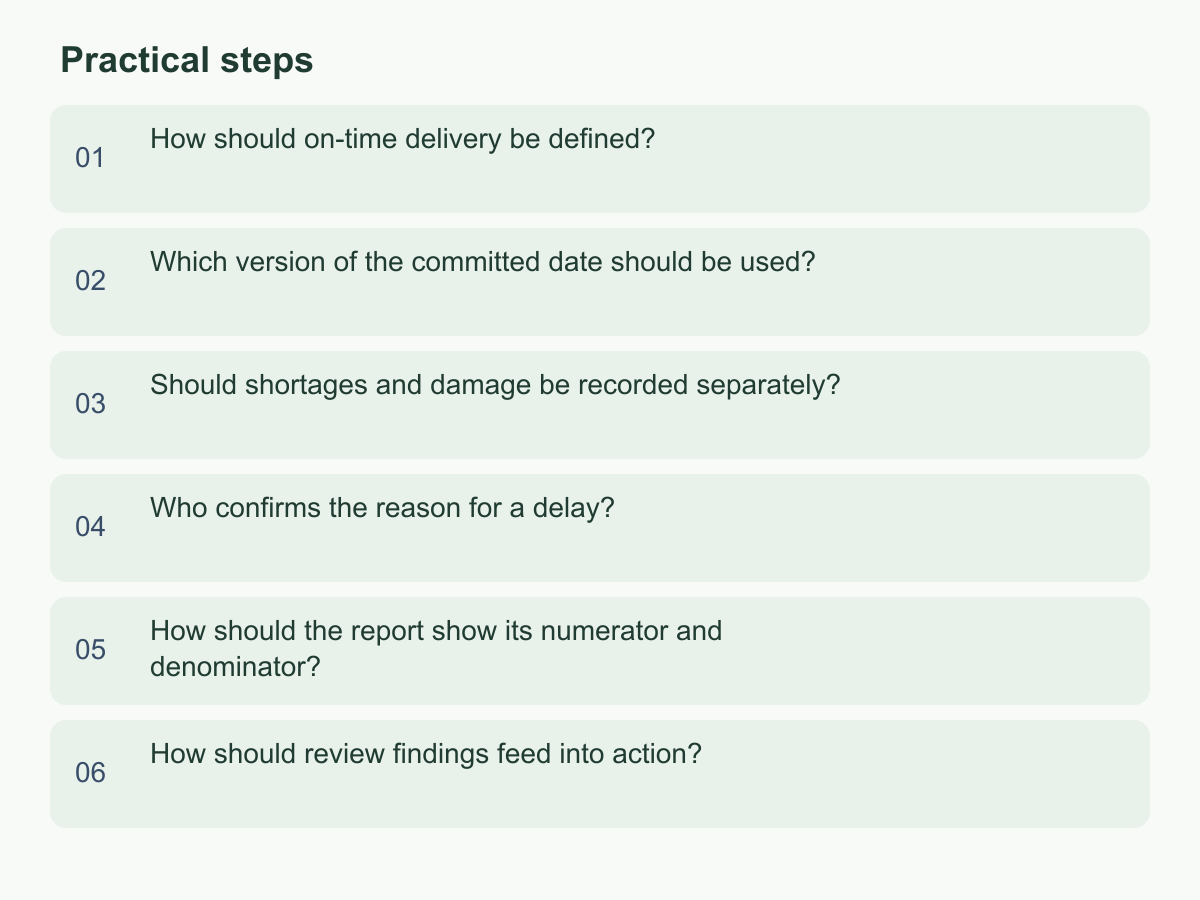
How should on-time delivery be defined?
Choose a unit you can consistently reconstruct from records, such as each supplier purchase-order line. Separate lines show item-level performance when one order covers three SKUs. Set a receiving cutoff: use the commitment’s calendar day or a local time at the receiving site, and decide whether completion means unloading, signed receipt, or inspection.
A workable rule is that a line is on time and in full when its confirmed quantity is fully received by the last confirmed commitment cutoff. If only part arrives, record an on-time receipt and a shortage at cutoff; do not count it as complete on-time delivery. For example, with a Wednesday 4 p.m. cutoff, if 10 of 12 units are checked in by then and two arrive Thursday, the line is not on time and in full.
For split deliveries, record first arrival for delivery start and full receipt for commitment performance. For early arrivals outside the agreed receiving window, record arrival and when the goods became receivable. Apply one rule across suppliers and months; document time zone and acceptance criteria, note the effective month for any rule change, and keep each batch’s timestamp. Ask a colleague to recalculate a normal and an exception case before comparing suppliers.
Which version of the committed date should be used?
Date choice determines whether a late delivery can still appear on time. Keep the original date, each update date, proposer, approver, reason, and communication record. Choose a baseline: the date confirmed with the order or the latest date confirmed by both parties before shipment. Show changes from the original separately from performance against the valid date; this prevents a buyer-requested reschedule being labelled supplier delay.
Use a later date only with traceable evidence, such as email, an order-system record, or a follow-up confirmation. Mark an unsupported verbal update as pending and calculate against the baseline. For example, if the original date is June 10 and the buyer asks to move it to June 12 because of warehouse capacity, receipt on June 12 is on time against the valid date only if both parties confirmed it. Keep the original change visible. A unilateral supplier move does not reset the baseline.
If the system keeps only the current date, create a linked change log from emails or confirmations. Freeze each monthly version; correct an issued report with a dated record explaining the reason and impact. Keep proposer and approver separate, label buyer-requested, supplier-proposed, or joint changes, and sample dates, attachments, and receiving locations.
Should shortages and damage be recorded separately?
Shortage and damage describe different delivery problems and need separate follow-up. A shortage is the quantity received below the effective commitment. By line, retain committed, received, and missing quantities, when the gap was found, and any replenishment date. If three units are missing, record all three. Damage is the quantity found defective or unusable during inspection; note carton, packaging, product, or transit observations and link available photos, inspection records, and disposition.
Both flags can apply to one batch. If 12 units were ordered, 10 arrived, and one was damaged, record two missing and one damaged; usable quantity is nine. Do not count the damaged unit again as undelivered. If inspection follows receipt, keep received quantity separate from accepted usable quantity and record when inspection ended, so month-end results do not depend on inspection speed.
Keep original receipt facts when goods are returned, replaced, discounted, or substituted. Log the disposition, confirmation, replacement SKU, and actual arrival date; state whether an agreed substitute counts as fulfilment. A signed receipt does not prove every unit was usable. Compare recurring shortages and damage by item, then test whether packing, dispatch checks, buffer stock, or receiving inspection needs attention before assigning responsibility.
Who confirms the reason for a delay?
Capture observable facts: original and valid commitment, arrival, short or damaged quantity, freight evidence, notices, and receiving availability. Use a short list of process-based causes: supplier stock not ready, carrier delay, buyer reschedule, unavailable receiving window, incomplete paperwork or labels, external event, or unknown. Treat a supplier’s explanation as unverified until checked.
Assign each cause a status: pending, confirmed by both parties, or disputed. Purchasing sends the specific variance and evidence to the supplier; warehouse staff check receiving records, and logistics checks tracking. The person responsible for the supplier relationship confirms the report category. If accounts differ, retain both descriptions and mark the issue disputed; do not force one cause or use unknown to hide a known event.
Link each event to its order, notice, and receipt evidence. Record who reported, replied, and confirmed it, and when. If the supplier shipped late and the carrier also delayed the load, record primary and related factors when evidence supports both. Later evidence may change the explanation and status, but not the historical receipt result. Keep categories few, add notes for detail, and check records before deciding on countermeasures.
How should the report show its numerator and denominator?
Define scope before calculating. Count eligible purchase-order lines by supplier and due month. Count each line once in its due-month cohort, and list later replenishment separately. The denominator is in-scope lines, not boxes or total units. For quantity analysis, report committed and received units separately from the line-based rate.
Suppose 10 lines are due: seven are received in full by cutoff, two partly arrive on time but remain short, and one arrives late. On-time receipt of any quantity is 9/10 = 90%. On-time and in-full is 7/10 = 70%. The short-line rate is 2/10 = 20%; the late-line rate is 1/10 = 10%. These measures answer different questions. A shortage can overlap with a late delivery, so percentages need not add to 100%.
Show each numerator and denominator beside its percentage. List excluded or unresolved lines, such as cancellations, buyer-requested reschedules, or missing records, and explain their treatment. If no lines are due, report no data to calculate, not a 0% on-time rate; cancelled and not-yet-due lines do not belong in the denominator. For supplier totals, sum counts first and calculate the rate; do not average percentages. Report shortage and damage unit counts separately, linked to line records.
How should review findings feed into action?
Use the review to assign checkable follow-up. Before the meeting, share the line list, commitment history, receipt evidence, and unresolved causes. Start with recurring variances affecting supply. Confirm facts, impact, provisional cause, and missing evidence before agreeing on action.
Set each action clearly: the supplier confirms pick quantities before dispatch, purchasing saves both parties’ approval for date changes, or receiving records split-delivery times and damage photos. Assign a responsible role, due date, expected response, and evidence of effectiveness. Avoid penalties or promised improvements without evidence. At the next review, check completion and whether the issue changed under comparable item and commitment rules. If not, identify capacity limits, unclear process, or lack of response before choosing the next step.
For an isolated unknown cause, gather evidence and track it into the next review. For repeated shortages or delays, share the lines and impact for joint review. Record effective dates for changes to definitions, date versions, or categories. Keep decisions, owners, due dates, status, and evidence links in an action log; check overdue actions next month. Note supply-volume or delivery-term changes before comparing trends.
Sample the latest month of due lines, calculate the measures, and find related information at Chan & Chung.