
Cross-border travel expense claims often stall for three reasons: receipts are scattered, exchange-rate methods differ, and approval of the business purpose is buried in chat messages. Break the process into pre-trip setup, itemized submission, variance checking, and payment settlement so each expense can be traced to its payer, purpose, and source record. The steps below are practical administrative guidance, and the exchange-rate figures are hypothetical. Completing a reimbursement process does not determine tax deductibility. The goal is a record another person can use to reconstruct what happened.
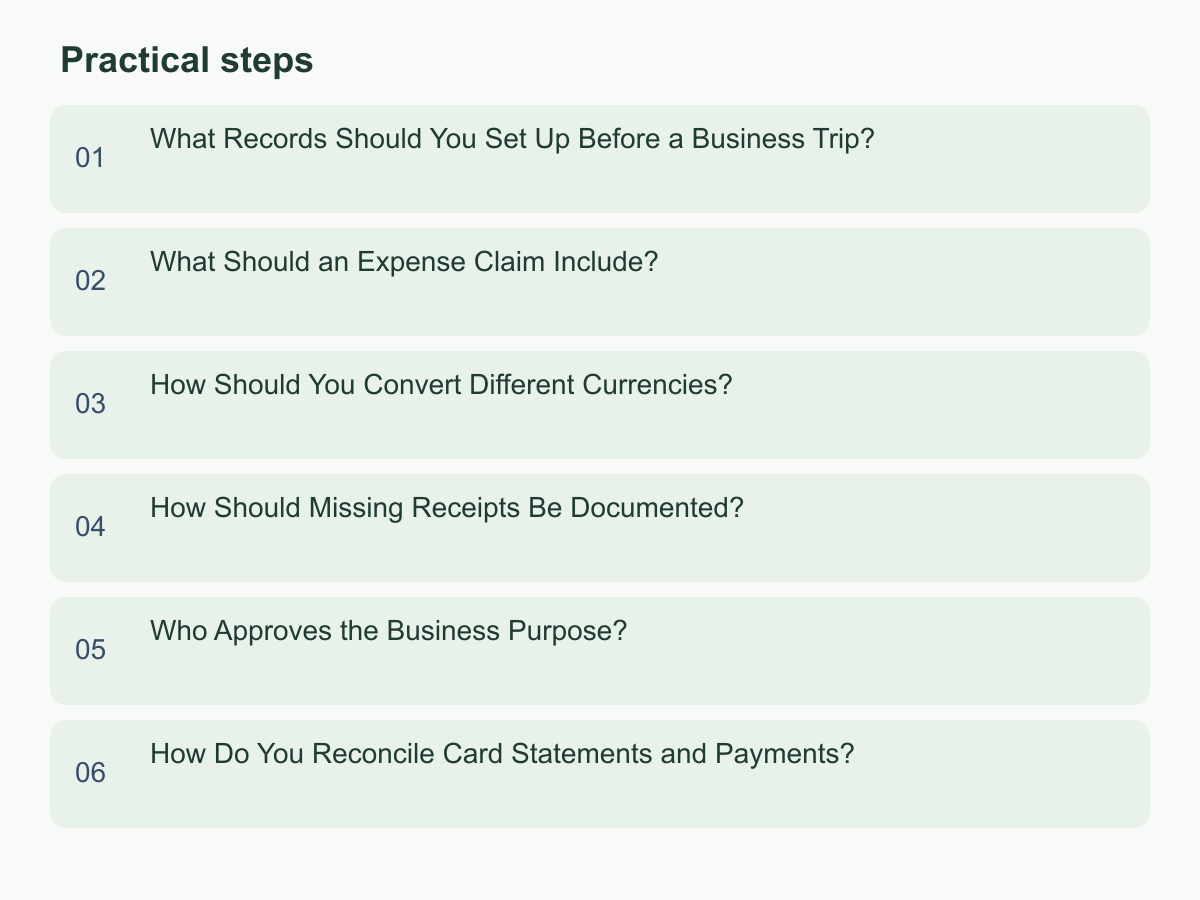
What Records Should You Set Up Before a Business Trip?
Before departure, put who is travelling, why, how costs will be paid, and what must be submitted on a one-page checklist shared by employee and approver. Include purpose, client or project, dates and locations, expected transport and lodging, company-card or personal-payment arrangements, acceptable records, and submission and approval steps. Follow existing travel rules. If none exist, the responsible person should define reimbursable items, preapproval requirements, and exceptions so staff do not have to guess during the trip.
Require each record to show date, currency and amount, merchant or payee, purpose, and payment method, supported by a receipt, electronic confirmation, or payment record. Keep lodging booking details and payment proof. Without paper transit tickets, save the itinerary, payment page, or electronic record showing the amount. Ask employees to save files in a phone trip folder named “date_merchant_purpose” and take clear photos with all edges and legible text and amounts.
State the submission route, approver, delegate, and contact method if the approver is unavailable. Travellers should claim what they paid; anyone paying for another person records the beneficiary and allocation to avoid duplicate claims. Test one small expense from receipt to approval before departure. Record changed plans, the reason, and any follow-up approval in the same trip record.
What Should an Expense Claim Include?
Include the employee, department or project, trip dates and destination, business purpose, receipt ID, transaction date, merchant, original currency and amount, payment method, evidence link, claimant, and submission date. Use one expense per row; do not merge several days of meals, transport, and lodging. For mixed personal and business receipts, claim only the business portion and show the calculation.
Separate claim and bookkeeping currencies, rate and date or source, converted amount, actual debit, and variance. Preserve the local-currency card posting; an estimate is not the bank’s actual debit. Record approval status, approver and date, return reason, missing-item status, payment batch or reference, and settlement date. Mark blanks “not applicable” or “pending,” rather than leaving them ambiguous.
Use an existing template if it shows payer, purpose, amount, conversion, approver, and payment status. Keep one line per expense, link attachments, and record editor and time. Add missing details in notes rather than building a new process. The claimant checks totals and attachments, the approver checks purpose and exceptions, and the payer checks payee details. Separate receipt currency and statement currency fields explain differences without manual recalculation.
How Should You Convert Different Currencies?
Keep three amounts distinct: the receipt’s original-currency amount, the internal claim converted at the company’s chosen rate, and the actual debit on the card or bank record. They support the transaction, internal reporting, and settlement, respectively, and may differ. Record rate, source, date, and calculation so the amount can be rechecked. Use one consistent internal basis, and preserve the original details when refunds, posting-date differences, or payment channels create a variance.
This example is hypothetical only. At an assumed rate of TWD 32.5 per USD, USD 120 converts to an estimated TWD 3,900. If the card debit is TWD 3,940, the variance is actual debit minus estimated claim: TWD 40. Keep both figures and the variance without overwriting the original-currency amount; apply company rules to the recorded cost.
| Field | Hypothetical example |
|---|---|
| Original amount on receipt | USD 120 |
| Internal assumed rate | TWD 32.5 per USD |
| Converted claim amount | TWD 3,900 |
| Actual card debit | TWD 3,940 |
| Variance (actual debit minus claim) | TWD 40 |
For cash exchange, retain the exchange record and account for unused cash or refunds. For a personal card, mark the amount estimated until the statement posts, then update the actual debit with revision history. Do not call an assumed rate official or treat a variance as automatic extra reimbursement. List a refund or shared expense with its source and calculation. Internal reimbursement completion does not determine tax treatment.
How Should Missing Receipts Be Documented?
First identify whether evidence is missing for the transaction, payment, business purpose, or completeness. Keep any available email, order page, card entry, itinerary, or correspondence; note why the item is missing and how records can cross-check it. For a lost receipt, record the date, merchant, amount, currency, purchase, payment method, and any colleague present. Ask the merchant for a duplicate when available and log the contact; never recreate a document that looks like the original.
If a payment record lacks detail—for example, it shows only merchant and amount—add the purpose and itinerary link. If a receipt lacks the payer, add the payer and method. Separate any personal amount and show the calculation. Track the missing item, reason, remedy, outstanding information, owner, expected follow-up date, and any exception. That date is an internal target, not a statutory deadline.
The approver applies company exception rules and checks that evidence supports purpose, amount, and payer, requesting reasonable additions where needed. Link later files to the original claim row with the updater and time. If evidence remains unavailable, record the gap and decision. An order or payment reference can help locate the transaction. These notes clarify internal handling; they do not make an expense tax-deductible.
Who Approves the Business Purpose?
Name the approver in the internal process: usually a manager, project lead, or administrator who knows the trip, budget, and project. The employee’s “business” checkbox is insufficient. In one sentence, state why the employee travelled, whom they met or what they handled, and the business connection. Link a meeting invitation, client correspondence, event registration, or project plan, while limiting sensitive details to what the reviewer needs.
Check advance authorization, dates and business purpose, amount against itinerary, payer, supporting attachments, reproducible rate and variance, and duplicate or personal items. For out-of-budget costs, colleague-paid items, changed plans, or missing evidence, record the reason and obtain exception approval from the authorized person. Keep the approver, date, review scope, and any return or conditional terms—not just a click.
Name a delegate and handoff method for approver absences, identify the acting delegate, and provide access to necessary records. Purpose review, amount reconciliation, and payment may be assigned to different people or one person; mark each step and time. Approval is an internal control, not a tax, legal, or bank conclusion. Refer uncertain cases to an appropriate professional without promising deductibility or approval.
How Do You Reconcile Card Statements and Payments?
Match each expense line to payment evidence. For company cards, compare date, merchant, original amount, and posted amount; for personal payments, compare the approved amount owed with the transfer record. Track advances, returned balances, and outstanding items separately. A monthly card total is related context, not the employee’s trip claim.
Record payment method, payer, transaction reference, statement currency, actual debit, estimated claim, variance and reason, approval and payment status, and settlement date. Locate the transaction first; keep purchase and posting dates if they differ. Mark unmatched items pending, check refunds, shared or similar same-day transactions, exchange-rate differences, and broken links, then record the resolution and formula so the variance’s sign is clear.
Summarize amounts claimed, approved, and paid, advance offsets or refunds, and unsettled amounts. Assign an owner and internal follow-up date if the employee must repay the company or the company still owes the employee, until a receipt or payment record can be matched. The person closing the trip records the completion date. Use a recent trip to find missing template fields. If the card statement is unavailable, leave the claim pending rather than treating it as settled. For more information about Chan & Chung Consultancy, visit the homepage.