
Cross-border sales quotations often combine figures checked on different dates: supplier prices, exchange rates, freight estimates and expected payment timing. A simple “valid for seven days” may hide those assumptions, while an expired file can continue circulating as if current. Good quotation control records each input’s source and date, identifies what may change, sets a review point, and makes each revised version traceable.
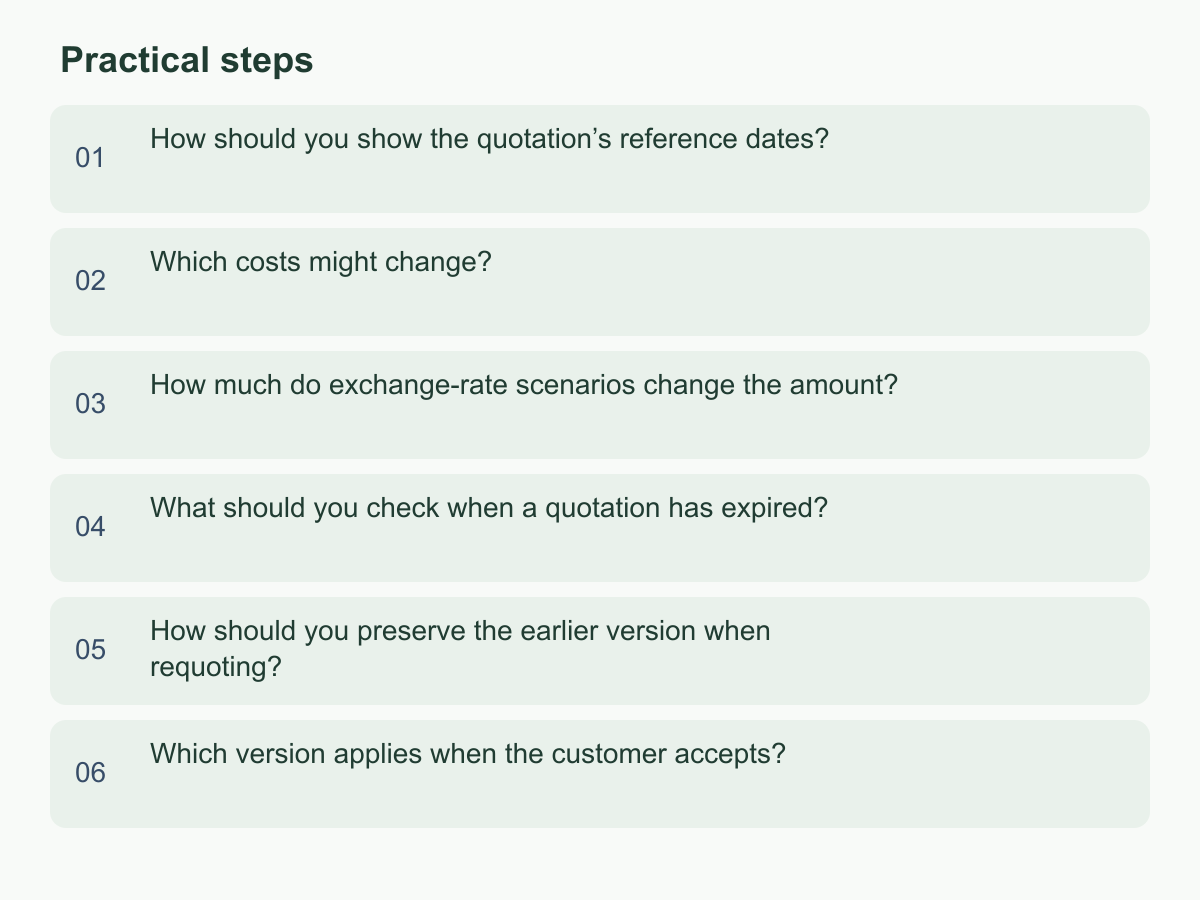
How should you show the quotation’s reference dates?
Separate the preparation date from each pricing reference date. Record when the exchange rate, supplier price, freight estimate, and other material inputs were checked. State the currency, quantity, specifications, delivery method, included and excluded items, and relevant conditions. If sources differ, date each line instead of saying all prices reflect the quotation date.
State expiry as a date, time, and time zone, and explain the next step: “Amounts are estimates based on the listed exchange rate and cost assumptions. After expiry, changed inputs will be rechecked before confirmation.” Avoid “valid this week” or “valid seven days” alone. Set the period by supplier confirmation, customer timing, and review frequency.
For example, a quote prepared October 18 could use that day’s rate and request a reply by 6 p.m. Taipei time on October 25. If a supplier price is confirmed only through October 22, show its earlier checkpoint or shorten the whole quote’s validity. Before sending, check dates, currency, scope, and version. On an extension request, verify assumptions before retaining the amount or issuing a revision.
Which costs might change?
Classify each worksheet line as fixed for this calculation, condition-dependent, or unconfirmed. Procurement may depend on supplier quote, specifications, quantity, and timing; freight or insurance on route, volume, packaging, and arrangements. Labor, packaging, commission, and payment fees depend on transaction terms. A foreign-currency expense also depends on rate and conversion method. These are possible categories, not universal charges or costs necessarily borne by the seller.
Record each line’s source, date, currency, unit, and conditions. Check whether a supplier price is per unit or lot, freight matches route and volume, and a fee is fixed, percentage-based, or charged to the recipient. Mark missing information pending, assign an owner and deadline, and keep guesses or exclusions out of the total.
When information changes, compare specifications, currency, quantity, delivery method, and validity dates before recalculating. If the customer changes from 40 standard-packaged items with a longer lead time to 20 shipped sooner, recheck supplier pricing and transport; record affected and unchanged lines. This separates changed scope from market movement. State who bears shared expenses and how they are calculated; do not count a charge twice. For unconfirmed items, provide a sourced range or exclude them from the provisional subtotal.
How much do exchange-rate scenarios change the amount?
Identify who exchanges currency and the expense and quotation currencies. Choose a rate source and timestamp: published rates may differ from bank or payment-provider quotes, which may include spreads or fees. Match assumptions to the payment arrangement and record the conversion method; “rates may fluctuate” alone is not enough.
Figures below are hypothetical, not live rates or quotation data. Assume US$1,000 procurement cost, NT$4,000 other costs, and target gross margin 20% of selling price. At US$1 = NT$31, total cost is NT$35,000. Divide by 0.8 to retain that margin, giving a reference selling price of NT$43,750.
| Assumed exchange rate | Converted total cost | Reference selling price | Change vs. baseline |
|---|---|---|---|
| US$1 = NT$31 | NT$35,000 | NT$43,750 | Baseline |
| US$1 = NT$32 | NT$36,000 | NT$45,000 | +NT$1,250 |
| US$1 = NT$33 | NT$37,000 | NT$46,250 | +NT$2,500 |
Moving from 31 to 32 adds NT$1,250 to the selling price; moving to 33 adds NT$2,500. These figures preserve the target margin; they are not a forecast or a promise of customer acceptance. Model scenarios, the foreign-currency share of costs, and an internal review trigger. Rate movement alone does not show impact, and a stress scenario does not commit either party.
What should you check when a quotation has expired?
Identify the version sent and whether the customer’s reply matches its quantity and delivery terms. Use the document and correspondence, not a filename or copied total. Expiry alone shows neither acceptance nor rejection; clarify an ambiguous reply before proceeding.
Recheck only inputs that may have changed: foreign-currency amounts and rate source/time, supplier quote dates, quantity and specifications, freight and insurance, delivery arrangements, payment method, and excluded fees. Keep valid inputs with original dates and sources. If the supplier has not updated a price, mark it unconfirmed rather than assume availability.
Compare with company triggers, such as a chosen rate movement, supplier update, or customer change in quantity or timing. These are internal procedures, not universal standards. If impact is minor, follow approval rules and record why the amount was retained. If a cost changed or a source expired, recalculate affected lines and tell the customer what changed, what remains, and when figures will be checked again. Save before-and-after values, affected scope, latest check date, and decision owner.
How should you preserve the earlier version when requoting?
Create a new version instead of overwriting a sent quotation. Give it a unique number, preparation time, expiry, currency, pricing conditions, and change summary. Keep the original, worksheet, and sending record together under the company’s retention process. A name like “CustomerCode_QuoteID_V1_Date” is easier to trace than repeated “final” or “latest” files.
The summary should state the affected item, old and new values, source dates, and effect on total or validity, plus unchanged conditions. For example, if V1 used supplier and rate data checked October 18 and a new supplier price arrives October 21, V2 records the new date, affected line, and recalculated total. Keep both files to show the reason for the difference.
When sending V2, name it, summarize the changes, and ask the customer to reply against that version. If an earlier file may circulate, say: “Please use the attached V2 for this review; do not use the earlier version as the basis for this update.” The parties’ documents and correspondence determine the terms. Send a complete revision instead of silently replacing one figure, and record recipient, time, attachment, reply status, and (internally) preparer/reviewer if needed.
Which version applies when the customer accepts?
Link acceptance to a quotation number and version, not only an amount or “that works.” Check currency, quantity, specifications, delivery method, included and excluded items, payment milestones, and validity. If the reply names only a total or differs from attachment scope, restate key terms and ask which version applies. Silence, forwarded messages, and internal verbal summaries do not confirm a version.
Store the reply, referenced version, and attachment in the shared business record. A note like “Customer confirmed V2, 40 items, currency NT$” must match actual correspondence. For options or staggered deliveries, record the chosen option or batch; partial confirmation does not cover the whole quote. Review related contracts or purchase documents for additional terms.
If the customer responds after expiry or proposes new quantity, specifications, or payment currency, mark pending recheck. Verify affected inputs, then confirm the original or issue a new version. Record why inputs remain valid even when terms are unchanged; do not silently extend an old document. Link current cost sources to the accepted version.
Start with a recent cross-border quote: add reference dates, cost checks, expiry, and version fields before the next review. For more information, visit the Chan & Chung English homepage.