Published · Updated

A Companies Registry search result showing “dissolved” is not enough to determine whether a Hong Kong company can be restored. A Taiwanese business owner planning to use a Hong Kong company for cross-border operations should first confirm why it was dissolved, the effective date and the applicant’s eligibility. Company registration, business registration, tax and bank records each require separate checks. Hong Kong restoration follows Hong Kong law; Taiwan company-registration rules do not apply. Start with a traceable company identity and status record, then assess the route and maintain separate follow-up lists for each authority or institution. Collect the identifiers, formal dissolution evidence and applicant records before discussing the matter with a prospective handler.
The example below is hypothetical, not a client case: a Taiwan-based owner has only a company name and an old email address. A search shows the Hong Kong company as dissolved, but it is unclear whether it applied for deregistration, was struck off by the Registrar, or went through winding up. Mark anything not yet found as unverified and check it against records that can be retained.
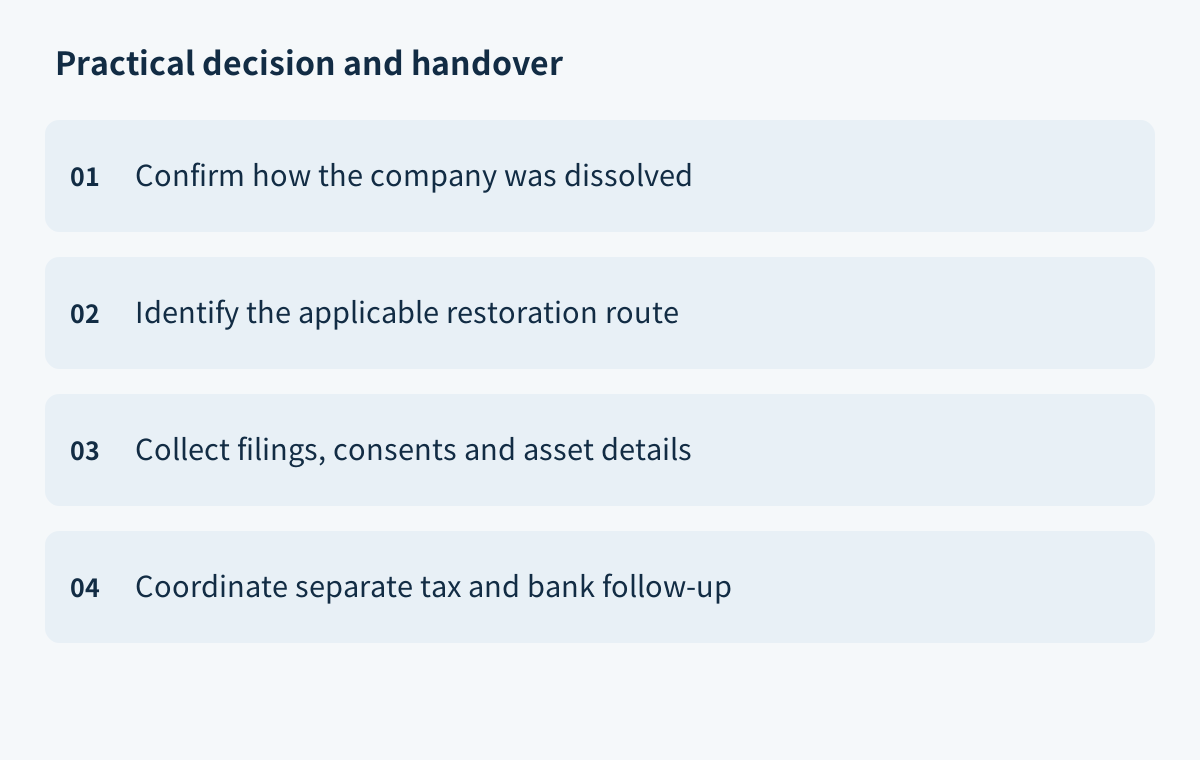
First establish how the company was dissolved or struck off
Compile the company’s full English and Chinese names, Business Registration Number (BRN), old company number, former names and approximate year of incorporation. Search the Companies Registry’s e-Search Services. If you have only an old company number, use the search instructions to locate the corresponding record and cross-check it against the name. Do not rely only on an old email, invoice or search-engine snippet: similar names and name changes can lead to a mistaken identification.
Save the search result, document index and Gazette notice. Record the status wording, notice date, effective date of dissolution and latest filing. Distinguish a strike-off by the Registrar from voluntary deregistration; winding up has its own records and procedures. A company described as dormant or no longer trading is not necessarily dissolved. The Registry says a company declares itself dormant by special resolution, so confirm its status in the register and formal notices. See the Dormant Companies FAQ and the FAQ on deregistration, striking off and winding up.
In the hypothetical case, if the search says only “dissolved” and no notice or reason can be found, record “reason and date of dissolution unverified”; do not assume overdue filings caused it. A handover record should include the name, BRN, old number, status, notice link, dissolution date, document index and missing evidence. If names, numbers or dates conflict, retain each discrepancy and confirm it with the Registry before drawing a conclusion. Name downloaded files with the company number and retrieval date, and preserve the search terms and source page so another person can repeat the check. If a notice cannot be downloaded, note the query date, notice title and Gazette number for later verification.
Administrative and court restoration have different conditions
The route depends on how the company was dissolved. A company dissolved by deregistration may apply to the Court of First Instance for restoration. A company dissolved after the Registrar struck it off may be considered for administrative restoration or a court order, subject to the relevant conditions. Administrative restoration is not available if the company was dissolved by deregistration or winding up. If records point to winding up, identify that procedure before preparing restoration documents. See the Companies Registry’s FAQ on deregistration and restoration.
The Registrar handles administrative restoration. For a local company, the conditions include that it was operating when struck off, that the applicant brings the Registry’s records up to date, and that any relevant Government consent and reimbursement of costs relating to property vested in the Government are addressed. Applicant status and member authorizations also need checking. A court application instead requires assessment of the dissolution route, the applicant’s legal basis, the order sought and supporting evidence; its documents and hearing arrangements differ from an administrative application. Evidence of a former role, shareholding or creditor status must relate to the specific basis for applying.
In the hypothetical case, a Gazette notice confirming a strike-off by the Registrar opens an assessment of the administrative and court routes; it does not establish eligibility. Record the confirmed cause, possible route, conditions still to verify and documents to find. If the notice shows deregistration or winding up, stop preparing an administrative restoration application and check the applicable procedure instead. The Registry’s Guidance Notes on Application for Administrative Restoration set out the administrative requirements.
Check applicant eligibility, deadlines and company status
For administrative restoration of a local company, check whether the applicant was a director or member and confirm the dissolution date from the Registry’s records. The application generally must be made within 20 years after dissolution, and the Registrar will usually ask for written member authorizations. Non-Hong Kong companies have different conditions and a six-year period measured from the date of striking off; do not apply the local-company rules to them. The Registry’s restoration FAQ explains these distinctions.
Court deadlines also generally involve a 20-year period, but section 766 of the Companies Ordinance sets different starting points according to the statutory basis, including the Gazette notice date, deregistration or date of dissolution. An application to enable a personal-injury damages claim is a statutory exception. If the Registrar refuses a qualifying administrative restoration application after the 20-year period has expired, the court application must be made within 28 days after notice of refusal. Ask a Hong Kong legal professional to calculate the applicable deadline using the cause of dissolution, applicant’s status and legal basis. Keep the Gazette publication date, dissolution date, administrative refusal date and date notice was received as separate entries. See Part 15 of the Companies Ordinance and Hong Kong e-Legislation.
For handover, record the applicant’s name and status, evidence of any former role or shareholding, member authorizations, dissolution date and source, route under consideration, who calculated the deadline and what remains unverified. In the example, a company name and old email do not prove applicant eligibility. Look for historical director or member records, the register of members and Registry documents. If a deadline is near or may have passed, give the date evidence to the legal professional responsible for assessing the procedure before sending an application and waiting for a response.
Compile overdue filings, assets and relevant consents
If administrative restoration is being assessed, use the Registry’s guidance to identify records that may need to be filed or updated. These can include outstanding annual returns (Form NAR1) and financial statements where appropriate; Form NR1 if the registered-office address changed; and Forms ND2A or ND2B if director or company-secretary appointments or particulars changed. Check the applicable years, supporting documents and fees against the company’s actual history and current requirements rather than relying on an old checklist. The guidance is dated May 2014 and was updated in December 2023. Before filing, check the Registry’s current Other Forms and Specified Forms pages.
Check member authorizations separately from Hong Kong immovable property and any property that may have vested in the Government as bona vacantia. Establish whether the company held Hong Kong property before dissolution and obtain relevant land-search or title records. If property vested in the Government, confirm whether it has no objection to restoration and how any costs or expenses must be verified. These details may not appear in the Registry’s general document index, so an empty index is not proof that there were no assets. For anything unresolved, list the authority to contact, the person responsible and the evidence needed; do not state an assumption as a fact in an application.
Use a checklist recording each document, applicable year or change date, current version, reason for any gap, applicability, signature or authorization status, verification contact and next step. Keep originals and retrieval dates indexed with resolutions, authorizations, historical filings and asset evidence. Before submission, check the current form, instructions, signature requirements and attachments. Incomplete drafts or unverified signatures are not proof of authorization. Court proceedings require a separate document list; administrative restoration files do not establish that court materials are complete. Keep submission receipts and track any matters still awaiting the Registrar’s action.
Restoration does not automatically update bank and tax records
Restoration to the Companies Register confirms the company’s registration status; it does not show that the bank, Inland Revenue Department (IRD) or Business Register has updated its records. The IRD maintains a separate Business Register, so check the company’s Registry record, Business Registration Number and certificate, tax correspondence and bank-account status separately. See the IRD’s general information on business registration.
After restoration, ask each institution whether its records reflect the change, whether anything remains outstanding, what evidence it accepts and whether it needs to reconfirm authorized persons or contact details. Ask the relevant bank to confirm whether the account still exists, who may operate it and whether customer information must be updated. Without a written response from the bank, do not assume the account is usable or arrange payments on that basis. Keep the inquiry date, channel, reference number, response and remaining actions.
For tax follow-up, check correspondence, notices, unanswered letters and supporting records using the company’s identifiers; if an old authorized person or contact method no longer works, ask about the current verification process. Keep unanswered items marked as pending. In the example, even after restoration is confirmed, the handover list should separately show “Companies Registry: confirmed,” “Business Registration/IRD: awaiting reply” and “Bank: awaiting reply.” Record the next owner and any stated response conditions for each item, and follow up through the institution’s formal channel if it does not respond.
Have a professional handling the matter confirm the full scope
For court proceedings, verify that the person taking the matter is a Hong Kong legal professional and check the engagement documents for the parties, scope of work and fees. Assign responsibility separately for accounting records, tax correspondence, company filings and bank checks, including any required authorizations. If a trust or company service provider (TCSP) is involved, independently check the provider’s licensing status and permitted scope. Help with organizing records does not itself amount to legal advice or cover procedures handled by other institutions.
A handover can include the company search and Gazette notice, dissolution reason and date, applicant records, member authorizations, overdue returns and financial records, Hong Kong asset information, and pending bank, business-registration and tax questions. Ask the prospective handler to provide a written list of what has been verified, what is missing, who will contact each authority, expected deliverables, work required from the company and exclusions. Compare advice with the original Registry records and legislation; resolve any difference in the basis before deciding whether to apply.
Before engagement, confirm the contracting party, payee, document custody and return process, and secure channels for sharing sensitive records. If a quotation is provided, separate Government charges, third-party costs and professional fees, and check their calculation basis, recipient and conditions that could change them. Treat amounts awaiting confirmation as estimates rather than a fixed total. If a provider says it can handle legal, accounting, tax or licensed company services, verify the actual person doing each task and their qualifications; a marketing page is not proof.
For broader context, A timeline of Hong Kong company incorporation and post-incorporation compliance discusses general compliance after incorporation, while How to choose a Hong Kong company registration service provider: fees, process and TCSP checks covers the service-provider market and license checks. These articles do not establish that any provider has taken on a restoration matter. For a case-specific assessment, you may submit a question through the contact details on the website. This article is not legal or tax advice and does not guarantee an outcome.