Published · Updated

A written directors’ resolution records a collective decision; a complete document does not prove that the right people approved it or complete a contract or filing. Check authority, the company’s articles, conflicts and procedure before choosing written agreement or a meeting. Hong Kong law governs regardless of the reader’s location.
Use the figure for initial checks; confirm signatures, filings and execution separately:
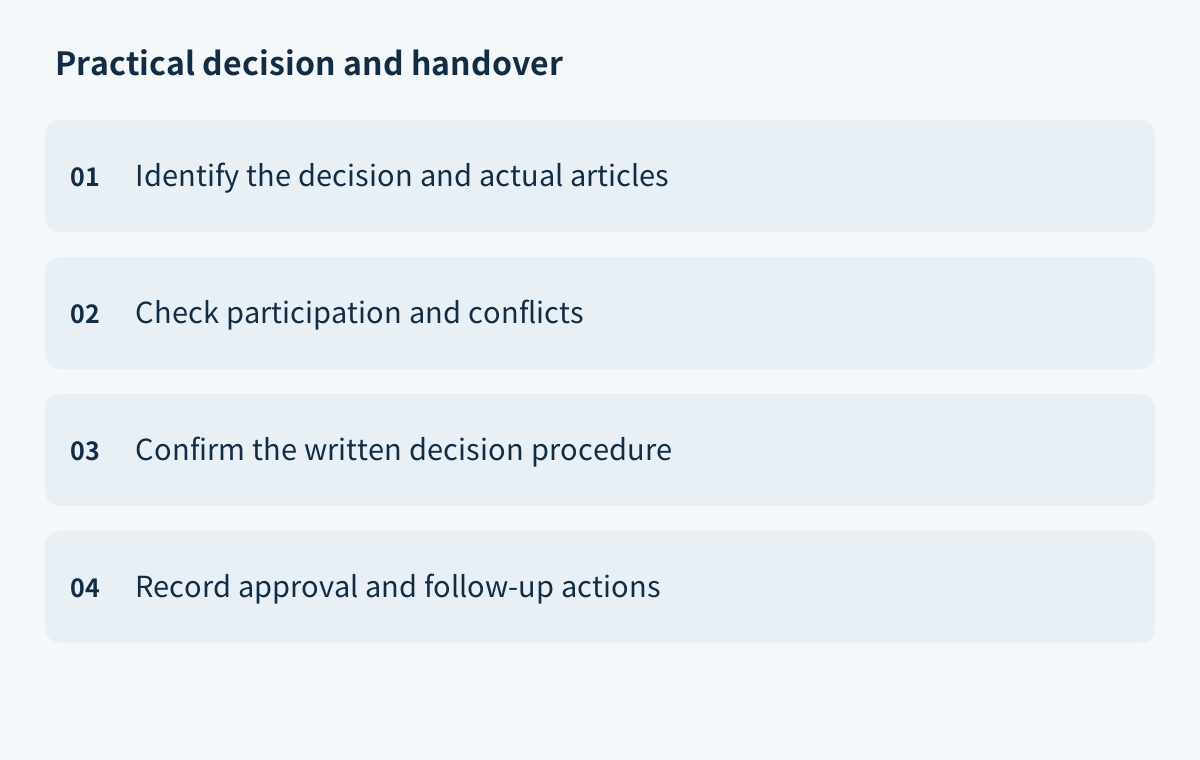
When Should Directors or Members Approve a Decision?
Who approves?
State the matter precisely: approve a logistics contract, appoint a director, or change share capital. Check company type, current articles and amendments, board delegations, member-reserved matters, and approval clauses in shareholder, financing or transaction documents. Directors act within their authority; where law, articles or transaction documents reserve the matter to members, board approval alone is insufficient. A single arrangement may also need counterparty consent. Record approvals separately, in order, with outstanding conditions.
If a multi-director company adopted unamended Model Articles Schedule 2, decisions may be made by majority at a meeting. A written unanimous decision needs every eligible director’s agreement and enough eligible directors for a quorum. Other articles may differ. Companies (Model Articles) Notice, Schedule 2
How to map approvals?
Map the matter, authority clause, approvers, quorum and voting rule, format, and execution owner. Flag pending conditions. Section 552’s 5% threshold concerns members’ requests to circulate a proposed written resolution, not a board threshold; articles may set a lower percentage. Members generally have 28 days, or the period in the articles, to agree. After passage, notify members and the auditor within 15 days. Companies Registry: Meetings, Resolutions and Company Records FAQ
Check the Articles and the Decision First
What to check?
Obtain the articles in force, including amendments. Review director appointment and delegation documents, shareholder and financing agreements, major contracts and transaction terms. Identify who may approve, matters reserved to members, notice and quorum rules, voting restrictions, lender or counterparty consent, and the intended effective time. Company type affects the rules; model articles do not replace company documents. Record the articles’ version, amendment dates, reviewer and relevant clauses; follow cross-references through the full text.
What to record?
For each matter, note its governing clause, approver, votes needed, conflicts, format, conditions, record location, owner and deadline. For example, before a cross-border e-commerce company signs a logistics agreement, check authority and disclosure for any director connected with the supplier, then confirm participation and quorum. Do not draft a unanimous approval and repair the process later. This illustrates process, not a company-specific conclusion.
Separate legal requirements from internal administration, such as who stores attachments, so internal practice is not mistaken for a legal threshold. For related context on capital and shareholder arrangements, see Hong Kong company share capital structure: designing capital and shareholder agreements.
Disclose Conflicts and Set Participation Rules
When to declare?
Section 536 addresses a director’s material interest in a business-significant transaction, arrangement or contract, including a proposed one; public companies also have rules for connected entities’ material interests. Under section 537, declare an interest in an existing transaction as soon as reasonably practicable, and one in a proposed transaction before the company enters into it. Section 538 allows declaration at a directors’ meeting, by written notice to other directors, or by general notice. Electronic delivery depends on the recipient’s agreement to receive it electronically. Check company type and applicable provisions. Companies Ordinance, sections 536–538
Ask directors about direct or indirect counterparty links before circulating the agenda. Record the interest’s nature and extent, transaction, recipients, notice method and time, and supporting documents. Record corrections to incomplete or inaccurate notices.
Can the director vote?
Disclosure and participation are separate questions. Check conflict provisions, exceptions, voting restrictions and quorum rules. Under Model Articles Schedule 2, a director with a material interest in a transaction significant to the company’s business generally cannot vote or count toward its quorum, subject to specified exceptions. Other articles may differ. Companies (Model Articles) Notice, Schedule 2
Record the disclosure, attendance for that agenda item, any recusal, voting eligibility, quorum calculation and result. In the logistics example, document the director’s relationship and relevant clause; do not include or exclude the director from quorum before checking the documents and any exception. If facts remain unclear, obtain advice on the specific situation before deciding.
Written Consent or a Meeting?
Which method?
Written agreement may suit a settled proposal when all eligible directors receive the same materials, can clearly agree or disagree, and the articles permit it. A meeting is easier to document when questions remain, terms may change, views differ, a conflict needs discussion, or the articles require a meeting. The format does not lower the threshold: under Model Articles Schedule 2, a meeting follows its voting rules, while written agreement requires every eligible director and a sufficient quorum. Model Articles Schedule 2, articles 7–12
For directors in different cities, check the articles’ meeting and notice rules and ensure everyone can hear, contribute and access the papers. Record connection failures or missing attachments; postpone a vote when needed.
Which records?
For a meeting, retain notice, attendance, agenda, disclosures, discussion summary, votes, resolution and attachments. For written agreement, retain the final proposal, each consent, signed copies and compiled version. State the decision date, articles relied on, conditions and owner. If adopted, Schedule 2 article 19 requires directors’ decision records for at least 10 years. Under article 20, a sole director must give the company a record of a non-written decision within seven days; retain that record and any written resolution for at least 10 years. Check adoption and amendments first. Model Articles Schedule 2, articles 19–20
Check Signatures, Dates, Electronic Methods and Validity
What proves agreement?
Confirm the decision method and who may vote. Under Schedule 2 article 8, a written unanimous decision may use resolution copies signed by each eligible director or other written indications of agreement. Send the same version to all. Acknowledging receipt or suggesting edits is not agreement to the final text. Model Articles Schedule 2, article 8
An e-signature platform, login check, email delivery or timestamp does not by itself establish validity or effectiveness. Check the articles, contracts, counterparty requirements, signatories’ identities and company receipt rules. Where directors or counterparties are in different jurisdictions, confirm the signing and delivery method meets the governing documents before relying on the resolution.
How to trace versions?
Keep a version log with the resolution name and number, summary, recipients and send times, responses and times, revisions, compiler and storage location. Match each signed copy to the approved version; preserve original responses, attachments and platform or email records rather than an unlinked screenshot.
The Companies (Amendment) Ordinance 2025 took effect on 17 April 2025. It changed electronic and website communications with members and debenture holders, including a website implied-consent route with notice safeguards. This does not validate every directors’ resolution or e-signature. Distinguish agreement, compilation and effective dates, and when conditions were met. Companies Registry: Promoting Paperless Corporate Communication
Connect the Resolution to Filings and Execution
What filings apply?
A board resolution does not always need filing with the Companies Registry. Check whether it causes a reportable change. The company generally reports a director’s appointment or cessation on Form ND2A within 15 days; use ND2B for a change in particulars, also within 15 days. If the company reports a resignation on ND2A, the director usually need not file ND4. Check ND4 if the director has reasonable grounds to believe the company will not notify the Registrar. Companies Registry: Directors and Company Secretary FAQ
For records made after the relevant 2018 amendment commenced, generally notify the Registrar on Form NR2 within 15 days if directors’ resolutions, meeting minutes or sole-director records are first kept outside the registered office, or their location changes. They may be kept elsewhere in Hong Kong. Transitional arrangements include some locations previously reported under former rules. Check the current specified forms list and the Companies Registry’s 2018 amendment FAQ.
What does handover include?
Bundle the final resolution, approval basis, conflict record, signing authority, tasks, filing form and deadline, storage location, open questions and owner. State who acts, under what condition, by when, and what proves completion. Separate internal work, such as authorizing a signatory or updating bank or platform access, from statutory notices. Banks, investors and counterparties may set separate requirements; a resolution alone does not prove acceptance. Keep a filing receipt or registry result, not just a prepared form. For market context on company-secretary pricing, see Hong Kong company secretary annual fees: what quotations include and how mid-year changes are handled.
For a case-specific assessment, submit a question through the website’s contact options. This article is not legal or tax advice and promises no outcome.