Published · Updated

The phrase Hong Kong Register of Members can refer to two different things: a company’s own register and information available through the Companies Registry’s public search services. These records serve different purposes, cover different information and may reflect different dates. A public search result does not replace the company’s internal register. This guide focuses on a company incorporated in Hong Kong with share capital. A re-domiciled company, a registered non-Hong Kong company or a company with a branch register should check the rules for its own structure. It is intended for business owners and decision-makers in mainland China, Taiwan, Malaysia and other overseas Chinese markets who are planning to expand through a Hong Kong company.
A Register of Members Is Different from Public Search Records
Section 627 of the Hong Kong Companies Ordinance (Cap. 622) requires a company to keep a Register of Members in English or Chinese. Depending on the company and the particulars involved, the register records each member’s name and address, the dates on which the person became and ceased to be a member, and share details. The company maintains this record as events occur; a Companies Registry search report is a view of information available through the Registry’s search system, not a transaction-by-transaction log of every change made by the company.
The Registry’s electronic search services provide company information reports, a Document Index and images of registered documents. Reports vary by company type. For example, the Registry’s August 2026 guide to obtaining company information says a company information report can include shareholder information for a company incorporated in Hong Kong with share capital or a re-domiciled company. The Document Index lists documents filed, whether registered or pending registration, along with filing dates, image-record information and processing status. A pending filing should not be treated as a completed registration. Usual residential addresses and full identification numbers in documents delivered for registration on or after 24 October 2022 are not available for public inspection; some other protected information also has statutory access restrictions.
An annual return, Form NAR1, is also not a substitute for the company’s own register. It reports company information as at a particular return date. To understand how a change was recorded, check the supporting documents and the company’s own entries. Before searching, identify the company type, the report required and the date of the information you need. Record the company name, report type, search date, document name and filing date. Save public-search results separately from internal records, then list any differences and open questions so the next person can trace each item to its source. The Registry’s specified forms index is a useful reference for form names and filing categories.
Check Member Identity, Shares, and Holding Records
First confirm which fields apply to the company, then compare each entry with supporting documents. For a company with share capital, the statutory particulars include the shares held by each member, identification by share number if the shares have numbers, and the amount paid or agreed to be treated as paid on each member’s shares. A working reconciliation may also include share class and quantity, but label these as internal management fields where they are not part of the specific statutory list. Check each member’s name and address and the dates they became and ceased to be a member. Interpret each field in light of the company type and the actual circumstances.
Every entry should be traceable to a source, such as incorporation documents, allotment records, completed transfer documents, company approval records or information supplied by a member. A reconciliation sheet can record the information date, document name and version, storage location, person who checked it and any differences found. For a corporate member, check that the name matches its registration details. If English and Chinese spellings, address formats or share classes do not match, preserve the source documents and flag the difference instead of overwriting the earlier record.
Under section 627, the company must enter relevant particulars in the register within the applicable period; the section provides for entry within two months after the company receives the relevant notice. Keep former members’ entries as well as the current list. The Companies Registry’s company records FAQ says the minimum retention period for a former member’s record is 10 years from the date that person ceased to be a member. If documents conflict, record their names, dates received, the difference and what remains to be confirmed. Preserve the original versions so a colleague can continue the verification.
How to Update Allotments, Transfers, and Changes to Names or Addresses
Start by identifying the event. An allotment, a share transfer, a member’s name change and an address change may involve different evidence and filing requirements. An allotment is the issue of shares to an allottee. The Companies Registry’s PAM 5E filing guide, dated May 2025, says a company must file Form NSC1 within one month after an allotment. That deadline concerns allotments; do not apply it automatically to a share transfer.
Before a transfer, check the company’s articles and any applicable agreements for restrictions or approval steps. Confirm that the transfer instrument, transaction date, relevant company decisions and share records agree. Check whether stamp duty or other document requirements apply; the documents and steps may differ between companies and transactions. After the transaction documents are completed, update the internal register within the applicable period under section 627, then separately confirm whether any filing, notice or other record needs to be updated. For a member’s name or address change, retain the notice and supporting evidence and update the register under the applicable rules. Do not treat an allotment return as the record of a transfer.
Handle the annual return separately. The Registry’s PAM 5E guide says a local private company generally has 42 days after its incorporation anniversary to deliver its annual return. Confirm the company type and applicable rule, particularly for a public company, a company limited by guarantee or a re-domiciled company. Filing NAR1 does not replace the duty to maintain the internal register when the company receives information about a change. For each event, save the documents, confirm approvals and applicable procedures, update the internal record, check external filing requirements, retain submission evidence and assign any unfinished step to a named person. For background on share classes and shareholder arrangements, see Hong Kong Share Capital Structure.
Confirm the Place of Keeping and Inspection Arrangements
Confirm where the Register of Members is actually kept, who is responsible for it, the company type and whether the location satisfies the applicable rules. Section 628 of the Companies Ordinance provides for the register to be kept at the registered office or a prescribed place in Hong Kong. If the register is first kept somewhere other than the registered office, the company must notify the Registrar in the specified form within 15 days. A change to the place where it is kept, other than a change to the registered office address, must also be notified within 15 days. The section contains exceptions, including circumstances involving a register that has always been kept at the registered office and qualifying existing registers. Form NR2, listed on the specified forms page, covers the location of registers and company records. Check the record type, company history and actual location; do not apply the SCR’s location rules to the Register of Members.
Before arranging an inspection, confirm the requester’s identity, the type of record, the date or period requested and whether a copy is needed. Under section 631, a member who makes a request in the prescribed manner may inspect the Register of Members and its index without charge. Another person may also inspect by following the prescribed procedure and paying the prescribed fee. The Registry’s company records FAQ says records subject to the inspection rules must be available during business hours, subject to reasonable restrictions, with at least two hours per day allowed for inspection. A register may be closed under separate procedures, so check the applicable notice and period first. Keep the request, the company’s response, the records or copies provided, any item that could not be provided and the handling dates.
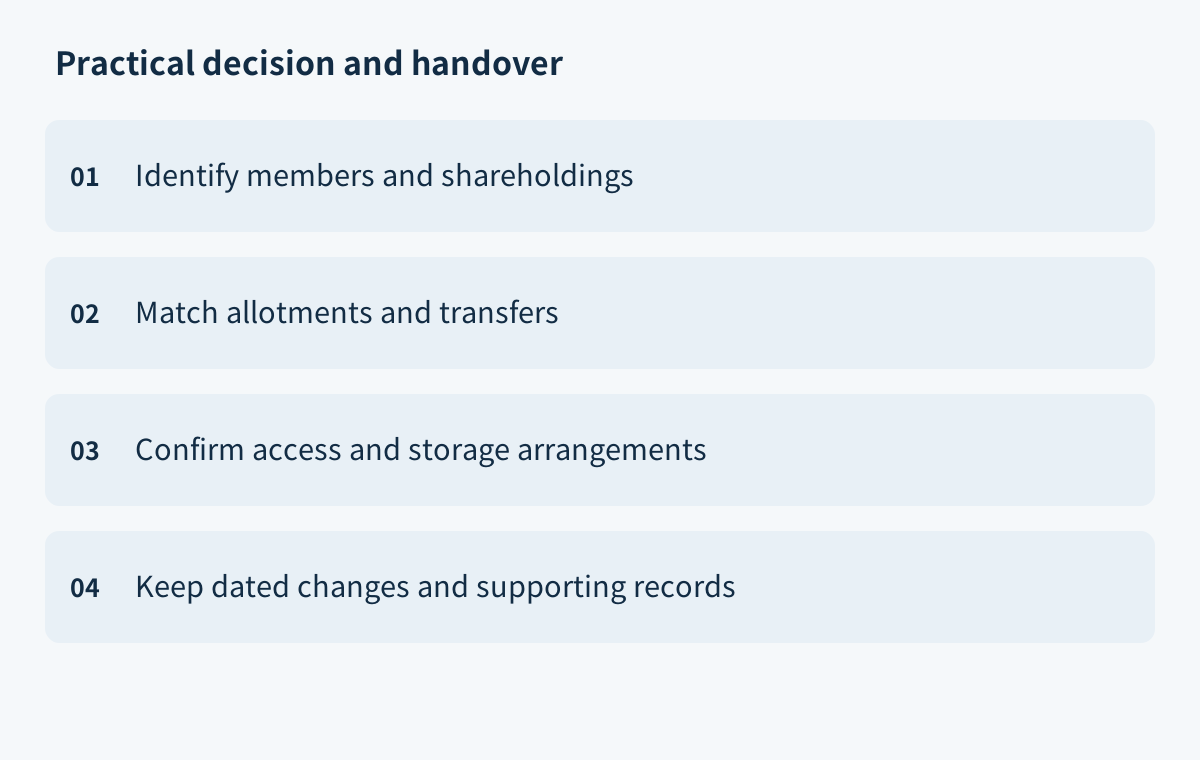
For a clear handover, keep the actual storage address, relevant notice status, inspection contact, file version and outstanding steps together. Before moving records, confirm that the new location is suitable, identify which registers or company records will move and check whether location notices need updating. Moving the files alone does not confirm that the location record is complete.
How to Reconcile Share Certificates, the SCR, and Bank Records
Separate four records by purpose. The Register of Members records the company’s registered members and share particulars. A share certificate or transaction document can help check an allotment or transfer, but it does not on its own replace the company’s register. The Significant Controllers Register (SCR) records information about significant controllers when the requirements apply. Bank KYC documents are collected and assessed according to the requirements of the relevant financial institution. The registered holder and the person who ultimately controls the shares may be different, so matching names alone does not show that the records agree.
The SCR is neither a public shareholder register nor proof of bank approval. The Companies Registry’s SCR overview says a company incorporated in Hong Kong or a re-domiciled company must keep an SCR under the Companies Ordinance, which is open for inspection by law enforcement officers on demand. Confirm whether and how the requirements apply to the company in question. The format and updating requirements for bank documents are determined by the financial institution for each case. A Registry report or share certificate does not mean a bank has accepted the information or completed its review.
A reconciliation sheet can list the source document, registered holder or controller, share class and quantity, information date, document version, difference, person responsible and next step. Check the period covered by each source, then identify whether it records the legal holder, a transaction counterparty or a control relationship. If a name, share count or date differs, preserve each source as it is and check whether the difference reflects transaction timing, an incomplete update or different record purposes. Do not change records with different purposes just to make the entries look identical.
Maintain Versions and Records of Completed Changes
Create a traceable record for every change. Include at least the event type, document date, effective or entry date, supporting documents, information before and after the change, person who updated it, person who reviewed it, external filing status and whether the SCR or bank KYC records should be checked. A version log is an internal method for maintenance and handover; it is not a statutory version-control requirement. Verify the legal particulars separately for the company type and event.
After an update, confirm that:
- The internal register matches the supporting documents.
- The previous version is retained and has not been overwritten.
- Applicable filing and notice requirements have been checked.
- Submission receipts and responses have been saved.
- Related SCR, share certificate or bank KYC records have been assessed for review.
- Each unfinished item has an owner and a next-action date.
If documents conflict, do not mark the change complete while a material fact remains unconfirmed. Attach the source documents, explain the difference and list the questions still to be resolved so the next person can continue the check. For formation-related context, see Hong Kong Company Formation Process. In routine recordkeeping, ask: What date does the register represent? Are the change documents complete? Have internal records and external filings been checked separately? Are the current version and supporting documents sufficient for someone else to repeat the check?
If you need a case-specific assessment, you may submit a question through the website’s contact channels. This article is not legal or tax advice and does not promise any outcome.