
Entering a market can strain cash because expenses come due before customers pay. Separate one-time launch spending, recurring costs, per-sale outflows, and receipt dates. Use conservative, baseline, and faster cases to find the lowest projected balance. All amounts below are illustrative in one currency unit; replace them with quotes, orders, contracts, and actual payment terms.
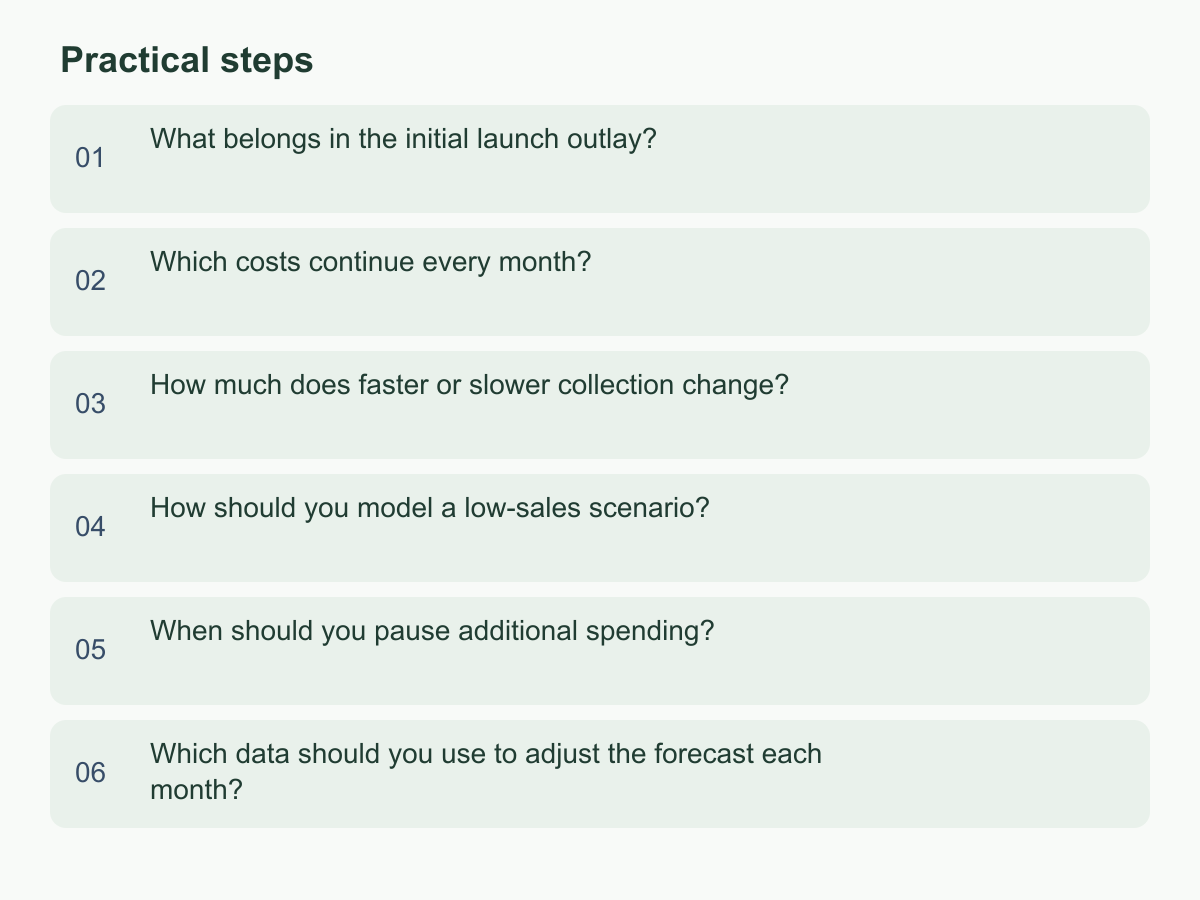
What belongs in the initial launch outlay?
Separate must-pay launch costs from deferrable ones, and sort each by due date. In this illustration, research and creative materials cost 12,000; samples and localization, 18,000; initial inventory and test shipping, 32,000; and tool setup, 8,000. The itemized total is 70,000.
| Illustrative item | Cash outflow before launch |
|---|---|
| Research and creative materials | 12,000 |
| Samples and localization | 18,000 |
| Initial inventory and test shipping | 32,000 |
| Tool setup | 8,000 |
| Total | 70,000 |
Record each payment in full when due, even if inventory may later sell, a deposit may be refunded, or creative assets may be reused; none is cash available today. Add an assumed 10,000 contingency to set an 80,000 initial funding need.
For each line, record currency, payment date, upfront requirement, purpose, cancellation deadline, and validation question. Does the sample win acceptance, shipping work, or content generate qualified inquiries? If unknown, shrink the test or split payments into dated milestones. List minimum-order excess as inventory risk. If a quote does not confirm shipping, packaging, or returns, mark those amounts unconfirmed instead of guessing. Milestones let you stop before a later payment if the test misses its threshold.
Which costs continue every month?
Use a separate schedule for recurring costs. In this example, local customer support and content maintenance are 12,000 a month, warehousing or operating support 5,000, and tool subscriptions 3,000, totaling 20,000 in fixed monthly outflow. Advertising, shipping materials, and transaction or payment-channel fees vary with activity; keep them variable to avoid counting them twice.
For each line, record a range, billing cycle, first bill date, cancellation notice, confirmer, and whether it is necessary or deferrable. Replace estimates with contracts and bills. Include staff time, outsourced quotes and milestones, and work displaced from existing staff. For foreign-currency tools, note the conversion assumption and track rate changes separately.
If monthly testing costs 20,000 and a 6,000 photography fee is planned for month one, defer it to month two if inquiry quality remains unvalidated. Replace estimates with actual payments monthly and explain repeated variances before resetting the funding floor.
Model launch delays: subscriptions or warehousing may bill during preparation. One extra month before the first order adds at least 20,000, before variable costs. Check deposits, minimum commitments, cancellation terms, and notice deadlines. Cancellable does not mean recoverable today; confirm terms before treating payment as deferrable.
How much does faster or slower collection change?
Assume 100,000 available, 70,000 for launch, fixed costs of 20,000 monthly, and a 60,000 first-month sale whose product cost is already in launch spending. After launch, 30,000 remains; month-one costs leave 10,000. Assume costs are paid at each month’s start and receipts arrive at month-end:
| Scenario | After month-one collection | End of month two | Before month-three collection |
|---|---|---|---|
| 60,000 collected in month one | 70,000 | 50,000 | 30,000 |
| Collected at the end of month three | 10,000 | -10,000 | -30,000 |
Two extra fixed-cost payments before collection consume 40,000, taking delayed cash from 10,000 to -30,000. Before the month-three receipt, the faster case is 30,000, a 60,000 difference between scenarios. Only bank receipts are available cash; invoices and pending payouts are not. Log evidence, confidence, and slower-case dates for expected receipts. Move supplier or purchasing milestones that precede them.
Use a weekly cash calendar with opening balance, confirmed receipts, necessary payments, and closing balance. Flag disputes, unsettled channel funds, and foreign currency; verify conversion and transfer timing. If inventory is paid after sale, enter it on its actual date without omitting or double-counting it.
How should you model a low-sales scenario?
Change shipment, collection, and replenishment timing, not just revenue. Assume 100,000 available, 70,000 launch spending, 20,000 monthly fixed costs, and 12,000 collected each month from month two. After launch, 30,000 remains; month-one costs leave 10,000. Collect 12,000, then pay 20,000 in months two and three, ending at 2,000 then -6,000.
| Timing | Cash movement | Closing balance |
|---|---|---|
| Start with 100,000; pay launch costs | -70,000 | 30,000 |
| Month one: pay monthly costs | -20,000 | 10,000 |
| Month two: collect 12,000; pay 20,000 | -8,000 | 2,000 |
| Month three: collect 12,000; pay 20,000 | -8,000 | -6,000 |
This simplified case excludes other income and variable costs unless separately counted or absent. Add inventory, freight, and channel fees on actual dates before collection. Ground conservative, baseline, and faster cases in observed results, strongest evidence, and specific supported improvements. Vary receipts, order volume, or collection delay one at a time; compare the lowest balance and date.
Bookings and invoices are not cash. Stress-test one fewer order, a one-week delay, or a higher inventory payment. Use the conservative path to reduce deferrable spending, postpone replenishment, or rearrange due dates.
When should you pause additional spending?
Set a cash floor reflecting essential obligations and unpaid commitments; no universal percentage applies. With necessary outflows of 20,000 monthly, an owner might reserve 40,000 for two months. If the conservative forecast dips below that floor before the next receipt, pause an uncommitted second inventory order or extra advertising. Check receipt dates, cancellation terms, and signed obligations first.
Pause if more spending buys no usable information. If initial materials produced too few relevant inquiries to compare, repeating exposure may use cash without answering the market question. Set a measurable indicator and review date before the next payment. Recheck price, direct costs, and timing when suppliers must be paid before collection; higher sales can deepen the cash gap.
Classify non-cancellable costs, delayable commitments, and ideas not yet ordered. Refresh the lowest balance for coming weeks. If it stays below the floor, narrow region, range, or advertising while preserving the key test. Resume only when improved collections are evidenced, cash exceeds the buffer, or funding and receipt dates are confirmed. Set a numeric trigger, owner, review date, and restart condition—for example, the revised receipt arrives and the conservative balance exceeds the buffer.
Which data should you use to adjust the forecast each month?
At month-end, record opening and closing cash, receipts, paid expenses, unpaid commitments, and invoice dates. Keep sales, shipments, and bank receipts separate; orders not in the bank cannot fund payments. Group by market, product, or channel; explain variances by volume, price, refunds, expenses, or receipt timing. Revenue alone cannot explain a shortfall.
Against a 50,000 forecast, 35,000 in bank receipts leaves a 15,000 gap. Confirm each unpaid item's owner and date; move uncertain receipts to the slower case. If necessary outflows remain 20,000 monthly, carry the gap into the lowest-balance forecast for three months; do not assume automatic recovery. Compare budget and actual payments, separating one-time, recurring, and sales-linked costs.
Update monthly; revise the next 13 weeks when a receipt or large payment changes. For each variance, log amount, cause, owner, action, and review date. If collection shifts, move the receipt date and inspect supplier payments in the same week. Match refunds, discounts, and currency differences to source transactions. Identify the earliest floor breach, move uncertain items to the conservative case, and recalculate with slower collection. For more about Chan & Chung, visit the Chan & Chung website.