
Before preparing an overseas supplier invoice for payment, compare the approved purchase commitment, actual deliveries, and amount being billed. When an item, quantity, price, currency, or freight charge differs, trace the source before deciding how to handle it. A similar total does not mean the underlying lines match.
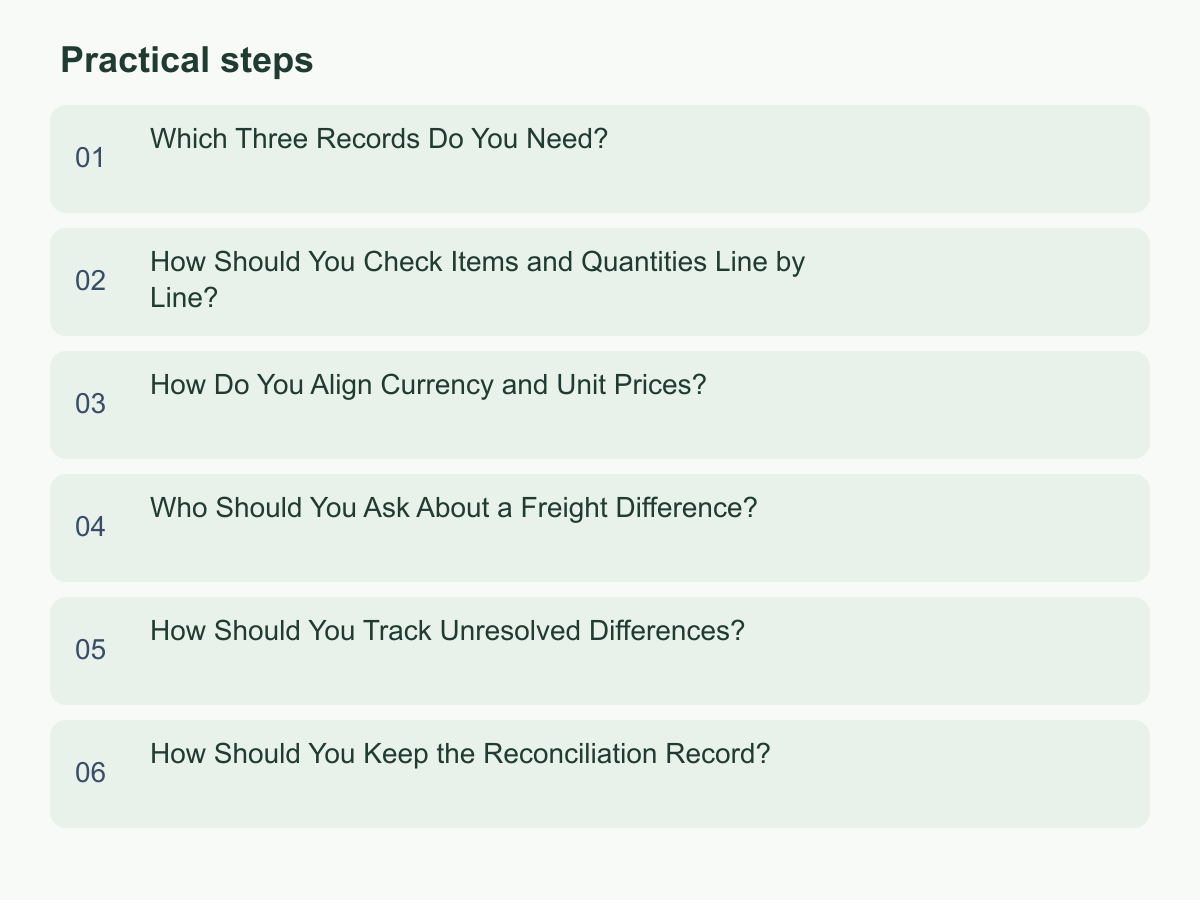
Which Three Records Do You Need?
Gather the supplier invoice, the effective approved purchase order (PO), and delivery records. The invoice states what the supplier is asking to be paid; the PO records the buyer’s approved items, quantities, prices, and terms; receiving records show what arrived, when it arrived, and whether anything was short or damaged. Compare the lines, not just totals: an overcharge and an undercharge can cancel each other out.
Check the supplier’s legal name, invoice number and date, currency, payee, and item descriptions. If a group has several receiving entities, compare the invoice’s legal name with the PO’s transaction party and flag differences. Use the approved PO version that took effect, keeping revisions and approval records for changes to quantity, schedule, or price. Do not use an early draft as the commitment. Delivery evidence may include signed notes, warehouse receiving logs, batch delivery lists, or inspection records showing exceptions.
For example, if an invoice has the expected total but names a different payee entity, do not rely on the amount. Compare the purchase documents, supplier notice, and payee details already confirmed internally, then ask the purchasing or payment owner to resolve it. If goods arrived in three shipments, keep each date and batch visible so you can tell whether the invoice covers the full PO or one delivery. Link the records with a shared transaction reference. Note missing documents, their source, who will obtain them, invoice coverage, and any items still outstanding. This also helps prevent duplicate checks on split invoices.
How Should You Check Items and Quantities Line by Line?
Compare the PO, invoice, and delivery record row by row before comparing totals. Check supplier and buyer item codes, specifications, model, packaging, and unit of measure. Similar descriptions may refer to different specifications, so verify that substitutes were approved. Do not compare cartons, pieces, kilograms, or sets directly. Use and retain the documented conversion, such as pieces per carton. If pack size changed, confirm whether the price is per carton or per item.
Add quantities received in each batch. Separately record refused, damaged, returned, replacement, and still-in-transit quantities. A signed count is not always an accepted quantity; show amounts signed for, accepted, or awaiting inspection separately. Compare the invoice quantity and identify whether a difference reflects a short shipment, overbilling, a batch in transit, an unrecorded return, or a unit-conversion error. Check approved terms for prepayment, milestone billing, or another billing basis instead of assuming every invoice must equal the quantity received.
As a hypothetical example, assume the PO is for 12 cartons of 24 pieces each. Two deliveries contain 7 and 4 cartons, so 11 cartons arrived. An invoice for 12 cartons has a one-carton difference. An invoice for 288 pieces bills the full order; confirm whether terms allow billing before delivery. Show both the original unit and converted quantity, state the difference, and link each batch to its receipt record. If the cause is unclear, mark the line unverified and ask purchasing or receiving to check the records. Do not change the invoice yourself. Retaining the PO line number makes the approval basis easier to find.
How Do You Align Currency and Unit Prices?
Check that the PO and invoice use the same currency before comparing unit prices; converted totals alone can hide a price difference. If the PO is in US dollars but the invoice requests another currency, confirm an approved change to the price or settlement terms. Record the exchange-rate source, date, conversion direction, and person calculating it. Show exchange differences separately from supplier price changes. Do not choose a favorable rate to force a match or treat the bank’s payment-day conversion as the supplier’s original unit price.
Compare unit price, pricing unit, discount, minimum order quantity, and tier price on the same basis. For a negotiated change, check the approved quotation, revised PO, or confirmation between the parties, including effective batch and date. A verbal explanation or new invoice price alone is not an approval record. To locate rounding differences, calculate quantity times unit price by line, then compare subtotals, discounts, and total. If a discount appears only against the total, request a breakdown. Keep discounts, packaging differences, and extra charges separate, with the approval basis for each.
The figures below are hypothetical; both records use US dollars:
| Item (hypothetical) | Purchase order | Invoice | Initial check |
|---|---|---|---|
| A: 10 units | 10 × USD 48 | 10 × USD 48 | USD 480; matches |
| B: 5 units | 5 × USD 20 | 5 × USD 22 | USD 110; USD 10 higher |
| Total | USD 580 | USD 590 | USD 10 difference |
The USD 10 difference comes from item B’s price, not currency conversion. Check whether the change was approved. If not, ask the supplier for an explanation and a corrected invoice or supporting evidence, then ask purchasing to confirm. Record the original-currency amount and any separately calculated reference amount so price, exchange, and arithmetic differences remain distinct.
Who Should You Ask About a Freight Difference?
Check the PO, quotation, or confirmed shipping terms to see who arranged and bears freight, and whether it was included in the item price or billed separately. An extra charge is not automatically wrong, but delivery does not mean the buyer accepted every cost. If freight was included, ask the supplier to explain the added line. If the buyer arranged the carrier, check its invoice or booking record for duplicate billing.
Ask the party who has the needed evidence. The supplier can explain the charge and calculation; purchasing can confirm an approved change in delivery method or cost responsibility; a carrier or logistics contact can confirm the shipment, route, weight, or extra service. Put the original terms, actual arrangement, and invoice line together, then ask a specific question. For a vague label, ask which shipment it covers and how it was calculated.
Suppose the purchase documents list freight at USD 50 and the invoice lists USD 80, a USD 30 difference. Check whether USD 50 was an estimate, cap, or fixed approved amount, and whether the shipment changed to a faster service. Find the purchasing approval and request the supplier’s or carrier’s charge detail. If the carrier already billed USD 80 separately, check for a duplicate on the supplier invoice. Record freight separately from goods, with the amount pending, missing evidence, person asked, and response. Update the reconciliation only after confirmation under the internal approval process; do not edit the original invoice.
How Should You Track Unresolved Differences?
Keep open amounts in a discrepancy register marked “pending confirmation.” Do not change unsupported figures to make them match or offset one item’s overcharge against another’s undercharge. For each entry record the supplier, invoice and PO numbers, affected item, original-currency amount, difference type, available evidence, owner, latest contact date, next action, and follow-up date. “On hold” here is a payment-preparation status, not a prescribed accounting entry or substitute for existing finance rules.
Decide whether an issue affects the whole invoice or only certain lines. If the transaction party, currency, or approval status is uncertain, mark the invoice as not ready for payment preparation. If only one quantity or charge is open, identify its line and amount, and ask finance or an authorized manager whether confirmed lines may proceed under the established process. Do not promise a partial payment, delay, or deduction yourself; these depend on approved terms and internal authority. Make follow-up questions specific, such as confirming a shortage in a named batch or requesting approval for a particular price revision. Date each question and response in the same entry.
As a hypothetical example, an invoice has nine matching lines and one line overbilled by USD 30. Keep the original total, checked lines, disputed line, and source of the difference rather than recording only a net amount. If the supplier issues a corrected invoice, retain both versions and explain how they relate. If purchasing confirms a revised price, attach that approval. Set an internal follow-up date and return overdue items to their owner. At closure, record who confirmed the result, which document supports it, and how the reconciliation changed so another colleague can follow the decision.
How Should You Keep the Reconciliation Record?
Keep a file set that lets someone trace the result back to its evidence. Use consistent folder or file names based on supplier, PO number, and invoice number. Retain the original invoice, effective PO, revisions and approvals, delivery proof for each batch, correspondence, discrepancy register, and closing note. For emailed documents, keep the original message or a traceable export showing sender and time; an attachment screenshot alone may not be enough. Make sure scans show item descriptions, quantities, amounts, and page numbers. Label each version by receipt date and purpose so later documents are not mistaken for the original bill.
Record the line-by-line result, not just “matched.” Include reviewer, review date, PO version, source for received quantities, currency and conversion basis, difference lines, open decisions, and the portion sent for payment preparation. State whether a corrected invoice replaces or supplements an earlier one, and which batches were included. Keep source files from being overwritten and save updates separately. Limit access under the team’s arrangements for commercial records. Check retention periods and accounting classification against applicable requirements and internal policy; do not infer a general deadline from one transaction. Before handoff, confirm attachments still open.
Ask another preparer to sample one line: can they find its invoice line, PO approval, and delivery proof, and tell whether the difference is closed? If not, add the missing link, batch, or explanation. For open items, show the owner and next action clearly. Start with one received overseas-supplier invoice, reconcile it against the three record types, and file the originals, discrepancies, and closure evidence together. For broader information about taking a Hong Kong business overseas, visit the Chan & Chung English homepage.